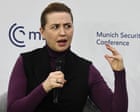
Pushed further on Greenland and if the US interest is now over, Frederiksen says “unfortunately not.”
“I think the desire from the US president is exactly the same,” she says, adding Trump remains “very serious” about controlling the territory.
She says that she is open to discussions on ramping up security arrangements for the Arctic, but there are obvious limits to it.
Can you put a price on it, if Trump keeps pushing?, she gets asked.
“Of course not. Can you put a price on a part of Spain, or a part of the US, or a part of anywhere else in the world?,” she responds.
She stresses that this goes back to “one of the most basic democratic principles” of respecting sovereign states.
“And the Greenlandic people have been very clear: they don’t want to become Americans,” she says.
in Munich
If you are looking for a quick summary of events so far, I caught up with our diplomatic editor Patrick Wintour who is also here at the Munich Security Conference to get his thoughts on what the events of the last 48 hours mean for the transatlantic relationship.
Here is his answer:
Poland’s Sikorski gets asked about what would Poland’s response be if Russia crossed the border and invaded its territory.
He gives this rather entertaining answer:
“We joined Nato for common defence.
If they cross the border, start killing Nato citizens, Polish citizens, we would expect the North Atlantic Council to meet and to activate the contingency plan, and after that, the plan is very easy: we win, they lose.”
And that ends this panel.
US Democratic senator Elissa Slotkin – also on the panel, in a rather awkward position of having to comment on the US policies she disagrees with – says she is “very concerned” about the 2026 US midterm elections in November.
“He [Trump] is telling us what he wants to do. He is laying it out for us, and is up to the Americans to believe him, right? That, just like in 2020, he said, If I don’t win, then it wasn’t a free and fair election. He is repeating the playbook now, threatening to put uniformed federal agents around polling locations. I mean, he’s telling us the playbook.”
She says “the question is what are we going to do as Americans to defend our democracy that we helped invent.”
Lithuania’s president Gitanas Nausėda offers a bit more insight into Russia and Belarus’s hybrid threats affecting his country.
He says Lithuania has been “exposed to different kind of hybrid attacks,” first with irregular migration which he says was an “artificially created problem by Alexander Lukashenko, sending people from the Middle East, from north Africa, to Minsk, then from Minsk to the border.”
“And we could see the officials and employees of Alexander Lukashenko’s regime instructing them how to cross the border, how to create this destabilising situation at the border,” he says.
More recently, Lithuania faced further disruptions caused by meteorological ballons sent across the border from Belarus to block the Lithuanian airspace, he says.
He says Belarus should face stricter sanctions over its role in Russia’s campaign against the west.
Sikorski also says that the Ukraine war is increasingly about “who will crack first” as Russia seems to be determined to test the resolve of the Ukrainian people as its own economy is under growing pressure.
He says:
“Putin says he wants peace and in a sense … every dictator and every conqueror wants peace: if you give up and you capitulate, you’ll have peace.
But the question is under what conditions, and [it seems that] Russia can tolerate Ukrainianness as a sort of provincial version of Russian folklore but Russia cannot tolerate Ukraine, or at least Putin cannot, as a nation with its own identity, history, interests, including security interests, and its own desire to integrate with other organizations than Russia’s.
The question in this war is, who will crack first?
And Ukrainians are showing that they’re not cracking on the frontline. Russian advances are tiny, and history teaches us that that bombing populations doesn’t work. The Luftwaffe didn’t break the spirit of London, the Royal Air Force didn’t break the will to fight of the people of Germany. In fact, they get stiffened.
So, the real question is when will Putin run out of resources to carry out this war, and the cracks are beginning to show in the Russian economy.”
He also goes back to his previous point as says that Europe should be at the table because the stakes are “incredibly high” not just for Ukraine, or the eastern flank of Europe.
“It is about the place of Europe in the future, and the distribution of power in the world, or in other words, who will be the third leg – it’s China, the United States, and [either] Russia or the European Union. Don’t ask me which I would prefer.”
Poland’s foreign minister Radosław Sikorski says that Europe should get a place at the table in peace talks on Ukraine as it carries by far the largest part of the burden of the war and supporting Kyiv’s resistance.
He says:
“It was natural for the US to be in the lead in these negotiations, when the US was providing the bulk of the military assistance, and the US was also brave and effective in deploying strategic intelligence to deprive the Russians of the casus belli in the days before the war and in the early days of the war.
But I would like, particularly our American guests, to know – because it’s not fully in the American infosphere – that we are now paying for this war.
The American outlay for the war for last year was close to zero. We are buying American weapons to be delivered to Ukraine. There is no package in the US Congress and that there isn’t even the prospect of a package.
If we are paying, if this is affecting our security, not just Ukraine’s, then we deserve the seat at the table, because the outcome of this war will affect us.”
Pistorius says that Germany will keep looking for ways to secure “a reliable peace, because Ukraine’s future is fundamental, not just to European security, but to global security.”
He says that “the ball is in Putin’s court.”
“He is the one who is dragging out negotiations and is showing no willingness to compromise. He is shifting the cost of war to his own people, but he must not be mistaken: we will continue doing everything in our power to protect Ukraine as an independent, sovereign European nation.”
He also says Ukraine will need strong, reliable security guarantees.
Pistorius also curiously picks up on Rubio’s speech earlier today, cautioning that:
“Yes, our international organisations have failed to solve many crises and conflicts, but the answer cannot be for a great power to go it alone. That might work in the short term, but in a world of more competing great powers, this will definitely not work in the long term.”
He says that Europe and its allies face “a highly armed and aggressive military power with the world’s largest nuclear arsenal at its disposal,” warning that “Russia is driven by raw power, revisionism and egoism.”
“Nowhere does this become more apparent than its brutal war of aggression in Ukraine,” he says.
He says Germany is responding to the challenge, amending its constitution to spend more, and reforming the army.
Opening, Germany’s Pistorius says that the US starting to look away from Europe isn’t entirely surprising, as “to be frank, having the United States provide for our security was never supposed to be the norm, [and] it was always an exception.”
“Naturally, exceptional arrangements never last forever. They are not meant to.”
But he says this week’s Nato ministerial meeting gives him a sense that Europe is getting realistic and pragmatic – and gives reasons to be optimistic.
“The US has made this new burden sharing very clear, and Europe is acting. Nato is becoming more European so that it can remain transatlantic,” he says.
in Munich
Next up on the main stage we have a panel on “defending Europe and supporting Ukraine” with Germany’s defence minister Boris Pistorius, Lithuania’s president Gitanas Nausėda, Poland’s foreign minister Radosław Sikorski, Ukraine’s foreign minister Andii Sybiha and US senator Elissa Slotkin.
Expect some good lines as pretty much all of them tend to be rather outspoken…
Meanwhile, Venezuelan opposition leader María Corina Machado is taking part in the MSC, joining online.
You can watch her panel here:
Frederiksen also expressed her frustration that any disputes between allies like over Greenland could undermine the alliance more broadly.
“[It’s] only once in our history [that] we had to activate Article Five, that was because of what happened in the US. The rest of time we have been able to provide freedom, democracy, prosperity and wealth [relying] only [on] the wording of Article Five, because all our enemies know that if they attack us, they will attack all of us.
…
Maybe the most important thing … that is secured by us as political leaders, … is our unity.
Therefore to question the transatlantic relationship, or to threaten allies, or to do anything that [would] undermine the idea of Article Five [would] be a threat to all of us, So let’s stick together.
That’s my short advice.”
And that ends this panel.
Spain’s Sánchez also says that a part of the EU’s response to Russian challenges needs to be to reform the bloc and continue with its enlargement.
But he also says that Europe needs to tackle other issues than Russia, including on climate, health and inequalities.
The Guardian
About the Author



