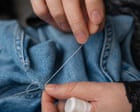
We’ve all thrown away something “perfectly good” that just suffered a minor flaw: a wobbly chair. Jeans with a knee hole. A toaster that won’t latch. All replaced by new versions that will break the same way. Most of these things could’ve been salvaged with 20 minutes and the nerve to try.
Fixing things yourself isn’t about pinching pennies. In the rising visible mending movement, it’s about refusing to treat everything as disposable. “The lightbulb moment for me was realizing I could make mending a creative act,” says Katrina Rodabaugh, textile artist and author of Mending Matters. “I was less worried about ruining my textiles and more interested to see how I could be resourceful, make a creative statement and keep my clothes out of the landfill.”
You don’t need to be a pro to salvage many common household items. We asked furniture restorers and textile artists to share their tips for simple fixes: not complex restoration projects, just the repairs where the biggest barrier is believing you can do it.
Here are nine that will save you money, reduce waste and give you something to feel good about.
At a glance: DIY repair kits
For patching jeans:Sewing kit with needle, thread and safety pins
$6.99 at Amazon
For headphone cable repair: Soldering kit
$19.99 at Amazon
For loose eyeglass screws:Eyeglass repair kit with replacement screws and magnifying glass
$3.49 at Amazon
Stuck zipper
First, check for caught fabric. A thread or bit of lining gets wedged in the teeth more often than you would think. Work it free with tweezers or needle-nose pliers. Don’t yank – you’ll tear fabric or bend the teeth.
If the zipper moves but won’t stay closed, the slider has stretched. Squeeze the top and bottom (not the sides) gently with pliers to narrow the gap. Test after each squeeze. You want tension, not a crushed slider.
For a slider that’s completely stuck, try graphite. A regular No 2 pencil works better than oil, which just attracts grime. Rub the tip along both sides of the teeth, then work the slider.
Rodabaugh’s advice: fix problems early. “If you see your zipper is starting to break down, don’t keep forcing it.”
Tools needed:
Graphite pencil (No 2 works fine)
Needle-nose pliers
Small tweezers
Video tutorial:How to fix every zipper issue
Wobbly wooden chair legs
Wobbly chairs are one of the easiest furniture repairs if you use the right glue.
“Chairs wobble as the glue joints loosen,” says Thomas Johnson, an antique furniture restorer in Maine. “There is a lot of stress put on these joints during everyday use.” The traditional fix involves taking the chair apart, scraping out old glue and reclamping everything. Johnson recommends something simpler for most people: cyanoacrylate glue, AKA super glue.
Products such as Wonderlok ‘Em Tite Chairs are designed to penetrate loose joints without disassembly. Flip the chair upside down. Wiggle each leg to find the loose ones. Apply glue directly to the gap where the leg meets the seat. The thin formula wicks deep into the joint.
Work the joint slightly to spread the glue, then hold it in position for 30 seconds. Leave the chair upside down for an hour before using it.
If it still wobbles after the glue cures, check your floor. Sometimes the problem isn’t the chair.
Tools needed:
Wonderlok ‘Em or similar thin cyanoacrylate glue
Damp cloth for cleanup
Video tutorial:Gluing chairs with cyanoacrylate glue
Patching jeans
A hole in your favorite jeans doesn’t mean they’re done. A simple external patch can add years of life.
“If you’re just starting to mend your clothes, the simplest repair is an external patch–like those ubiquitous elbow patches on blazers,” Rodabaugh says. Match materials: use mid-weight denim to patch denim, and thick cotton thread that can take abuse.
Cut a patch from scrap denim (old jeans work) at least half an inch larger than the hole on all sides. If the edges fray, tuck them under or trim with pinking shears for a zigzag edge that resists unraveling.
Pin the patch over the hole on the outside of the jeans. Stitch around the edge with a needle and thread (or a sewing machine with a denim needle) using a basic running stitch. “Use double knots, a basic stab stitch and just do your best!” Rodabaugh says. “The more you patch, the more confidence you’ll have with future repairs.”
For visible mending – think highlighting or celebrating the repair rather than hiding it – try contrasting fabrics or decorative stitching. Japanese sashiko stitching with thick embroidery thread turns a fix into a design element.
Tools needed:
Scrap denim for patch
Sewing kit with needle, thread and safety pins
Pinking shears (optional)
Video tutorials:How to do a running stitchSashiko and whipstitches (for advanced repair)
Stuck drawer
“Drawers that don’t work properly often just need to have the ‘working’ parts waxed,” Johnson says. Five minutes and costs almost nothing.
Pull the drawer all the way out (lift the front while pulling if it has stops). Check the slides – the parts of the drawer that touch the cabinet – for dirt, dust or old wax. Clean with a dry cloth. Vacuum debris from the cabinet tracks.
Take an old candle, paste wax or paraffin wax. Rub it anywhere wood touches wood: the bottom edges of the drawer sides, and the cabinet pieces the drawer sits on. The wax creates a slippery surface.
Test the fit before pushing it back in. If it still binds, look for high spots where humidity has swelled the wood. Light sanding helps, but be conservative – you can always remove more, but you can’t put it back.
Never use oil or grease on wood drawer slides, which attract dirt and make the problem worse.
Tools needed:
Paste wax or old candle
Dry cloth
Vacuum
Fine-grit sandpaper (if needed)
Video tutorials:Antique drawers rescued and repairedHow to make that sticky drawer slider better
Small holes in knitted sweaters
A tiny moth hole doesn’t mean your sweater is ruined. It just needs darning, the same technique used to repair socks for generations.
“Most knitwear, like sweaters, socks, gloves and hats, etc, are best repaired with basic darning,” Rodabaugh says. The same over-under weaving technique is how you made those woven potholders in elementary school.
Thread a tapestry needle with yarn that matches your sweater’s weight – bulky wool yarn for a bulky wool swearer, thinner yarn for cashmere. Working from the wrong side of the fabric, create vertical stitches across the hole (the warp stitches), extending at least half an inch beyond the damaged area. Then weave horizontally (the weft stitches) through the warp. Over one thread, under the next. These weft threads fill the gap and integrate with the existing fabric. Don’t pull too tight. Knit fabric needs to stretch.
“Be sure your repair extends beyond the edges of the hole,” Rodabaugh says. “And you’ll create the least friction if your yarn and sweater are a similar weight.” Once you’ve got basic darning down, experiment with contrasting colors or decorative patterns. “Try using one color yarn for the vertical stitches and another for the horizontal – have fun with it!”
Tools needed:
Large darning needle
Yarn matching sweater weight
Darning egg or mushroom (optional but helpful)
Video tutorial:How to darn a hole in a sweater
Broken toaster lever
When a toaster lever won’t stay down, the culprit is probably just crumbs.
Most toasters use an electromagnet to hold the lever down while toasting. When you push the lever, it completes a circuit that powers the magnet. “The malfunction typically stems from either something like crumbs blocking the magnet or a defective coil within the electromagnet,” according to iFixit’s troubleshooting guide. Some older or simpler toasters use a spring-powered latch instead, which can disconnect or break.
The fix: first unplug the toaster. (Very important!) Then turn it upside down over the trash and shake firmly. Open the crumb tray if your model has one and use compressed air or a wooden skewer (no metal forks) to dislodge stubborn debris. You’d be surprised how much builds up in there.
If shaking doesn’t work, open the toaster’s outer shell (usually a few screws on the bottom or sides) to access and clean the mechanism. Use a cotton swab with rubbing alcohol on the magnet surface and let it completely dry before plugging back in.
Oh, and always check if the toaster is plugged in when you’re pushing the lever down. Many models won’t latch unless powered, which is a safety feature, not a malfunction.
Tools needed:
Phillips screwdriver
Small brush or compressed air
Needle-nose pliers
Cotton swabs
Rubbing alcohol
Video tutorial:How to fix a toaster that won’t stay down without taking it apart
Headphone cable repair
Frayed headphone cables don’t mean your headphones are dead. With a little basic soldering, you can keep those tunes humming.
“It’s a pretty doable beginning soldering job,” says Elizabeth Chamberlain, iFixit’s director of sustainability. “In fact, that was my first soldering project.”
The problem is usually at stress points, either where the cable enters the plug or at the earpieces. Repeated bending weakens the internal wires until they break.
The fix: cut the cable cleanly above the damaged section. Strip about an inch of the outer insulation to expose the internal wires. You’ll see three or four thin wires in different colors (typically red for right, blue or green for left, and gold or copper for ground). Twist the ground wires together if there are two.
Thread the cable through a replacement 3.5mm plug housing (available online for a few dollars). Strip the enamel coating from each wire, apply a tiny bit of solder to “tin” the ends, then solder each wire to the correct terminal on the plug. A drop of hot glue between the wires prevents shorts.
For cable breaks in the middle (not near the plug), you can splice in a new section. Just strip both ends, twist matching colors together, solder and cover with heat-shrink tubing.
Tools needed:
Wire strippers
Soldering kit
Heat-shrink tubing
Replacement 3.5mm plug
Video tutorial:Easy DIY repair for broken headphone cables
Written tutorial:iFixit headphone cable repair
Leather boot conditioning
Leather boots that appear ready for retirement often just need basic care. “Leather is skin, and if it’s moisturized regularly, it’ll look better and crack less – just like moisturizing your face,” says Nick English, founder of the boot review site Stridewise.
For mild scuffs, cleaning, conditioning and vigorous brushing with a horsehair brush can work wonders, says English. For tougher scuffs, use leather colorant or matching shoe polish applied after you condition them. For serious grime that regular cleaning won’t touch, saddle soap can lift out almost anything, but be careful: it can damage leather if you don’t follow the instructions. “It’s a ‘break glass in case of emergency’ type product,” English says.
Between major cleanings, wipe them down to remove dust and dirt, then apply a leather conditioner, says Trent Potter, a boot restorer whose YouTube channel Trenton & Heath has documented hundreds of restorations. “If the leather boots are worn often, you may want to condition them once a month. If worn occasionally, condition them two to three times a year.”
Oh, and don’t forget the cedar shoe trees. “They help to pull moisture [sweat, water, etc] from the leather, as well as hold the shape,” says Potter. Without them, boots develop what English calls “toe spring” where the toe curls upward as the leather dries, “making your shoes look like Aladdin’s”.
Tools needed:
Leather conditioner (Venetian Shoe Cream or Cobbler’s Choice)
Horsehair brush
Soft cloths
Matching shoe polish (for scuffs)
Cedar shoe tree
Saddle soap (for deep cleaning, use carefully)
Video tutorial:How to clean and condition boots
Loose eyeglass screws
Eyeglass screws work loose from daily handling, opening and closing frames, and even temperature changes.
The fix? Most eyeglass repair kits include tiny screwdrivers and replacement screws. But tightening alone isn’t enough. The screw will just loosen again.
“A little bit of Loctite blue or other threadlocker would be my reco,” says iFixIt’s Chamberlain. “And make sure the screwdriver is well-seated and you apply firm pressure as you tighten (stopping when you hit resistance) so you don’t strip the screw.”
Clear nail polish can work as a budget threadlocker if you’re fresh out of Loctite. Apply a tiny drop to the screw threads before inserting and it will hold the screw in place. You can remove it if you need to adjust the fit later.
For lost screws, many opticians replace them for free. Keep a small repair kit in your bag for emergencies.
Tools needed:
Eyeglass repair kit with replacement screws and magnifying glass
Loctite threadlocker or clear nail polish
Video tutorial:How to tighten eyeglasses
Written tutorial:iFixit guide to eyeglass repairs
Christopher Allbritton is a journalist, editor and media strategist based in Washington DC. He has covered technology and international affairs for more than two decades. A committed DIY tinkerer, he draws on personal experience for his writing on accessible technology, repair culture and sustainable living.
The Guardian
About the Author