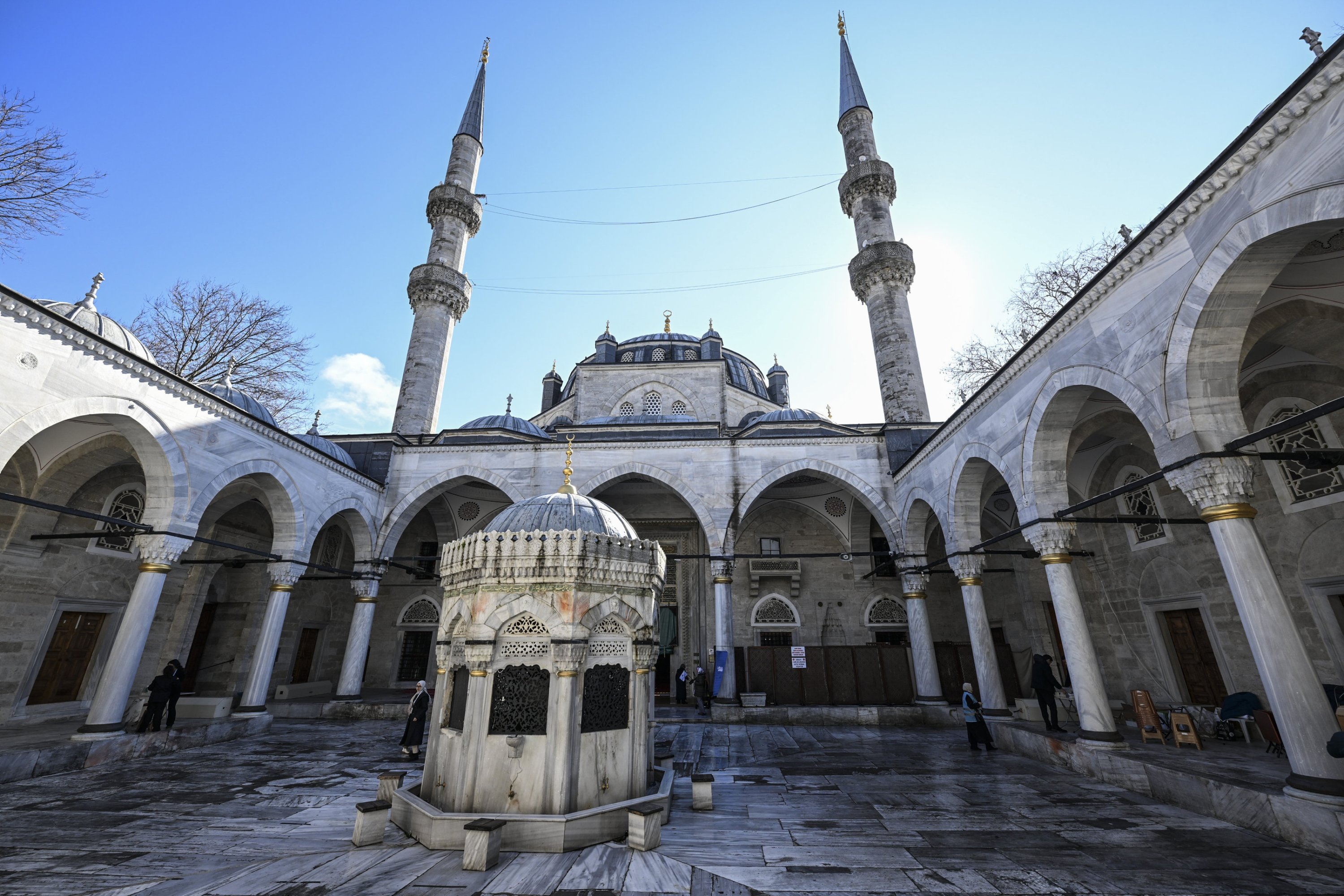
Rising prominently over Üsküdar’s ferry square skyline in Istanbul, the Yeni Valide Mosque continues to represent one of the most distinctive architectural statements of late Ottoman religious design, combining the structural discipline of the classical era with the refined ornamental language that would later define the Tulip Era.
For more than three centuries, the mosque has remained a central landmark, reflecting both architectural continuity and stylistic transition within the city’s urban fabric.
Yeni Valide Mosque is examined as a pivotal example of how classical Ottoman mosque architecture evolved at the beginning of the 18th century.
The mosque forms the core of a comprehensive külliye commissioned by Gülnuş Emetullah Sultan, the mother of Sultan Ahmed III. Construction of the complex began on Nov. 7, 1708, and was conceived as a multifunctional religious and social center.
In addition to the mosque, the külliye includes a primary school, public soup kitchen, mausoleum, cemetery, sebil, fountains, water reservoir, ritual washing facility, commercial units and a royal pavilion, reflecting the Ottoman approach to integrating worship, education, charity and daily life.
Architecturally, the mosque is distinguished by its elevated platform and stone staircases, which enhance its monumental presence within the surrounding square. The structure features a central dome and a porticoed courtyard, opening to worshippers on March 5, 1711.
The prayer hall follows a near-square plan, with the main dome supported by an octagonal system reinforced by arches resting on massive piers, ensuring both structural stability and spatial clarity.
Interior elements further underscore the mosque’s architectural ambition. The marble mihrab was designed on an imposing scale and framed with tiles associated with Kütahya production. One of the most prominent features inside the prayer hall is the royal gallery, positioned to the left of the mihrab and directly connected to the royal pavilion.
In front of the royal pavilion, the sebil and the mausoleum are regarded as among the most refined components of the complex. Gülnuş Emetullah Sultan’s mausoleum, completed following her death in 1715, follows an octagonal plan and stands out with its bronze lattice windows and a continuous band inscribed with Ayat al-Kursi, reinforcing both its spiritual symbolism and artistic quality.
The mahya illuminated between the minarets of the Yeni Valide Mosque carries the message “Fast and find health,” reflecting Ramadan traditions Istanbul, Türkiye, Feb. 18, 2026. (AA Photo)
The layout of the külliye reflects deliberate urban planning. The mosque occupies the central position, surrounded by a spacious outer courtyard, while the imaret was constructed closer to the shoreline to facilitate public access.
The complex underwent its most extensive restoration in 1940, a process that helped preserve its architectural integrity amid Istanbul’s rapid modernization.
Among the mosque’s most distinctive exterior features are its birdhouses, considered among the earliest examples of their kind in Ottoman architecture. These structures, integrated seamlessly into the façade, are widely interpreted as a reflection of Ottoman sensitivity toward animals and the environment, transforming compassion into a permanent architectural expression.
Mahmut Sami Kanbaş, a faculty member in the Department of Turkish-Islamic Art History at Marmara University’s Faculty of Theology, emphasized that the Yeni Valide Mosque occupies a unique position among Üsküdar’s imperial mosques.
He said that Gülnuş Emetullah Sultan was widely known for her charitable activities and that the mosque itself carries clear symbolic references to maternal respect and devotion.
Kanbaş pointed to a calligraphic panel inside the mosque bearing Sultan Ahmed III’s signature. A trained calligrapher, the sultan personally inscribed the saying, “Paradise lies beneath the feet of mothers,” a gesture that underscores the mosque’s role as both a religious structure and a personal tribute.
He further described the mosque as one of the final representatives of the classical tradition shaped by Mimar Sinan, while simultaneously displaying the early aesthetic impulses of the Tulip Era. In this respect, the Yeni Valide Mosque is widely regarded as a transitional monument, bridging two major phases of Ottoman architectural history.
Beyond its architectural significance, the mosque continues to play an active role in Istanbul’s religious and cultural life, particularly during Ramadan.
Long-standing traditions, including reciprocal ezan recitations with nearby imperial mosques and Enderun-style teravih prayers performed in distinct musical modes, contribute to its enduring spiritual presence.
DAILYSABAH
About the Author

