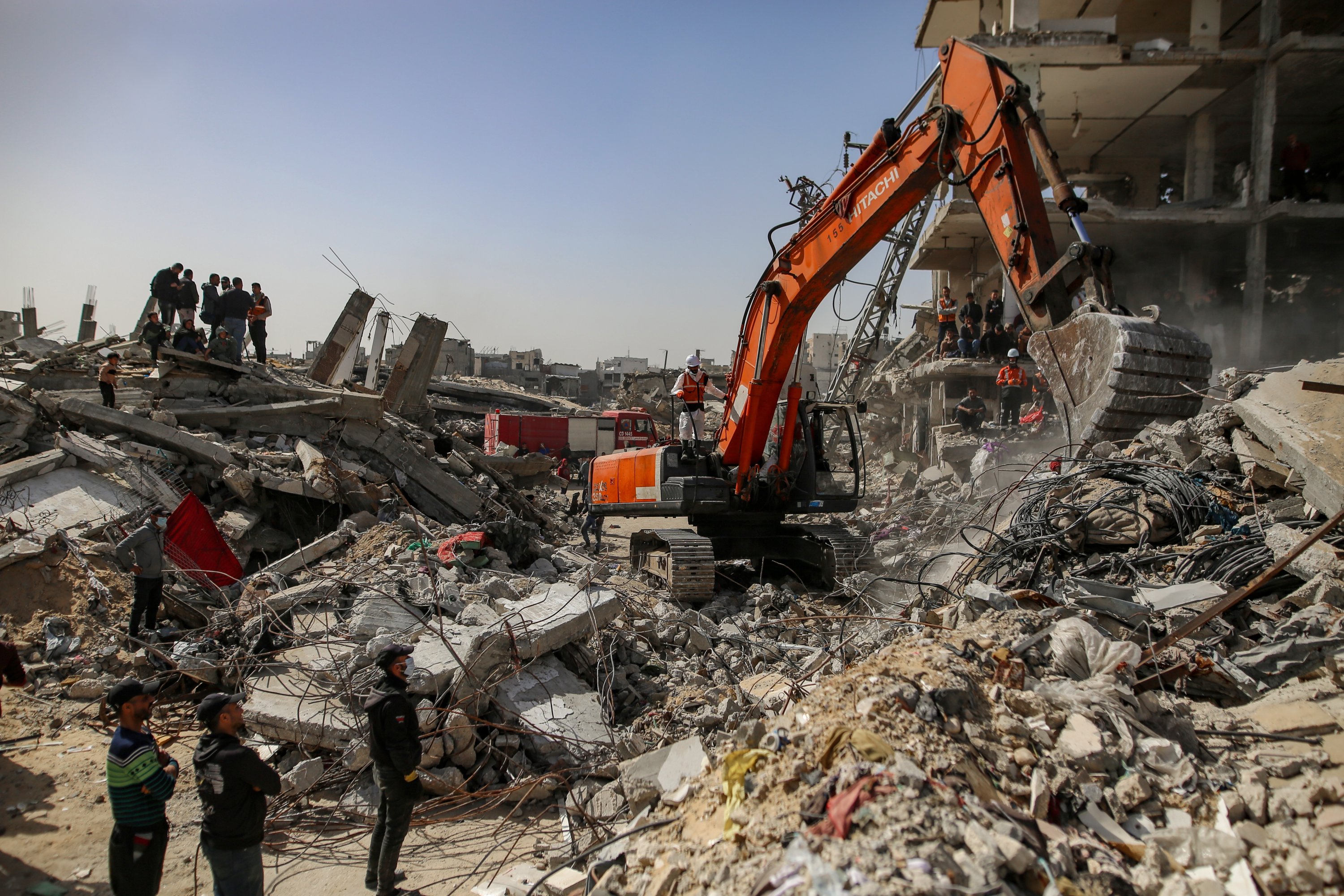
Senior diplomats from the European Union met in Brussels on Monday with Nikolay Mladenov, director of the Board of Peace, following the bloc’s uneasy reaction to Donald Trump’s initiative to oversee reconstruction efforts in war-torn Gaza. Mladenov held talks with EU foreign policy chief Kaja Kallas and ministers from across the 27-member bloc, who also planned to review the Ukraine conflict and potential new sanctions on Russia.
“We want to be part of the peace process in Gaza and also contribute with what we have,” Kallas said ahead of the meeting. Afterward, she said Mladenov updated diplomats on the humanitarian situation in Gaza and the Board of Peace’s activities and strategy, which included an EU presence in stabilization and humanitarian efforts.
“It was good to hear from Mladenov that it’s really right now trying to improve the situation, that he sees this in the same way, that actually they also need us there contributing,” Kallas said.
One EU nation blocked new sanctions on illegal Israeli settlers agreed by the rest of the bloc, she said, without naming the holdout. The EU’s planned training of Palestinian police in Gaza is awaiting approval by Israel, Kallas said.
Just across the Mediterranean Sea from the Middle East, the EU has deep links to Israel and the Palestinians. It now plays a crucial oversight role at Gaza’s Rafah border crossing with Egypt, and is the top donor to the Palestinian Authority.
The question of whether to work with the Trump-led board has split national capitals from Athens to Copenhagen. The EU is supportive of the United Nations’ mandate in Gaza.
EU members Hungary and Bulgaria are full members of the board, as are EU candidate countries Türkiye, Kosovo and Albania.
Twelve other EU nations sent observers to the inaugural meeting in Washington on Thursday: Austria, Croatia, Cyprus, Czech Republic, Finland, Germany, Greece, Italy, Netherlands, Poland, Romania and Slovakia. The EU flag was displayed at the event alongside EU observer and member nations.
European leaders like French President Emmanuel Macron and European Commission President Ursula von der Leyen turned down the invitation to join, as did Pope Leo XIV. But von der Leyen did send European Commissioner for the Mediterranean Dubravka Šuica to the meeting in Washington as an observer.
French Foreign Minister Jean-Noël Barrot said sending Šuica without consulting the European Council, the group of the bloc’s leaders, broke EU regulations.
“The European Commission should never have attended the Board of Peace meeting in Washington,” Barrot said in a post on X. “Beyond the legitimate political questions raised by the ‘Board of Peace,’ the Commission must scrupulously respect European law and institutional balance in all circumstances.”
“It is in the remit of the commission to accept invitations,” von der Leyen spokesperson Paula Pinho said Friday.
While the executive is not joining the board, it is seeking to influence reconstruction and peacekeeping in Gaza beyond being the top donor to the Palestinian Authority, she said.
Trump’s ballooning ambitions for the board extend from governing and rebuilding Gaza as a futuristic metropolis to challenging the U.N. Security Council’s role in solving conflicts. But they could be tempered by the realities of dealing with Gaza, where there has so far been limited progress in achieving the narrower aims of the cease-fire.
DAILYSABAH
About the Author