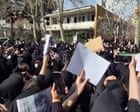
Plainclothes police and security forces, many of them armed, have tried to flood Iran’s remaining open universities in an attempt to crush a fourth day of student protests against the supreme leader, Ali Khamenei.
Running battles were reported on some campuses, with videos showing fistfights between the Basji state-backed militia and students at the University of Science and Technology in Tehran. Pick-up trucks with machine-guns were photographed parked outside the University of Tehran, with demonstrations also in Mashhad.
Elsewhere, students found themselves barred from entry if they had been identified as being involved in previous protests and university administrators also announced the closure of in-person classes. Nearly 80% of Iran’s universities are already conducting virtual courses, partly to prevent students being given a chance to gather to demonstrate against the government and its brutal crackdown of the January protests.
In videos from the University of Art in Tehran, a range of chants could be heard, including “We fight, we die, we take back Iran”, “Political prisoners must be freed” and “Khamenei the Zahhak [serpent king], we’ll bury you alive”.
The protesters have also called the Basijis the sons of sex workers and made comments about the sexual life of the supreme leader.
The protests form an uneasy backdrop to the third round of talks on Iran’s nuclear programme due to be held in Geneva on Thursday between the Iranian foreign minister, Abbas Araghchi, and the US special envoy, Steve Witkoff.
Iran’s attorney general, Mohammad Mohebi Azad, on Tuesday demanded retribution against the protesters. “The responsible agencies must quickly identify the related elements and take decisive and legal action against them,” he said. “Whenever the system has been on the path of negotiations, certain currents, under the guidance of the enemy, have tried to inflame the domestic atmosphere.”
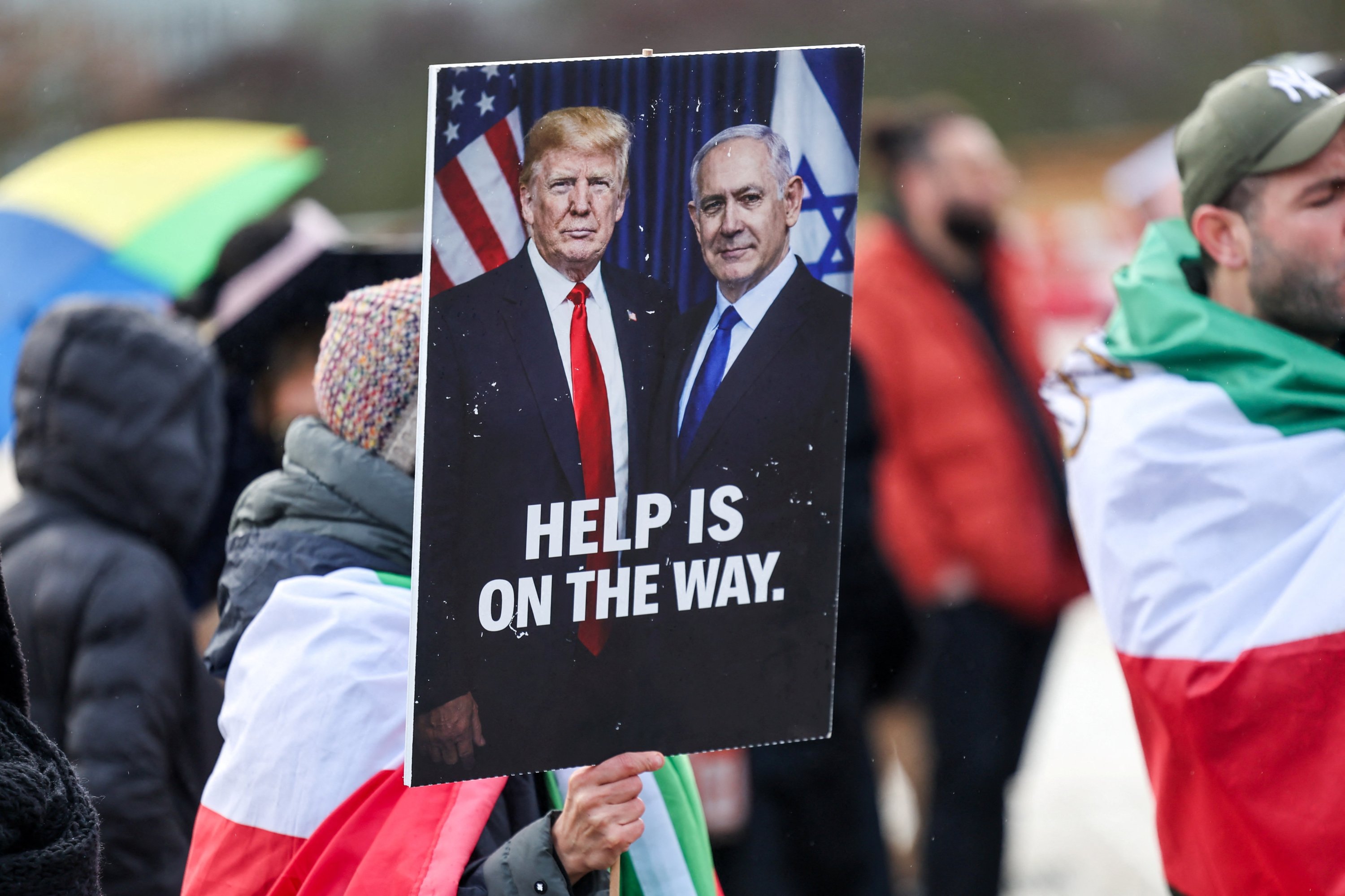
The indirect talks mediated by Oman are likely to be decisive and will be conducted as the US president, Donald Trump, finally completes gathering his formidable array of naval and air power in the region with which he could attack Iran.
The negotiation’s chances of success turn on whether the US is willing to give Iran a tokenistic right to enrich uranium inside Iran, for instance for medical purposes. If he rejects this compromise, Trump faces the risk of launching a war without clear objectives.
Trump has insisted a war against Iran is winnable and has been eager to reject reports the US chair of the joint chiefs of staff, Dan Caine, advised that an attack was inadvisableas the US lacked regional support and sufficient munitions.
He said in a social media post that if Iran did not make a deal it would be “a very bad day for that country and unfortunately for its people”. His reference to a bad day for Iranian people has been picked up inside the country as a sign that Trump recognises an attack will not benefit the people of Iran.
Ali Hashem, associate research fellow at the Center for Islamic and West Asian Studies, Royal Holloway College, pointed out that Khamenei had shifted his rhetoric away from “tactical restraint” and begun using the language of “confrontation through the lens of Karbala”. This refers to the central Shia narrative of Imam Hussein, who chose martyrdom over submission to an unjust ruler.
“For foreign audiences, such references may have symbolic meaning,” he said. “However, for the Shiite political consciousness, Karbala is a moral and political code; a celebration of resistance to an existential threat, rather than compromise. The idea of ‘dying standing and not living in disgrace’ challenges the US logic of proportionate response and coercive diplomacy.”
The Washington-based human rights organisation HRANA this week published detailed identities of more than 7,000 people it says were confirmed dead in the January protests.
In this report, titled Red Winter, the names of 7,070 victims have been published, along with their identity details, date of death, and the name of the city where they were killed.
The Iranian president’s office has published a list of the identities of 2,986 people killed in the protests and announced that the total number of deaths was still “3,117”.
The discrepancy of 131 is “the anonymity of some individuals and the discrepancy in the registration of the national IDs of some of the victims with the civil registration system”.
The Guardian
About the Author