PHARR, Texas — More than a year since President Donald Trump flipped the traditionally Democratic Rio Grande Valley, his deportation agenda is running headlong into the region’s workforce.
Several homebuilders who spoke to NBC News said they’re worried about whether they will make it through the year without the framers, foundation pourers, drywallers and other workers who were arrested in construction site immigration raids or who are too afraid to work.
Several builders openly acknowledge that the region relies on immigrant workers, many of them undocumented, a number of whom have been working and living there for years.
“This will put us out of business if it continues,” Ronnie Cavazos, president of the South Texas Builders Association and the owner of The Structure Team construction company in Mission, said this month at a luncheon in nearby McAllen, Texas.
The region has largely avoided clashes between federal agents and opponents of Trump’s immigration policies, despite high immigrant populations. Many support strict border policies and targeted enforcement and deportations.
But Trump’s mass deportation agenda is taking a toll in this southern swath of a very red state, several business owners said. While the construction industry is the most directly affected, other parts of the region’s economy also are feeling the pinch, including restaurants patronized by workers, real estate agents and some retailers.
A laborer builds the frame of what will be an apartment building in Pharr.Suzanne Gamboa / NBC News
Jaime Lee Gonzalez, a McAllen Realtor, said he had an investor lined up to buy over 100 lots who was hesitating because he feared “by the time they start construction they would not be able to complete the project.”
Maria Vasquez, 40, wheeling a cart through a grocery store parking lot, said she’s had to make “adjustments” to her household budget. Since construction has stalled, her husband is working fewer hours building frames for homes and he’s bringing in less money.
“Obviously, the payment for water, electricity, rent, those you can’t negotiate. Where you can adjust is in the food — you remove from your list, juices, things the kids want. Chips? No,” she said.
Builders concede other economic factors, such as inflation or interest rates, may also be at work. But Mario Guerrero, executive director of the association, described the immigration arrests and the worker shortage as the knockout “punch” that could end some livelihoods.
‘This one’s been taken’
“We sell flooring. We sell tile to contractors, to custom-home builders, and it’s affecting our business tremendously,” said Luis Rodriguez, a sales manager at Materiales del Valle in McAllen. “I have orders, but my customers aren’t picking them up. They don’t have anybody to install them.”
Xavier Vazquez, owner of the Summit Valley Homes homebuilding company, said Immigration and Customs Enforcement arrested almost all of the stucco crew he uses. As he’s tried to replace them, he’s found out “this one’s been taken or this one’s been taken.”
It’s getting tricky trying to find people to replace them, since “you also want it to be a good job,” said Vazquez, whose 3-year-old company builds throughout the Rio Grande Valley.
Xavier Vazquez, a homebuilder in Texas’ Rio Grande Valley, says immigration raids have made it tough to find workers to pour foundations for a building project.Suzanne Gamboa / NBC News
Paul Rodriguez, CEO at Valley Land Title Co. in McAllen, said he began noticing a slowdown in construction loans for residential properties last summer. Things worsened in the fall. The downward trends didn’t sync with the usual seasonal variations, he said.
What was happening, he said, was that ICE was showing up at his clients’ sites, conducting raids and checking workers’ immigration status. “Needless to say, they do have a number of individuals at the worksite who may be undocumented,” he said.
When worker shortages slow down construction, the builders have to get extensions, which means more interest on a loan, which means more costs, Rodriguez and others said.
Members of the South Texas Builders Association, which recently traveled to Washington and met with members of Congress, are demanding Trump and his administration back off from detaining its workers who have not committed serious crimes.
Guerrero said his industry is not unlike the agriculture industry, which has long used unauthorized workers — about 40% as of 2022, according to the U.S. Agriculture Department.
The American Immigration Council estimates that about 23% of construction workers in Texas are undocumented. Cavazos and others figure the share in the Rio Grande Valley is much higher.
“It’s pretty understood in the Valley. It is a reality of how it works,” Vazquez said. “Some of these people start saying, ‘Oh, it’s because we’re trying to get away with cheap labor.’ Naw. It’s what we have available.”
In an email to NBC News, the White House countered that Trump signed an executive order last April on workforce preparedness that, among other things, would create apprenticeships to address shortages of construction and other workers. The administration also created an Office of Immigration Policy in the Labor Department to help employers with workforce needs, including streamlining the visa processes for temporary workers, the White House said.
White House spokeswoman Abigail Jackson said “there is no shortage of American minds and hands to grow our labor force,” adding that 1 in 10 young adults are unemployed and not pursuing college or vocational education.
“President Trump will continue growing our economy, creating opportunity for American workers and ensuring all sectors have the legal workforce they need to be successful,” Jackson said.
A challenge to Trump’s red tide?
The Rio Grande Valley shifted right in the 2024 presidential election, handing Trump a win in the historically Democratic, heavily Latino region.
Guerrero said he doesn’t regret his vote for Trump. He blames former President Joe Biden for the large number of immigrants who arrived at the border, including in McAllen. He supported Trump’s campaign promise to focus on the “worst of the worst,” he said. But he said President Barack Obama was the “deportation king.”
“Why didn’t he ever terrorize people?” Guerrero asked. “Because he was running actual investigations on who they were going for and he did it right.”
Mario Guerrero at a construction site in Pharr.Suzanne Gamboa / NBC News
During Trump’s first nine months in office, deportations initiated in the interior of the U.S. rose largely because of a jump in street arrests, a large portion of which targeted people who had not been convicted of a crime, NBC news reported.
Isaac Smith, a co-owner of Matt’s Building Materials in Pharr, Texas, and a Republican voter, said his store has had to place a higher volume of liens on customers because of the slowdown over the past eight months.
But a Democratic flip of the Rio Grande Valley is more of a threat than a certainty, he said.
Smith agrees with those who consider all people who have crossed the border illegally to be criminals, as the Trump administration has repeatedly said. (Crossing the border without authorization is a federal Class A misdemeanor.) Smith also said he believes that some immigrants come for tax-subsidized benefits.
But “the system has been created this way over decades, and you’re not going to reverse it,” he said. “All we can hope for is people pay their fair share and we are being sensible about how we process people into our country.”
According to a recent NBC News Decision Desk poll, 60% of adults strongly or somewhat disapprove of how Trump has handled border security and immigration, compared to 40% approval. In addition, nearly three-quarters of those polled said they want changes to ICE.
Armando Rodriguez, owner of Castle Bridge construction, which does residential and commercial building, does not agree with the builders who he says are “protesting” the worksite raids, adding it “proves they want to get cheap labor and make more profits for themselves.”
“All of our people have papers. I had ICE stop by and they’ve been professional. My guys show ID and they leave them alone. I’ve been visited three times,” Rodriguez said. He said he’s been building homes and commercial sites for 22 years, doing $3 million to $4 million a year in construction.
Like the other builders, he uses a subcontractor who he says has workers fill out tax forms and show proof of having a Social Security number.
“I feel real bad about what’s going on, but I got a business to run, so I do the right thing, hire Americans,” he said.
Building a fence to secure a workforce
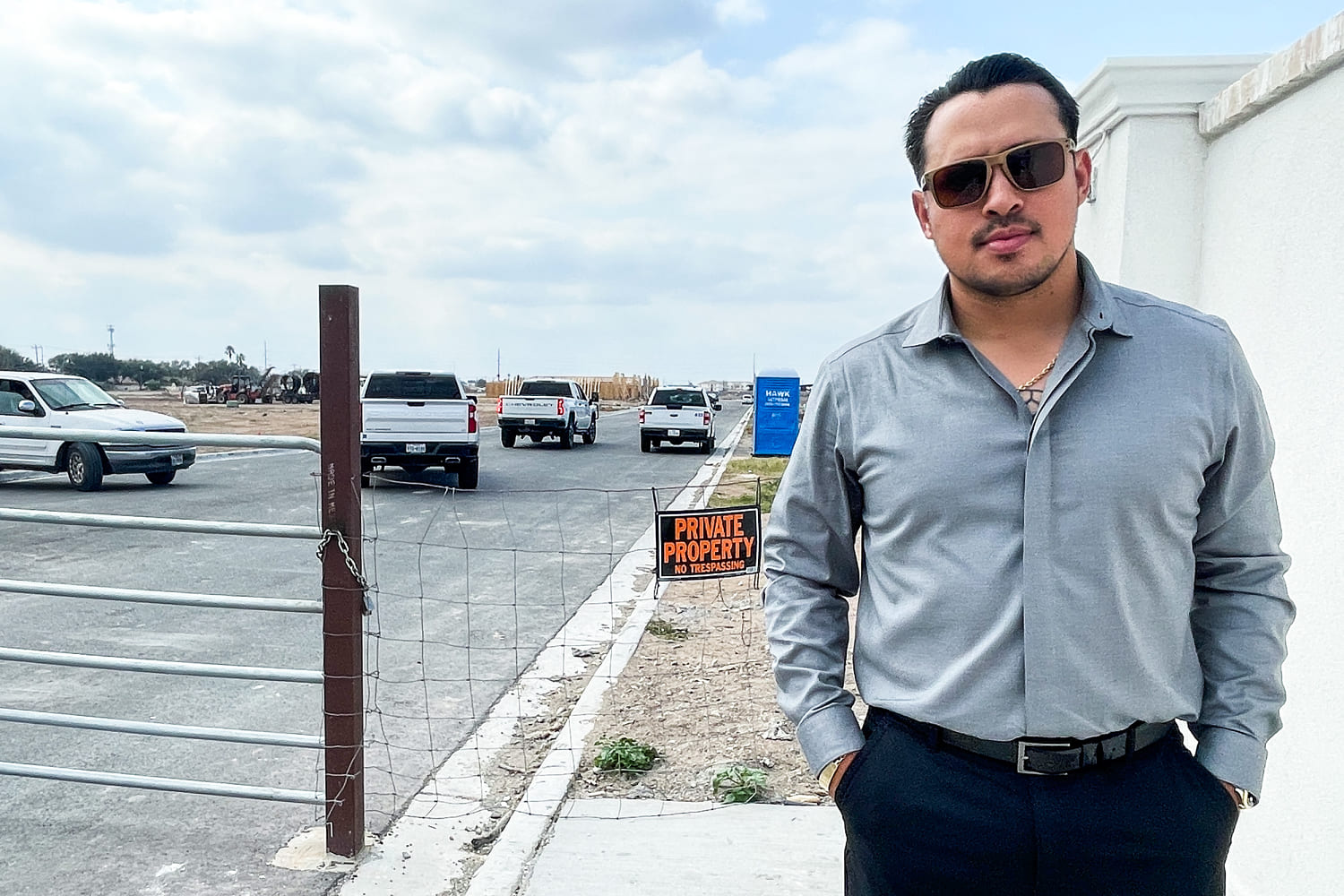
At a site where he’s developing an apartment complex, Guerrero has erected a gate similar to those seen at the entrances of ranches. It’s padlocked and chained and the code on it is changed weekly, he said. A couple of white pickups with hired security are stationed near the entrance.
Guerrero said builders were told by federal agents that if the general public can’t enter their site, they won’t either since it’s private property. Some workers will only agree to work at sites where such security exists, builders said.
Other builders said fences add costs and aren’t enough, because workers have to get to the jobsite and ICE can wait outside to arrest workers or pick them up in traffic stops.
Texas is using state highway troopers to help ICE check the immigration status of people it pulls over, and it requires sheriff’s offices to sign agreements with ICE to help with enforcement. The Rio Grande Valley also has multiple interior Border Patrol checkpoints, and Customs and Border Protection plans to add more in the area.
The homebuilders and other business leaders have asked elected officials to provide more H-2B visas for their industry. The visa is for temporary, nonagricultural workers and is often used in hospitality and tourism, landscaping, construction and other industries.
There have not been enough H-2B visas to meet demand in previous years, according to the American Immigration Council.
H-2B visas are capped annually at 66,000, but the Trump administration added another 64,716 H-2B visas for this year. By Feb. 6, U.S. Citizenship and Immigration Services announced it had “more than enough” applications for the first of three allocations of the visas through the year.
Guerrero said he’s not alone in his “disappointment” with the president’s immigration enforcement. And he thinks that sentiment is setting an ominous tone for GOP prospects in the region, both in the midterms and beyond.
“I can guarantee you, the Valley will never be red again,” he said. “At least not anytime soon.”
NBC News Top Stories
About the Author