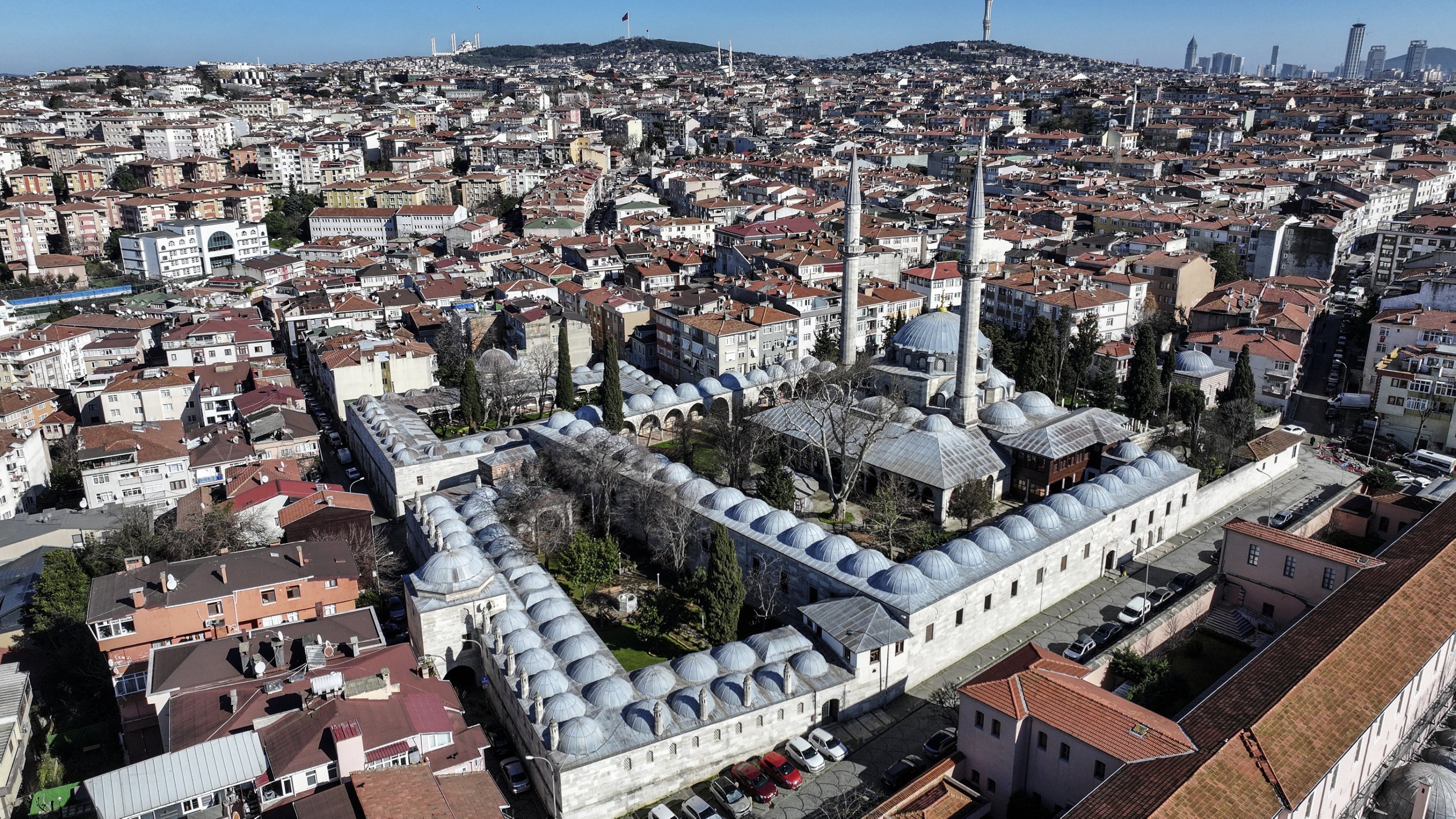
Located in Istanbul’s Üsküdar district, Valide-i Atik Mosque, one of the most distinguished works of classical Ottoman architecture, continues to function as both a place of worship and a center of cultural life centuries after its construction.
Designed by Mimar Sinan, the Valide-i Atik Mosque and its surrounding complex stand out as one of his most comprehensive projects, combining classical architectural language with a functional “külliye” layout and maintaining a prominent place in Istanbul’s historic urban silhouette.
Commissioned in the 16th century by Nurbanu Sultan, the mother of Sultan Murad III, the mosque was built during a period widely regarded as Mimar Sinan’s architectural prime. Following the later construction of another imperial complex by Gülnuş Valide Sultan, the mother of Sultan Ahmed III, in Üsküdar’s Iskele Square, the mosque came to be known as “Atik Valide,” “Eski Valide,” or “Valide-i Atik” to distinguish it from the newer Valide complex.
The mosque’s interior volume is defined by a sense of openness and clarity, supported by a carefully calibrated distribution of natural light that enhances both visual comfort and spiritual focus. These qualities place the Valide-i Atik Mosque among the key works produced during Mimar Sinan’s path toward full architectural mastery.
The interior decoration features outstanding examples from the most accomplished period of Iznik tile production. Particularly around the mihrab projection, underglaze tiles display refined floral compositions dominated by tulips, carnations, and smaller botanical motifs. These decorative elements contribute to a cohesive visual rhythm without overwhelming the architectural structure.
An Ayat al-Kursi inscription band, executed in white “celî sülüs” calligraphy on a deep blue background, encircles the interior and is enriched with coral red and turquoise accents. Complementing this calligraphic program are mother-of-pearl and ivory-inlaid wooden door panels, a finely carved marble mihrab, and an elaborately crafted minbar, all of which are recognized as distinguished expressions of the classical Ottoman aesthetic.
Iznik tiles decorate the mosque’s interior with floral motifs, Istanbul, Türkiye, Feb. 14, 2026. (AA Photo)
Beyond the mosque itself, the Valide-i Atik complex is notable for its integrated urban planning approach. The complex was designed as a tiered settlement and includes a madrasa, lodge, primary school, darülhadis, darülkurra, soup kitchen, hospital, and bathhouse. Together, these structures formed a self-sustaining social and educational hub that extended the mosque’s role far beyond ritual worship.
Experts emphasize that the complex was conceived not merely as a religious structure but as a fully functioning civic center. With educational institutions, healthcare facilities, charitable services, and commercial units operating in coordination, the Valide-i Atik complex effectively functioned as a small city within the city, addressing a wide spectrum of social needs.
The vision behind the complex is closely associated with the foresight of Nurbanu Valide Sultan, who commissioned the project with a comprehensive understanding of urban life and social responsibility. More than four centuries ago, she oversaw the creation of a carefully planned environment centered on a mosque and surrounded by institutions that supported learning, welfare, and daily life.
The mosque’s interior experience continues to attract attention for its strong visual and spiritual impact. The harmony between Iznik tiles, stained-glass windows, and calligraphic elements creates an atmosphere that supports both contemplation and aesthetic appreciation. Sunlight filtered through multicolored revzen windows enhances the decorative program while reinforcing the sense of serenity within the prayer hall.
The Ayat al-Kursi inscription, traditionally described as the heart of the Quran, encircles the interior like a protective band, reinforcing the mosque’s spiritual identity while also serving as a unifying visual element. In this respect, the Valide-i Atik Mosque is widely regarded as a complete külliye in religious, architectural, artistic, and social terms.
The naming distinction between “Atik” and “Cedid” Valide mosques reflects Üsküdar’s unique historical association with imperial women patrons. This legacy has led scholars to describe Üsküdar as a district shaped significantly by “valide sultans” and their architectural patronage.
During the month of Ramadan, the Valide-i Atik Mosque and its surroundings take on an additional layer of cultural significance. The area becomes a focal point for communal worship, illuminated mahyas, iftar gatherings, and a wide range of religious practices observed by different generations.
Ramadan in Üsküdar is widely characterized by a strong sense of community, continuity, and spiritual vitality, reinforcing the enduring role of the Valide-i Atik Mosque as both a religious landmark and a living social space within Istanbul.
DAILYSABAH
About the Author