Politics
By
,
Jennifer De Pinto,
Fred Backus,
February 24, 2026 / 5:25 PM EST
/ CBS News
Add CBS News on Google
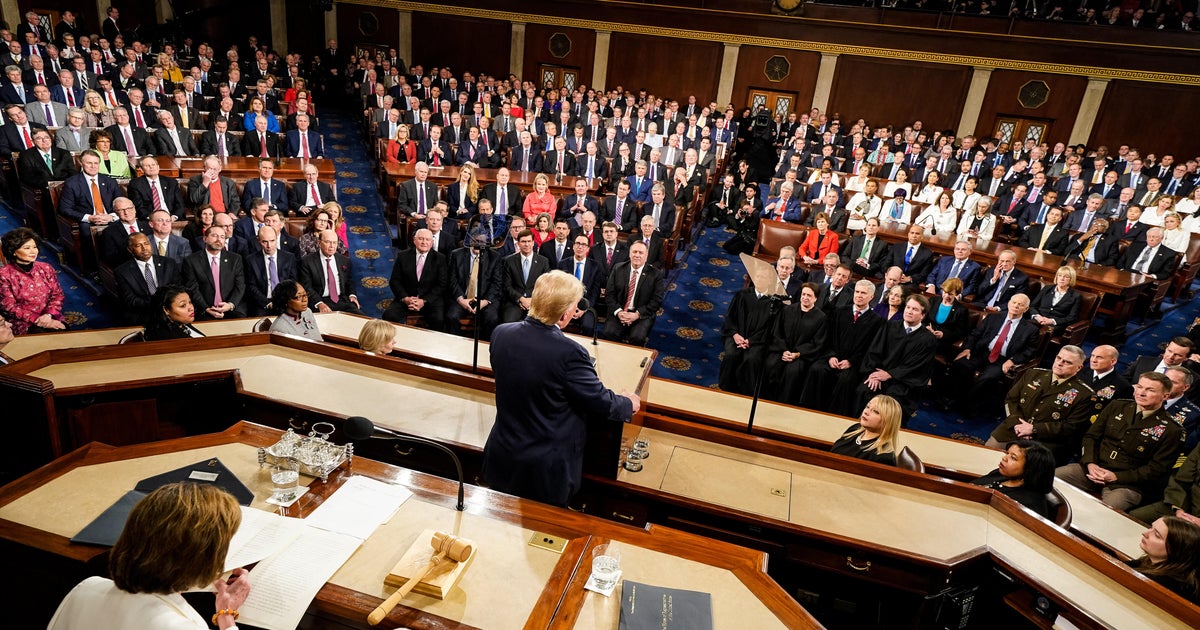
Asked how they’d describe the state of the country if they could give the address tonight, most Americans would use the word “divided.”
It’s a belief about division that has spanned administrations — before Joe Biden’s last State of the Union, most described the nation as “divided” too. And even more do now.
“Divided” far outpaces other descriptors like “strong” or “prospering,” though each of those is a bit higher now than in 2024 under Biden, too.
But Democrats and Republicans alike want to hear the president talk about the economy and the cost of living.
Most still call the economy bad — as they have for years, going back to the pandemic — but views are relatively improved of late, and off the lows for this term from last fall.
The way in which the president talks about that may be critical now: going into the State of the Union address, most Americans think Mr. Trump makes the situation with prices and inflation sound better than it really is.
There’s also a big majority that say he hasn’t explained potential military action against Iran.
Something fewer want to hear about: tariffs. Most still oppose them — or, coming off the recent Supreme Court decision — the idea that the president alone should be setting them. That, Americans say, is a job that at least involves Congress, if not one that is exclusive to Congress.
More broadly, asked how they’d describe the country compared to a year ago, Republicans already think it is doing better today. And they’re widely optimistic about the coming years ahead, too. A majority of Americans overall, though, feel the nation is doing worse.
And as with all presidents in recent years, his own partisans say they’re far more likely to watch the speech tonight.
Comparable numbers say “declining” and “weak” describe the state of the country, but the partisan views are flipped. When Joe Biden was in office, preparing to give his final State of the Union address, Republicans tended to use more negative terms than Democrats. Today, ahead of Mr. Trump’s address, Democrats use more negative terms.
What do Americans want to hear about?
Most want to hear about economic-focused topics like the cost of living and the U.S. economy, whether they plan to watch the speech or not.
Those issues have been on the minds of Americans for a long while.
Many also say it’s important to hear about Immigration and Customs Enforcement, deportation operations and immigration policy generally, along with health care and prescription drugs.
Far fewer want to hear very political things, like criticism of Democrats or support for Republicans — or about the Supreme Court, either.
It’s not just raising the subject, though; it’s the way the president describes things. Most continue to think Trump describes prices and inflation as better than they really are.
A sizable number in his own party — about four in 10 — also hold this view. This has been the case in the public mind for a while.
Tariffs, prices and the economy
Most Americans disapprove of new tariffs on imported goods, just as they did before the decision by the U.S. Supreme Court last week. (They’ve told us in other recent polls they feel tariffs increase prices.)
Who should decide on tariffs? Americans across party lines see at least some role for Congress in setting tariff policy. Very few say Trump alone should do it.
Specifically, Republicans see it as a matter for cooperation between Mr. Trump and Congress: few think Mr. Trump alone should set policy, even those who favor tariffs more generally.
Most continue to rate the nation’s economy negatively as they have for years, but the percentage who say it is good has been rising, off last fall’s lows for the term.
Americans have often said in previous polling this past year that prices are a main way that they evaluate the economy, and over the course of his second term, have felt the administration hasn’t been focusing enough on it. Today, Mr. Trump continues to get net negative ratings on his handling of the economy and inflation, as he has for several months.
Iran
Many also feel it’s important to hear about Iran tonight.
One reason: most don’t think the Trump administration has clearly explained the U.S. position on possible action against Iran.
Overall, the nation is divided — with slightly more opposed than in favor — of the idea of military action to prevent Iran from developing nuclear weapons.
Those who don’t think he’s clearly explained things are mostly opposed to military action.
There are partisan differences, too: Most Democrats and independents would disapprove of military action, but a big majority of Republicans would approve.
(For context, most Republicans — especially MAGA — did approve of the U.S. bombing of Iran’s nuclear facilities last summer, and of the more recent military action in Venezuela.)
Deportation and I.C.E.
Amajority continues toview ICE’s operations when it stops or detains people as “too tough.” This has been the case for a while.
That perception is linked to overall views of the deportation program.
Those who feel ICE operations have been too tough also overwhelmingly disapprove of the deportation program overall.
Over the course of this term, approval of the deportation program started out net positive, then became more divided last summer.
Today, more disapprove than approve of it.
But it has long stood out as something widely backed by the president’s GOP base. Republicans overwhelmingly back the deportation program, and give Mr. Trump high approval for his handling of immigration overall.
Views of President Trump
The president’s overall job approval rating has been fairly steady in recent months, hovering around the low 40s. It’s also been characterized by very strong backing from Republicans — for example, almost nine in ten today – and especially from MAGA.
Today’s 40% is also where it was last fall; it began this term higher, with majority approval, then dipped in the spring and summer of ’25. Over that same time, approval has declined among independents, younger people, and Latinos, among others.
In a nation that feels it is divided, this may be one reason. There are perceived differences in how the states are impacted by the president’s policies. Two-thirds feel Trump’s policies favor Republican states over Democratic ones (including over a third of Republicans who say so).
More broadly, most Americans think Mr. Trump’s policies have decreased peace and stability in the world rather than increased it.
Who plans to watch?
As is typical for a State of the Union address in recent times, a president’s partisans are more likely to watch. So the address will likely have a relatively friendly audience with Republicans outnumbering Democrats among viewers, though the impact will ultimately play out over the coming days as people see clips or read about it.
Republicans overall are already optimistic about the next three years — far more so than independents or Democrats.
As for whether it can change anything, most say their minds are made up about President Trump, but roughly a quarter think he might say something that could change their minds about him.
This CBS News/YouGov survey was conducted with a nationally representative sample of 2,381 U.S. adults interviewed between February 20-23, 2026. The sample was weighted to be representative of adults nationwide according to gender, age, race, and education, based on the U.S. Census American Community Survey and Current Population Survey, as well as 2024 presidential vote. The margin of error is ±2.3 points.
CBS News poll Trump State of the Union
Page of
CBS News Polls
More
In:
Opinion Poll
Donald Trump
State of the Union Address
© 2026 CBS Interactive Inc. All Rights Reserved.
Home – CBSNews.com
About the Author