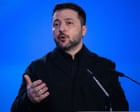
In further comments on the state of peace talks, Zelenskyy also said that this Thursday’s meeting will be part of “preparations for a trilateral meeting with Russia, which we believe will take place in early March”.
Other issues on the agenda for Thursday are prisoner-of-war exchanges and a “prosperity package” for the reconstruction of Ukraine, Zelensky said.
Witkoff confirmed the talks earlier this week saying the aim was to “explore different iterations about how we might get to a peace deal,” AFP reported.
If you expected some big lines on Ukraine or Europe from Trump’s State of the Union address overnight, well, there was hardly anything – but he did speak positively about Nato.
Here are the key bits, via this NPR transcript of his speech.
On Nato:
Nato countries, our friends and allies, and they are — they’re our friends and they’re our allies, have just agreed at my very strong request to pay 5 percent of GDP for military defence rather than the 2 percent, which they weren’t paying; we were paying for almost all of them. … Now they’re paying five as opposed to not paying for it. … And getting that 5 percent was something which everyone said would never be done, could not happen. We got it really easily with one meeting and [it’s] a big difference between 2 percent that’s not paid.
We were paying the freight of many of them. Very few were paid out. Now 5 percent then they’re paid. And everything we send over to Ukraine is sent through Nato and they pay us in full. They pay us totally in full.
On Ukraine:
“And we’re working very hard to end the ninth war, the killing and slaughter between Russia and Ukraine, where 25,000 soldiers are dying each and every month.
Think of that, 25,000 soldiers are dying a month. A war which would have never happened if I were president, would have never happened. As president, I will make peace wherever I can, but I will never hesitate to confront threats to America wherever we must.”
Trump also paid tribute to a Ukrainian refugee killed in Charlotte last year, Iryna Zarutska.
We are getting a line from Ukrainian president Volodymyr Zelenskyy, telling reporters that Ukraine’s negotiators are expected to meet with US representatives on Thursday, as they continue to look for ways to end the Russian aggression on the country, a day after the fourth anniversary, Reuters reported.
The European Union continues to look for ways to get around Hungary’s block on the latest round of sanctions against Russia and on the release of the €90bn loan to Ukraine.
The European Commission president, Ursula von der Leyen, said yesterday in Kyiv:
“The loan was agreed by 27 heads of state and government in the European Council, they have given their word. This word cannot be broken, so we will deliver on the loan one way or the other.”
Well, they better get creative as there is no sign that Hungary’s Viktor Orbán is willing to drop his veto, six weeks before the key election which could see him ousted after 16 years in power.
Responding to a letter from the European Council president, António Costa, who urged the Hungarian PM to stick by what was agreed in December, Orbán effectively told him “no” as he ramped up the pressure on Ukraine to restart oil transit via the Druzhba pipeline (Kyiv says the disruption was caused by a Russian drone strike, and has nothing to do with them.)
“We take a decision financially favourable to Ukraine that I personally disapprove, then Ukraine creates an energy emergency situation in Hungary, and you ask me to pretend that nothing happened.”
Separately, the German chancellor, Friedrich Merz, is in Beijing today for talks on trade and security.
Joining the growing list of western leaders to visit China in recent months, he intends to use the trip to urge president Xi Jinping and prime minister Li Qiang, whom he met last night, to put further pressure on China’s ally Russia to end the war in Ukraine, among other things.
Lots of things for us to cover.
Oh, and if you need something to brighten your mood: it’s Sanremo week, everyone! I will come back to this later.
It’s Wednesday, 25 February 2026, it’s Jakub Krupa here, and this is Europe Live.
Good morning.
The Guardian
About the Author

