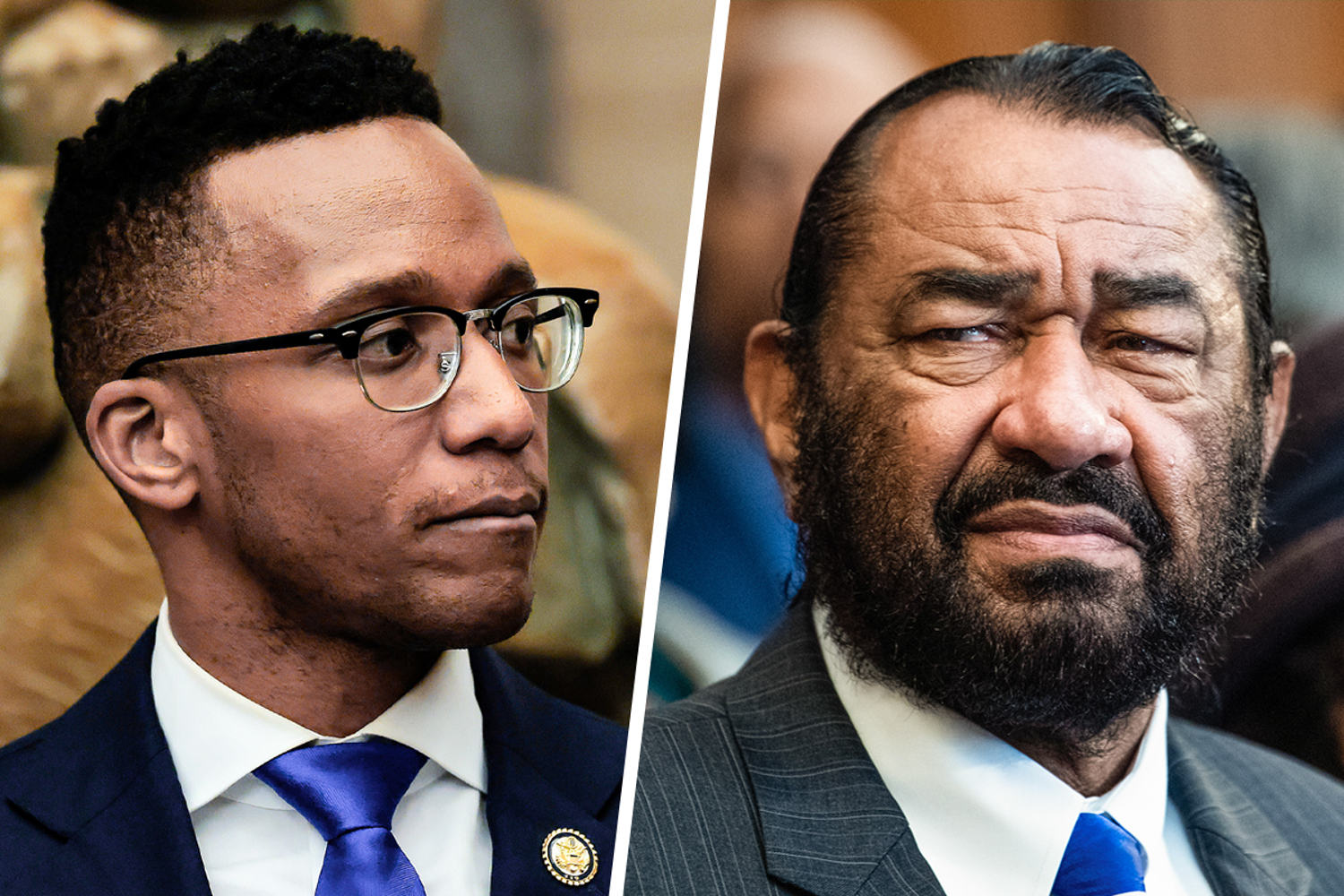
The new Texas congressional map that kicked off a nationwide redistricting fight last year was designed to boost Republicans in the midterm elections. First, in the primaries, the map is pitting the newest Democrat in Congress against one of his longest-serving colleagues in a primary.
Rep. Christian Menefee took office this month after he won a late January special election to fill the Houston-based seat of Rep. Sylvester Turner, who died last year. But because of the new congressional maps, Menefee is running for a full term in a district composed of a mostly new group of voters. Meanwhile, Rep. Al Green is running in the same district after the Legislature redrew his longtime seat to lean more Republican.
It’s not the only awkward primary matchup forged in part by redistricting. Democratic former Rep. Colin Allred, who endorsed current Democratic Rep. Julie Johnson to succeed him in a Dallas-based district in 2024, is now challenging Johnson after a redistricting shuffle that led two other Democrats from the metro area to leave their seats and Allred to leave the Senate race to seek election to the House once again.
Then-Rep. Colin Allred, D-Texas, at a campaign rally for Vice President Kamala Harris in 2024. Jordan Vonderhaar / Getty Images file
The race between Johnson and Allred has heated up over stock trading and immigration enforcement, while Menefee and Green’s has been fueled by calls for generational change. The primaries Tuesday highlight some of the issues that will echo through Democratic primaries around the country all year.
But the matchups have their roots in redistricting, which occasionally pits incumbents against each other — though usually only once every 10 years, after a census. Early voting in Texas has already begun as voters decide which members of Congress they want to keep.
“I think that we should always acknowledge and start from the premise that this is what the Trump administration wanted,” Allred said. “They wanted to draw districts together to force Democrats to run against each other. They wanted to sow division and reduce representation, and that’s what their aim was.”
Allred and Johnson are the best-known Democrats in the race, in addition to progressive attorney Zeeshan Hafeez and business owner Carlos Quintanilla, a perennial candidate. That means Allred is running against his endorsed successor.
Johnson said, “I think that it’s a little awkward, but at the end of the day, he made this choice.”
Rep. Julie Johnson, D-Texas, on Capitol Hill.Andrew Harnik / Getty Images file
In December, Allred dropped out of the Democratic Senate primary to run for the House, leaving the race to U.S. Rep. Jasmine Crockett and state Rep. James Talarico.
“I know Dallas, and Dallas knows me,” Allred said.
Menefee said he hasn’t had any “in-depth conversations” with Green even as they see each other on the House floor. Green and other House Democrats from Texas stood behind Menefee when Speaker Mike Johnson, R-La., swore him in.
“It’s an uncomfortable position to be in,” he said.
A spokesperson didn’t make Green available for an interview. In a recent interview with KRIV-TV of Houston reporter Greg Groogan, Green said that he has proven himself in Congress, including through his seniority on the Financial Services Committee, and that he is an “unbought and unbossed” Democrat.
“You don’t get there by showing up in Congress. You’ve got to be there, and you’ve got to serve,” Green said. “I’ve proven myself in Congress.”
Green, who is 79 years old and was first elected to the House in 2004, addressed concerns about his age and said he has delivered for his district.
“They’re saying that I’m too old. Well, I wasn’t too old to bring the federal judges. I’m not too old to bring the billions of dollars,” he said.
On Tuesday, Green was ejected from the State of the Union address as he protested President Donald Trump with a sign reading “Black People Aren’t Apes.” It was the second straight year he has been ejected from Trump’s address to Congress.
Menefee, 37, who was the Harris County attorney from 2021 to 2026, was just sworn in on Feb. 2. He said it has been “hectic” trying to balance both being a new member of Congress elected partway through a term and staying active on the campaign trail for a full term.
“When you come in on a special election, there’s no in-depth orientation,” he said. “It is: ‘Here’s your computer. Here’s your phone. You’ll be speaking to all of Congress, and then we’ll be casting votes. Get to work.’”
Asked how extensively Green’s age has played a role in the race, Menefee said he hasn’t “focused on age at all.” He said he is the only candidate in the race who has “stood up to the Trump administration.”
“This is the situation that we’re in, but I think I’m the person to carry this district into the future,” Menefee said, referring to the impact of the new maps.
The issue of age is on Democratic voters’ minds as the party continues to move on from Joe Biden’s one-term presidency and Kamala Harris’ 2024 election loss.
Mike Bobino, 51, a Menefee supporter who voted Friday at the Metropolitan Multi-Service Center in Houston, said of his chosen candidate: “He’s younger. I don’t think that he could be easily influenced. And Congressman Green has been in Congress for years. So what has he done?”
On Green’s side, voter Rocky Ramirez told NBC News: “I just think he’s a good candidate. But what mostly drug me out here today was voting for Talarico.”
In the Dallas-area race, Johnson and Allred have accused each other in different ways of supporting Immigration Customs and Enforcement or companies tied to it. The Texas Tribune reported last month that Johnson bought and later sold stock last year in Palantir, a data company with ties to ICE, according to congressional financial disclosure reports.
Johnson said that she had an independent money manager and that the stocks were sold last year before any ICE escalations in Minneapolis.
“I’ve consistently voted against ICE and against ICE incursion, against funding for ICE and against anything to do with Palantir’s interests,” she said.
Allred, who has faced criticism for having voted for the Trump-backed Laken Riley Act in 2024, has advocated for increased congressional oversight of ICE if Democrats win the majority in the midterms.
Johnson and Allred also don’t have the ballot to themselves. Progressives like Hafeez hope to see someone from the left win in the deep-blue district, citing the victories of Menefee and New York Mayor Zohran Mamdani.
“I don’t think it’s just about Democrat versus Republican anymore,” Hafeez said. “If you elect an establishment Democrat to Congress, are you really going to see the change that we need to see, especially at a time that we are in?”
Gretchen Brown, a longtime federal contractor, is also running in the 18th District alongside Green and Menefee. Amanda Edwards, a former member of the Houston City Council, suspended her campaign this month but will still appear on the ballot.
“My work has helped strengthen national security and shape federal policy decisions used by Congress and multiple administrations, so when I talk about bringing federal resources home, it’s not just talk — I know how to navigate the system,” Brown said.
Also at play in the Houston-area race is outside spending from the pro-cryptocurrency group Protect Progress. The group said it plans to spend $1.5 million against Green, who it said has voted against bipartisan crypto legislation on the House Financial Services Committee.
Green said in the local interview that he has fought cryptocurrency groups and accused the group of backing Menefee.
Jamie Stewart-Aday, Menefee’s campaign manager, said in response that Menefee hasn’t received contributions from cryptocurrency companies or executives and that he is the only candidate in the race who refuses corporate PAC money.
Stewart-Aday said Menefee believes Congress should set “clear rules” to protect consumers from crypto fraud and scams while ensuring “we do not ignore” emerging financial technologies.
NBC News Top Stories
About the Author