Twenty-nine years have passed since Türkiye’s Feb. 28, 1997, National Security Council (MGK) meeting, widely described as a “postmodern coup,” a process that reshaped the country’s political, social and institutional landscape for years.
The meeting, held amid escalating tensions between the military establishment and the elected government, produced decisions that ultimately forced the resignation of the coalition led by Prime Minister Necmettin Erbakan.
The developments surrounding the Feb. 28 process remain a defining episode in Türkiye’s political history, often cited as an example of military-bureaucratic intervention against democratic will.
The events unfolded during the tenure of the 54th government, formed by the Welfare Party (RP) and the True Path Party (DYP), which took office on June 28, 1996.
Erbakan served as prime minister, while DYP leader Tansu Çiller held the posts of deputy prime minister and foreign minister. The government quickly became the focus of controversy amid accusations from secular circles that it posed a threat to the constitutional order.
Rising tensions
Political and institutional pressure intensified in early 1997. The Chief Public Prosecutor’s Office at the Supreme Court warned the Welfare Party over activities during a January visit by Erbakan to Kayseri, stating that uniform clothing worn by local party officials violated the Political Parties Law and demanding disciplinary action.
The warning included the possibility of a closure case if the party failed to comply.
Tensions escalated further following a Jan. 31 event known as “Jerusalem Night,” organized by Sincan Mayor Bekir Yıldız of the Welfare Party and attended by Iran’s ambassador to Ankara. The speeches and displays at the event fueled nationwide debate over the government’s orientation.
On Feb. 1, despite objections and resistance from some coalition partners, Erbakan submitted for Cabinet signature a decree allowing the headscarf at universities, another development that intensified political polarization.
Investigations, military signals
Judicial authorities opened investigations into the Jerusalem Night event, while Iran’s ambassador was summoned to the Foreign Ministry to receive a formal protest.
One of the most memorable moments of the period came on Feb. 4, when tanks and armored vehicles moved through the Ankara district of Sincan en route to a military exercise area. The display was widely interpreted as a warning from the armed forces and caused public alarm.
That same day, Interior Minister Meral Akşener suspended Mayor Yıldız from office. He was later arrested along with several others on charges including aiding an illegal organization and inciting public hatred.
The developments triggered sharp political debates, drawing in then-President Süleyman Demirel and exposing growing strains within the coalition.
‘Balance adjustment’ to democracy
Public tensions spilled into the streets, with civil society organizations arranging large demonstrations in Ankara.
Following mounting criticism, Iran’s ambassador left Türkiye. Meanwhile, Demirel requested an investigation into alleged “religious fundamentalist” staffing in municipalities.
Erbakan sought to calm concerns, stating after a Feb. 21 meeting with Demirel that Türkiye did not face a regime crisis.
On the same day in Washington, then-Deputy Chief of General Staff Gen. Çevik Bir made a remark that would become emblematic of the period, saying the military had given “a balance adjustment to democracy” in Sincan.
Decisive MGK meeting
Amid intensifying controversy, Demirel sent Erbakan a letter on Feb. 26 outlining concerns about the direction of the regime.
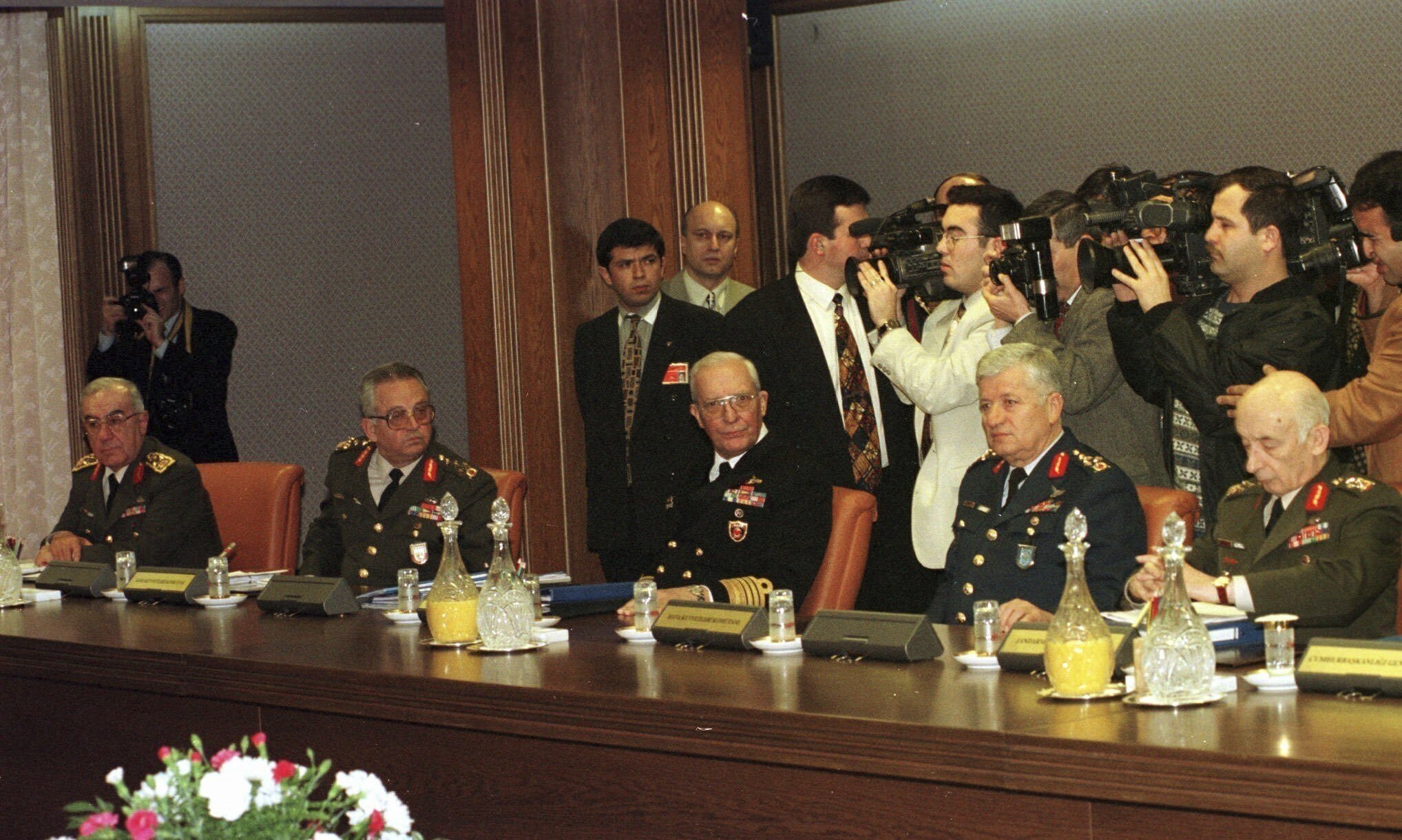
Two days later, the MGK convened under Demirel’s chairpersonship in one of the longest meetings in its history. The session lasted eight hours and 45 minutes, running from midafternoon until nearly midnight.
Top civilian and military officials attended, including Chief of General Staff Gen. Ismail Hakkı Karadayı and senior commanders of the armed forces.
Following the meeting, the council issued a statement emphasizing that no concessions would be made in implementing constitutional principles and warning against activities seen as undermining the secular, democratic order.
The decisions were later followed by a list of 20 measures presented to the government, including extending compulsory education to eight years and restructuring religious vocational schools.
Pressure on government
Erbakan initially resisted some of the measures, and political tensions deepened as voices within the DYP began calling for withdrawal from the coalition.
Çiller met Erbakan to persuade him to sign the MGK decisions. At a press conference, Erbakan pushed back against political maneuvering, declaring, “Governments are formed in Parliament, not at the MGK.”
Nevertheless, he signed the decisions on March 5.
Debates over their implementation, particularly the education reform, accelerated divisions between coalition partners and weakened the government’s position.
Political restructuring
As tensions grew, Çiller requested that the premiership be transferred to her in July. Erbakan refused.
President Demirel stressed that the MGK decisions were constitutional and warned that failure to implement them would disrupt state functioning.
Meanwhile, the Supreme Court chief prosecutor filed a case on May 21 seeking the closure of the Welfare Party on the grounds that it had become a focal point of activities against secularism.
Within the military, the General Staff established the Western Working Group on June 11 to monitor religious activity, a move later cited by critics as evidence of institutional pressure.
On June 18, Erbakan resigned, hoping that Çiller would be tasked with forming a new government under a revised coalition arrangement.
Instead, after consultations with opposition leaders, Demirel gave the mandate to Mesut Yılmaz, leader of the Motherland Party (ANAP). The decision drew strong criticism from the outgoing coalition partners.
End of Welfare Party era
The new government was formed on June 30 under Yılmaz, in coalition with other parties.
One of the most consequential policies of the Feb. 28 process, eight years of uninterrupted compulsory education, was approved by Parliament in August and implemented at the start of the 1997-1998 academic year.
The political repercussions continued.
On Jan. 16, 1998, Türkiye’s Constitutional Court ordered the closure of the Welfare Party, ruling that it had violated the principles of the democratic and secular republic and become a center of anti-secular activity.
Several senior figures, including Erbakan, received five-year political bans. The decision, published in the Official Gazette on Feb. 22, brought the party’s 14-year political life to an end.
Lasting impact
The Feb. 28 process is widely viewed as a defining moment in Türkiye’s modern political history, an intervention carried out without a direct military takeover but through coordinated pressure from military, judicial and bureaucratic institutions.
Today, for many, the episode represents a period in which an elected authority was constrained by unelected actors. The events are frequently invoked as a cautionary example of tutelary intervention and as a turning point that reshaped Türkiye’s democratic trajectory.
Nearly three decades later, the legacy of Feb. 28 continues to influence political discourse, institutional reforms and debates over civil-military relations, religious freedoms and the limits of democratic authority in Türkiye.
DAILYSABAH
About the Author