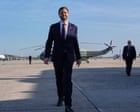
US vice-president JD Vance has warned Iran not to “play” the US as he headed overseas for negotiations aimed at ending their war.
Vance, who has long been sceptical of foreign military interventions and outspoken about the prospect of sending troops into open-ended conflicts, set off Friday to lead mediated talks with Iran in the Pakistani capital of Islamabad.
Boarding Air Force Two on his way to Pakistan, the vice president said:
We’re looking forward to the negotiation. I think it’s gonna be positive. We’ll of course see.
He cited Trump, adding: “If the Iranians are willing to negotiate in good faith, we’re certainly willing to extend the open hand.”
But he said: “If they’re gonna try and play us, then they’re gonna find that the negotiating team is not that receptive.”
Vance also said that Trump “gave us some pretty clear guidelines” on how talks should go, but he didn’t elaborate. The vice president did not take questions from reporters traveling with him.
Here are some of the latest images on the newswires:
Further to the announcement by the Israeli foreign affairs ministry of Spain’s exclusion from the Civil-Military Coordination Center (see previous post), the Israeli prime minister, Benjamin Netanyahu, has accused Madrid of “hostility” towards his country.
In a video message posted today, he said:
Israel will not remain silent in the face of those who attack us.
Spain has defamed our heroes, the soldiers of the IDF, the soldiers of the moral army in the world.
Therefore, I have instructed the removal of the Spanish representatives from the coordination center in Kiryat Gat, after Spain has repeatedly chosen to stand against Israel.
Whoever attacks the State of Israel instead of the terrorist regimes, whoever does this, will not be our partner in the future of the region.
I am not willing to tolerate this hypocrisy and this hostility. I do not intend to allow any country to wage a diplomatic war against us without paying an immediate price for it.
Israel’s foreign affairs ministry announced Spanish representatives will not be allowed access to the US-led centre responsible for monitoring the ceasefire in the Gaza Strip due to what it described as a “blatant anti-Israeli bias”.
In a statement on its website, the ministry said the decision was made to block Spain from participating in the Civil-Military Coordination Center (CMCC) in light of “the anti-Israel obsession of [Spanish] Prime Minister [Pedro] Sánchez’s government and its serious harm to Israeli (and also American) interests – including during the war against Iran”.
It added that the US was informed in advance of the decision.
Sánchez has arguably been the most vocal western critic of Donald Trump’s war in Iran. While most European leaders have reacted with cautious optimism at news of the ceasefire between the US and Iran, Sánchez said his government “will not applaud those who set the world on fire just because they show up with a bucket”.
In a statement, the Israeli foreign affairs minister, Gideon Saar, said: “The Sánchez government’s anti-Israel bias is so egregious that it has lost all capability to serve as a constructive actor in implementing President Trump’s peace plan and in the CMCC operating under that plan.”
US vice-president JD Vance has warned Iran not to “play” the US as he headed overseas for negotiations aimed at ending their war.
Vance, who has long been sceptical of foreign military interventions and outspoken about the prospect of sending troops into open-ended conflicts, set off Friday to lead mediated talks with Iran in the Pakistani capital of Islamabad.
Boarding Air Force Two on his way to Pakistan, the vice president said:
We’re looking forward to the negotiation. I think it’s gonna be positive. We’ll of course see.
He cited Trump, adding: “If the Iranians are willing to negotiate in good faith, we’re certainly willing to extend the open hand.”
But he said: “If they’re gonna try and play us, then they’re gonna find that the negotiating team is not that receptive.”
Vance also said that Trump “gave us some pretty clear guidelines” on how talks should go, but he didn’t elaborate. The vice president did not take questions from reporters traveling with him.
Hezbollah chief Naim Qassem on Friday called on the Lebanese government to stop giving “free concessions” to Israel, with the two governments due to begin negotiations in Washington next week.
“We will not accept a return to the previous situation, and we call on officials to stop offering free concessions,” Qassem said in a written message broadcast on the party’s Al-Manar TV, in which he also denounced the “bloody criminality on Wednesday,” when Israeli strikes killed more than 300 people in Lebanon.
US trade representative Jamieson Greer said on Friday that the United States is trying to have a stable relationship with China, but if Beijing is going to be involved with Iran in a way that goes against US interests, that would complicate matters.
In an interview on CNBC, Greer said he expected president Donald Trump to have a good meeting next month with Chinese president Xi Jinping but not every challenge with China is resolved.
Hezbollah said it had targeted Israel’s Ashdod naval base with missiles, two days after deadly Israeli airstrikes on Beirut left more than 300 people dead.
“In response to the enemy’s violation of the ceasefire and its repeated attacks on Beirut, and after the Resistance adhered to the ceasefire while the enemy did not, the fighters of the Islamic Resistance targeted… the naval base in the port of Ashdod with missiles,” the group said in a statement.
Iran’s deputy foreign minister for political affairs, Majid Takht Ravanchi, said Tehran does not want a ceasefire that will allow the US and Israel to attack again.
Iran’s semi-official Tasnim news agency reported remarks he made during a meeting today with foreign ambassadors and heads of organisations in Tehran.
A translation of his remarks read: “We do not want a ceasefire that allows the aggressor enemy to re-arm and launch another aggression.”
He also claimed that “it has been agreed that Iran’s 10-point plan will be the basis for negotiations”.
Gulf states rethink security in light of US-Israel war on Iran
Gulf nations will seek to add security partners as they rebuild battered economies after the US and Israel’s war on Iran and deal with an emboldened Tehran.
The Gulf will have to live with a continuing threat from the regime in Iran and its remaining missile arsenal. American bases on their soil turned them into targets for Iran, as it retaliated against a joint attack by the US and Israel.
But, the countries say they can’t tolerate Iran keeping control of the strait of Hormuz, through which most of their trade flows. In agreeing to a ceasefire this week, Iran insisted it would retain the hold it took during the war over the waterway, which would allow Tehran to throttle the Gulf at will. The future of the strait will be one of the main disputes to be negotiated between the United States and Iran, in talks in Islamabad due to start as soon as Friday.
Gulf nations trumpeted success in largely intercepting the Iranian barrage of missiles and drones over the five weeks of the conflict, showing they can defend themselves.
The countries are, however, split over future relations with Iran, with a hawkish grouping led by the United Arab Emirates and Bahrain taking a harder line, and other nations hoping for peace through renewed ties with Tehran, experts say.
Read the full report here:
The Israeli military has claimed to have destroyed more than 200 Hezbollah rocket launchers since the start of the conflict.
The Israel Defense Forces (IDF) said in a statement online that it destroyed more than 200 rocket launchers, including approximately 1,300 launch tubes, belonging to the Iran-backed militant group since 2 March.
Keir Starmer said he used a call with Donald Trump to set out the views of Gulf states, the Press Association reported.
“I had a discussion with president Trump last night and set out to him the views of the region here, these Gulf states are the neighbours of Iran, and therefore, if the ceasefire is to hold – and we hope it will – it has to involve them,” the UK prime minister said in Qatar, where he was on the final leg of his Middle East tour.
“They have very strong views on the strait of Hormuz. We spent most of the time on the call talking about the practical plan that’s going to be needed to get navigation through the strait and the role that the UK is playing.”
Anwar Gargash, the UAE’s senior diplomatic envoy, said on X that his country will review regional and international ties in light of attacks by Iran to “determine who can be relied upon”.
The UAE’s defence ministry said yesterday that its air defences have intercepted 537 ballistic missiles, 26 cruise missiles and 2,256 drones since the start of the war.
Keir Starmer said he is “fed up” with energy bills going up in the UK “because of the actions of Putin and Trump”.
The remarks, made during an interview with ITV, were a rare display of frustration by the UK prime minister who seldom calls out Donald Trump directly in public. And, in this instance, he has linked the US president with Vladimir Putin.
Starmer is due to return to the UK today after visiting allies in the Gulf for talks on how to support the US-Iran ceasefire and secure a permanent reopening of the strait of Hormuz. After travelling to Bahrain, Saudi Arabia and the UAE, his last stop is Qatar.
You can follow our UK politics blog where my colleague Andrew Sparrow is reporting the latest on the impact of war on the UK and other related news:
Pictures: Islamabad on high alert ahead of talks between Iranian and US negotiators
The UN children’s agency, Unicef, reported that nearly 600 children have been killed or injured in Lebanon since the outbreak of the latest Israel-Hezbollah war on 2 March.
More than 30 children were killed and nearly 150 injured by the wave of bombings carried out on Wednesday by Israeli troops, Unicef said.
In a statement, the agency said:
Unicef is receiving reports of children being pulled from under the rubble, while others remain missing and separated from their families. Many are experiencing trauma, having lost loved ones, their homes, and any sense of safety. Across the country, more than one million people have been uprooted, including an estimated 390,000 children, many for the second, third, or even fourth time.
International humanitarian law is clear: civilians, including children, must be protected at all times.
The Guardian wp:paragraph
هلدینگ کاسپین استانبول | خرید ملک در ترکیه | صرافی معتبر ایرانی در ترکیه | خرید و فروش طلا در ترکیه | مهاجرت به ترکیه | واردات و صادرات در ترکیه | نیازمندیهای ترکیه | اخبار ترکیه | اخبار جهانی | توریست ایران | خدمات توریستی در ایران | تورهای گردشگری ایران | هلدینگ اول | خدمات کاریابی و فریلنسری و شغل | مرجع اطلاعات ایران (همه چیز در ایران) | کیف پول و خدمات مالی و پرداخت یار | اخبار ایران | تابلو زنده قیمت ارز در ترکیه و استانبول | صرافی آنلاین ترکیه | قیمت طلا و نقره در ترکیه | سرمایه گذاری در ترکیه | جواهرات در ترکیه | نرخ لحظه ای ارزها در استانبول | قیمت دلار امروز در ترکیه | قیمت دلار استانبول امروز | قیمت لحظه ای دلار | اخبار روز ترکیه استانبول | اپلیکیشن ISTEX | اپلیکیشن قیمت لحظه ای دلار و یورو و لیر و ارزها در ترکیه
About the Author