IE 11 is not supported. For an optimal experience visit our site on another browser.
Space
After a fiery trip through Earth’s atmosphere that lasted nearly 15 minutes, the crew’s Orion spacecraft splashed down in the Pacific Ocean just after 8 p.m. ET on Friday.
Listen to this article with a free account
00:0000:00
Add NBC News to Google
April 10, 2026, 10:39 PM EDT
The four Artemis II astronauts are back safely on Earth after flying around the moon on NASA’s first lunar mission in more than 50 years.
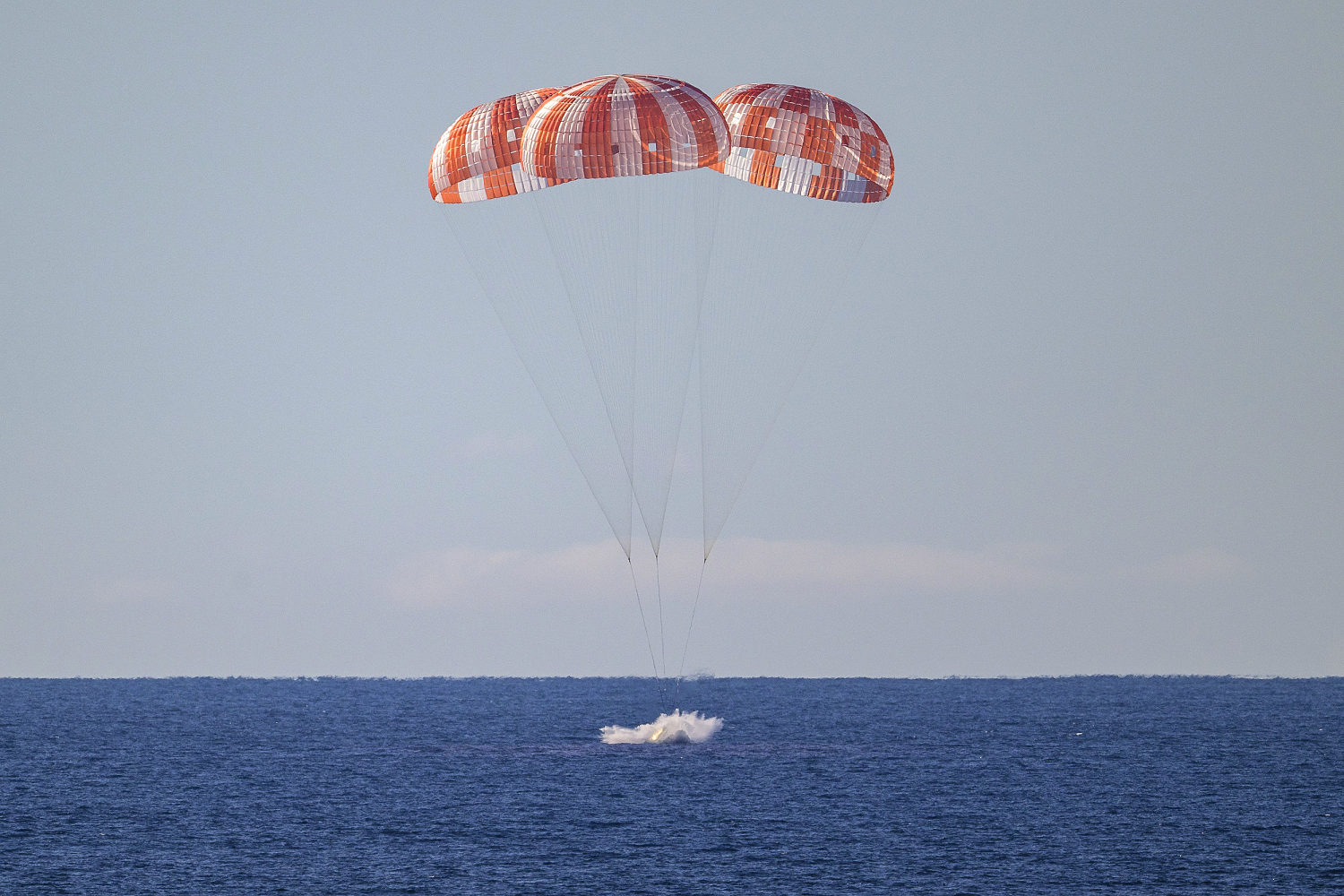
After a fiery trip through Earth’s atmosphere that lasted nearly 15 minutes, NASA astronauts Reid Wiseman, Christina Koch and Victor Glover and Canadian astronaut Jeremy Hansen splashed down in the Pacific Ocean off the coast of San Diego in their Orion capsule at 8:07 p.m. ET.
It was a picture-perfect splashdown under three huge parachutes, with the capsule landing upright and bobbing in the water as recovery teams raced to the scene.
Minutes before, a six-minute communications blackout with mission controllers made for a nail-biting finish to the mission as the capsule plunged through Earth’s atmosphere.
Then, a very welcome call-out came over the airwaves.
“Houston, Integrity, we have you loud and clear,” Wiseman radioed to Mission Control at NASA’s Johnson Space Center in Houston, using the name “Integrity” that the crew gave to their spacecraft.
NASA’s Orion spacecraft with Artemis II crewmembers NASA astronauts Reid Wiseman, commander; Victor Glover, pilot; Christina Koch, mission specialist; and CSA (Canadian Space Agency) astronaut Jeremy Hansen, mission specialist aboard is seen as it lands in the Pacific Ocean off the coast of California on Friday.Bill Ingalls / NASA via Getty Images
After NASA and U.S. Navy recovery teams checked the area for debris and other hazardous materials, the Artemis II crew members were helped out of the capsule one by one. Wiseman, the mission’s commander, was last to exit.
The four astronauts were then flown by helicopter to the USS John P. Murtha, a U.S. Navy transport dock ship. Once on board, they underwent post-mission medical evaluations. Later on Friday, the astronauts are expected to return to shore and fly to NASA’s Johnson Space Center in Houston, the agency said.
The astronauts’ return marks the end of the 10-day mission, during which they flew around the moon and became the first humans to see the entire lunar far side with their own eyes. The crew was also the first to launch aboard NASA’s Space Launch System rocket and Orion capsule.
As they swung around the moon, the astronauts set a new record for the farthest distance humans have traveled from Earth: 252,756 miles. They surpassed the previous record of 248,655 miles set by the Apollo 13 crew in 1970 during their emergency return to Earth.
Earth dips beyond the lunar horizon in this first photo from the far side of the Moon captured from Orion on April 6.NASA
During their lunar flyby, the Artemis II crew members captured breathtaking photos of the moon’s far side, including never-before-seen features on the lunar surface: rugged topography, countless craters, ridges, mountains and ancient lava plains. The moon’s far side permanently faces away from Earth, and even most of the Apollo missions of the 1960s and 1970s did not yield views of the far side because of the paths and timing of the flights.
The Artemis II astronauts recorded observations of impact basins that formed billions of years ago, when large objects smacked into the lunar surface, and studied jagged features along the moon’s terminator, the dividing line between its illuminated side and the side cloaked in darkness.
NASA said these images will help scientists understand how the moon formed and how its landscape has changed over time.
The successful end of the Artemis II mission is a major relief for NASA, given prior concerns about Orion capsule’s heat shield, the layer of thermal protection at the bottom of the spacecraft that protects astronauts from extreme temperatures during atmospheric re-entry.
Mission Specialist Christina Koch, Mission Specialist Jeremy Hansen, Commander Reid Wiseman, and Pilot Victor Glover with their zero gravity indicator “Rise,” inside the Orion spacecraft on their way home.NASA
Re-entering Earth’s atmosphere is always a dangerous and risky part of human spaceflight, because a capsule plunging through the atmosphere can be exposed to temperatures of around 5,000 degrees Fahrenheit. But the stakes were especially high for the Artemis II mission because the Orion heat shield had a known flaw in its design.
During the uncrewed Artemis I test flight in 2022, NASA found that part of the heat shield’s material cracked during re-entry, “causing some charred material to break off in several locations.” To minimize risk to the Artemis II astronauts, NASA modified the capsule’s entry path so that it descended faster and at a steeper angle to shorten the amount of time it was exposed to the most extreme temperatures.
NASA said a full analysis will be done to assess the performance of the heat shield now that the crew has safely splashed down.
NBC News Top Stories
About the Author

