The drone footage showed a sprawling residence in northern Hungary, complete with manicured gardens, a swimming pool and an underground garage. But it was what came next that captured much of the country’s imagination: zebras darting across the countryside.
The property caught on camera belongs to the father of the country’s prime minister, Viktor Orbán, offering a glimpse of the staggering wealth amassed by his inner circle, even as most in Hungary have become poorer. References to the zebras – which came from a neighbouring property belonging to Orbán’s best friend and Hungary’s richest man, Lőrinc Mészáros – soon began turning up across the country; plush toys were sold at protests, people posted videos of their own treks to spot the animals, and photos of zebras were plastered over government billboards.
“They became a symbol of the limitless corruption of the whole system,” said Ákos Hadházy, a Hungarian independent MP who last autumn organised a series of “safari tours” to the area in protest.
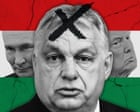
Those protests were just one part of a swelling opposition movement that has left Orbán facing the prospect of being ousted after 16 years in power.
The scope of this movement is set to be laid bare on Sunday, as Hungarians cast their votes in an election widely seen as the most consequential since the country’s transition to democracy in 1990.
Most polls suggest Orbán and his Fidesz party – who have transformed Hungary into a “petri dish for illiberalism” – could lose power, in a result that could rattle global far-right movements and reshape Hungary’s antagonistic relationship with the EU. But opposition supporters fear the polls are underestimating support for Fidesz, or that Orbán will find a way to retain power even if he loses the election.
“Hungary stands at a historic crossroads once again,” said Anita Orbán of the opposition Tisza party, the political force that has shaken up the race and now leads in most polls. “This moment carries powerful echoes of the past.”
The election comes 23 years to the day after Hungarians voted overwhelmingly to join the European Union. “Now, on 12 April, once again, voters are not simply choosing between parties, but deciding the direction, identity, and future of Hungary,” Anita Orbán, no relation to the prime minister, said on social media. “In many ways, this election is a referendum on whether Hungary returns to European values.”
It was a hint of how much has changed in Hungary since Orbán took power in 2010. What followed was, in the words of Zoltán Kész, a former member of the Fidesz party, nothing less than a “coup in slow motion,” albeit one that eschewed tanks for lawyers and clientelism.
The rightwing populist government had used its time in office to steadily whittle away at the checks and balances that constrained its power: rewriting election laws to its own benefit, manoeuvring to put loyalists in control of an estimated 80% of the country’s media, and retooling the country’s judiciary.
“We’ve come to the point in Hungary when we obviously can no longer talk about a real democracy,” said Kész. “It’s really a state capture that has been going on in Hungary with all the institutions that are supposedly independent. Whether it’s the courts or public services, they’ve been captured by one party, basically.”
On the streets and across dining room tables, Hungarians readily shared how this has played out in practice, from the university professor who has lost his job after speaking out against the government, to the music venues shut down after hosting artists who backed the opposition, and journalists whose newsrooms became government mouthpieces overnight after changes in ownership.
When Hungary’s economy was growing, many paid little attention to what was happening, said Kész. But as inflation soared after Russia’s full-scale invasion of Ukraine and economic stagnation set in, rumblings began over the growing disconnect between ordinary Hungarians and its ruling class.
It was against this backdrop that Péter Magyar, a former member of Fidesz’s inner circle, began speaking out. As he accused Orbán’s party of branding itself as a defender of Hungarians while siphoning off state funds, corruption rocketed to the top of voters’ concerns and Magyar’s hastily formed party climbed to the top of the polls.
Magyar’s lead has held as the government attempted to ban Pride events and mulled hardening its longstanding clampdown on independent media and NGOs.
What Magyar is up against is visible across Hungary: the omnipresent billboards, generated with AI and paid for by the government, depicting him as a danger to the country and a stooge of both the EU and the Ukrainian president Volodymyr Zelenskyy.
The result is a campaign that has pitted fear against hope, as one Hungarian news outlet noted this week. Orbán – whose government did not respond to a request for an interview – has sought to convince voters that Hungary’s biggest risk lies in the war in Ukraine, casting himself as the only leader capable of keeping peace. Magyar, in contrast, has focused on domestic issues, promising to crack down on corruption, funnel funds towards long-neglected public services and repair the country’s strained relationship with the EU.
A two-minute video released in January made clear the outsized role that the election in a country of less than 10m people, which produces 1.1% of the EU’s GDP, would play on the world stage.
Nearly a dozen rightwing leaders, from Italy’s Giorgia Meloni and Matteo Salvini to France’s Marine Le Pen, endorsed Orbán, praising the path he had blazed in Hungary. “Europe needs Viktor Orbán,” Germany’s Alice Weidel, a co-leader of the far-right Alternative für Deutschland (AfD), tells viewers in the video.
The extent of Orbán’s reach was laid bare this week as JD Vance landed in Budapest with his wife, Usha. As he campaigned with Orbán, the US vice-president parroted much of Fidesz’s campaign strategy, railing against the EU and taking shots at Ukraine. On Friday, Donald Trump posted : “I AM WITH HIM ALL THE WAY!”.
“I think the symbol of Orbán losing should not be underestimated,” said Daniel Freund, a German Green MEP who has long sounded the alarm on democratic backsliding in Hungary. “He is the absolute poster boy of this whole movement of the illiberal, anti-European, extreme right. He is the icon and the example that others follow.”
Vance’s visit was the culmination of years of precise targeting by Orbán, said Dalibor Roháč, a senior fellow at the American Enterprise Institute. After Orbán’s allies cast him as a model for Trump and others, the Hungarian government is alleged to have spent millions of euros on US lobbyists, tasking them with peddling this narrative in Washington.
Their efforts soon paid off, with people such as Kevin Roberts, the head of the US Heritage Foundation thinktank that produced Project 2025, describing Hungary as the model for conservative statecraft, “Orbán kept investing in these relationships and bringing people over,” said Roháč.
Budapest has swiftly become a hub of thinktanks and conferences aimed at amplifying the idea of Hungary, in the words of one local journalist, as a “Christian conservative Disneyland” where the global far right feels at home.
The global veneration has continued even as the country plunged in press freedom rankings, faced accusations of no longer being a full democracy, and became the most corrupt country in the EU.
As Orbán’s government cozied up to Vladimir Putin, growing more dependent on its crude oil, Budapest acted as a node between Washington and Moscow and offered Maga a jumping-off point to export Christian nationalist and far-right ideology to the rest of Europe.
Vance’s visit was a demonstration of this. While it made headlines around the world, there’s been no indication that it boosted Orbán’s position.
Instead, momentum seemed to be growing for Magyar. On Thursday evening, his supporters packed the central streets of Györ in north-west Hungary. Images of Hungarian flags prompted comparisons to a March rally in the same town, at which Orbán lashed out at demonstrators who booed him, accusing them of being pro-Ukrainian.
The confidence belies a note of uncertainty that has run through the campaign, as it is anyone’s guess as to whether the opposition surge would be enough to dislodge Fidesz. While the polls suggest a Tisza win, undecided voters and Hungarians abroad could still sway the result, as could the already-swirling claims of vote-buying and gerrymandering.
In the small city of Kecskemét, about 50 miles south of Budapest, many said the campaign had done little to endear them to Magyar. “There’s a level of palpable anxiety among people,” said Katalin, 81, citing fears that Hungary would be drawn into the war in Ukraine. “I don’t think that the Ukrainian people want a war, but their leader might.”
It was a thought that made Zsuzci, 83, shake with fear. “At this point, we can only pray,” she said. “I’m praying to preserve a Christian Hungary. We’ll get dragged into the war in Ukraine if Péter Magyar wins and he’ll also let in the migrants – he does exactly what the European Union tells him to do.”
Regardless of the outcome, it’s clear that Sunday’s vote marks the beginning of a wider reckoning with Hungary’s foray into illiberalism, said Kész. “Under normal circumstances, you lose an election, so what? You go in opposition, you come back in four years. That is a normal democracy, but this is not normal.”
During Fidesz’s 16 years in power, the party stacked the state, media and judiciary with loyalists, suggesting that Orbán’s system could survive him even if he loses.
“Even under the ideal circumstances, change will not happen overnight,” he said. “If you look at the state of the education system, if you look at the state of healthcare, courts, public services, and you name it – these need to be built up again from scratch. There’s a lot of work to be done by a new government.”
The Guardian
About the Author