Home – CBSNews.com
President Trump’s threat to block the Strait of Hormuz is “more bluffing than reality,” a spokesperson for the Iranian parliament’s National Security Commission said.
Ebrahim Rezaei warned that Tehran was prepared to respond if the situation escalates militarily.
“It will make the current situation (Trump) is in more complicated and will further agitate the market he is angry about, and we may also reveal other cards that we have not used in the game,” Rezaei said in a post on X.
CBS/AP
Kremlin spokesman Dmitry Peskov warned on Monday against a U.S. blockade of the Strait of Hormuz, saying it will likely hurt global trade markets.
“Most likely, such actions will continue to negatively impact international markets,” he said when asked to comment on President Trump’s announcement of a blockade on Iran’s ports and coastline. “This can be assumed with a high degree of certainty.”
Peskov told reporters: “Many details remain unclear and incomprehensible, so I would refrain from making any substantive comments at this time.”
The Strait of Hormuz is a chokepoint for shipments of oil, fertilizer and other vital goods. U.S. Central Command said on Sunday that the blockade will begin at 10 a.m. EDT on Monday.
CBS/AP
Prime Minister Benjamin Netanyahu said Monday that Israel supports President Trump’s decision to impose a naval blockade on Iran, adding that his government is coordinating fully with Washington on the matter.
“Iran violated the rules (of the peace talks in Pakistan), President Trump decided to impose a naval blockade,” Netanyahu said at a cabinet meeting, according to a video statement released by his office.
“We, of course, support this firm position, and we are in constant coordination with the United States.”
Netanyahu also said Vice President JD Vance, who led the U.S. delegation to the weekend peace talks in Pakistan between the U.S. and Iran, updated him on those talks and “made it clear that the main issue is the removal of all (of Iran’s) enriched (nuclear) material and ensuring that there is no more enrichment.”
Netanyahu said he visited Israeli troops Sunday in the security zone they established in southern Lebanon separating it from Israel.
“Of course the fighting continues,” he said. “It has not stopped. It continues all the time. Yesterday and today, it was concentrated in Bint Jbeil” in southern Lebanon.
Strikes by Israel on Iran proxy-Hezbollah in Lebanon and by Hezbollah into Israel have become a key bone of contention in the Mideast war.
Negotiations between Israel and the Lebanese government are expected to begin Tuesday in Washington after a surprise announcement from Netanyahu’s office that he had authorized the talks.
CBS/AFP
Iranian state TV released what appears to be Islamic Revolutionary Guard Corps-supplied footage Sunday depicting what’s described as a tense radio exchange between an Iranian IRGC naval station and a U.S. Navy destroyer near the Strait of Hormuz.
During the exchange, Iranian forces repeatedly ordered the U.S. warship to change course and warned that it would be targeted if it continued approaching, while claiming it was under surveillance by drones and naval assets. Excerpts of the exchange in English can be heard in the footage.
The U.S. vessel responded by issuing warnings of potential fire while maintaining its course.
The narration then shifts to Iranian commentary, claiming that missiles and drones were locked onto the vessel, an escort helicopter was forced to land, and that the U.S. ship ultimately complied and turned back toward the Indian Ocean.
The Iranian narrator frames the episode as evidence of a U.S. retreat, failed deterrence systems and successful Iranian control of the area.
Iran’s military has threatened to retaliate against the U.S.’s looming blockade of the Strait of Hormuz and Iranian ports.
“If the security of the ports of the Islamic Republic of Iran is threatened, no port in the Persian Gulf and the Gulf of Oman will be safe,” a spokesperson for the Khatam al-Anbiya Central Command headquarters said Monday.
“As we have repeatedly said, vessels affiliated with the enemy do not and will not have the right to pass through the Strait of Hormuz,” they added.
On Sunday, a spokesperson for Iran’s parliamentary National Security and Foreign Policy Commission called the U.S. blockade threats a “bluff.”
“The claim that Trump has said he will begin a naval blockade of Iran is bluff rather than reality, because such a move would be considered an act of war and we would respond,” Ebrahim Rezaei wrote on X. “It would further complicate the situation he has already gotten himself into and would unsettle markets that are already reacting with anger, and we may also reveal other ‘cards’ that we have not yet used in this game.”
“If you want the situation to improve,” he added, “respect Iranians, accept your defeat, and do not demand at the negotiating table what you failed to achieve in war.”
Oil prices once again rose above $100 per barrel on Monday after weekend U.S.-Iran peace talks failed to produce an agreement and President Trump announced blockades of the Strait of Hormuz and Iranian ports.
Brent crude, the international benchmark, hit $101.88 per barrel, while U.S. crude reached $104.69.
Oil prices spiked to nearly $120 per barrel earlier in the conflict but had come down last week in the hope that the peace talks would yield some stability.
However, after those talks ended without a deal, Mr. Trump announced that the U.S. would blockade all ships entering and leaving Iranian ports and the Strait of Hormuz, in an effort to cut Iranian oil revenue.
But the blockades appear set to push up prices at the pump for consumers around the world, with some experts predicting the price of a barrel could hit $110.
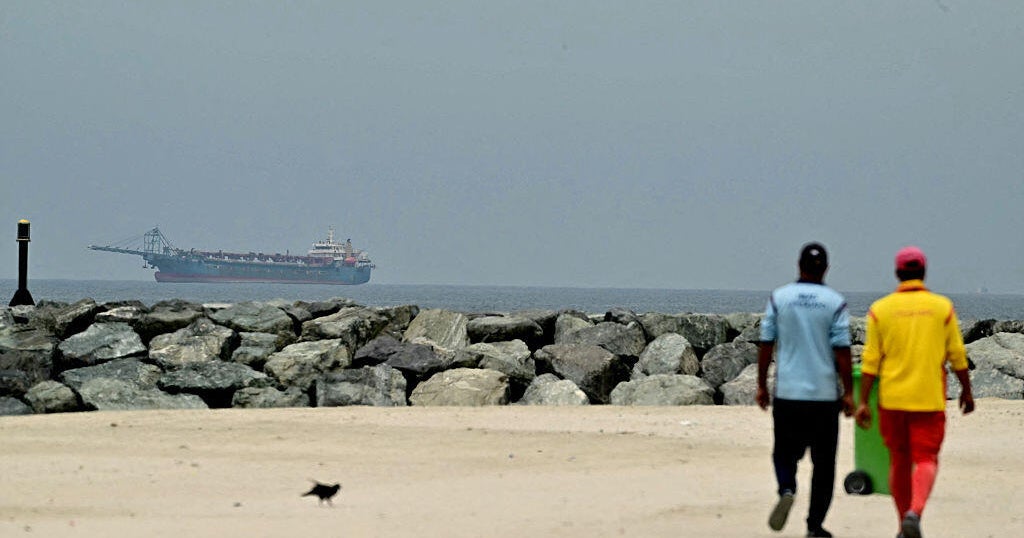
Around one-fifth of global oil and liquified natural gas moves through the Strait of Hormuz, making it one of the most important shipping lanes in the world — and perhaps Iran’s most important strategic lever in its ongoing conflict with the U.S. and Israel.
Pope Leo has responded to President Trump’s attack on him by saying he has “no intention to debate” Mr. Trump on Iran.
On Sunday, Mr. Trump lashed out at the pontiff on social media, calling him “WEAK on Crime, and terrible for Foreign Policy.”
“I don’t want a Pope who thinks it’s OK for Iran to have a Nuclear Weapon,” he added.
Leo had called Mr. Trump’s threat to wipe out Iranian civilization “truly unacceptable” and encouraged people to contact “political leaders … to ask them, tell them to work for peace.”
Speaking to journalists on the papal plane en route to Algeria for the start of his trip to Africa Monday, Leo directly addressed Mr. Trump’s accusations.
“The things that I say are certainly not meant as attacks on anyone, and the message of the Gospel is very clear: ‘Blessed are the peacemakers,'” he said.
“I will not shy away from announcing the message of the Gospel, of inviting all people to look for ways of building bridges for peace and reconciliation, of looking for ways to avoid war any time that’s possible.”
“To put my message on the same plane as what the president has attempted to do here, I think is … not understanding what the message of the Gospel is, and I’m sorry to hear that. But I will continue on with what I believe is the mission of the church in the world,” he said.
“I am not a politician,” Leo added. “I have no intention to debate with [Mr. Trump]. The message is the same: to promote peace.”
The U.K. won’t take part in the planned U.S. blockade of Iran’s ports, Prime Minister Sir Keir Starmer said Monday.
Speaking to BBC News, he said the U.K. was instead focused on getting the Strait of Hormuz — a shipping channel key to global oil and gas supplies — open again to reduce soaring energy prices “as quickly as possible.”
After marathon weekend talks between the U.S. and Iran ended without a peace deal, President Trump posted Sunday that the U.S. would begin “BLOCKADING any and all Ships trying to enter, or leave, the Strait of Hormuz.”
The blockade will include all vessels navigating to and from Iranian ports, including those in the Arabian Gulf and Gulf of Oman, according to the U.S. Central Command.
Since the start of the war, Starmer has ruled out direct British military involvement.
Approximately one-fifth of the world’s oil and liquified natural gas passes through the strait, which Iran has largely cut off since US-Israeli strikes began pumeling the country on Feb. 28.
A senior Pakistani government official has confirmed to CBS News that Islamabad has intensified diplomatic efforts to bring Tehran and Washington back to the negotiating table.
Despite the lack of a breakthrough in the historic face-to-face round of talks over the weekend, Pakistani authorities say they remain cautiously optimistic about the prospects for continued engagement between both sides.
Notably, there appears to be an element of rebranding underway, with officials now increasingly referring to the “Islamabad Talks” as the “Islamabad Process,” a shift that suggests an effort to frame the engagement as an ongoing diplomatic track rather than a one-off meeting.
The top-level source also said Monday that Pakistan is in active contact with both Washington and Tehran, urging them to resume dialogue at the earliest opportunity. The primary objective is to reach a workable understanding before the current ceasefire — set to expire around April 22 — ends, in order to prevent a return to all-out-war. Efforts are now underway to facilitate a second round of talks within this narrow window.
According to the source, these diplomatic initiatives are being pursued under the direct instructions of Pakistan Prime Minister Shehbaz Sharif and Army Chief Field Marshal Asim Munir. Both played a key role in bringing the two sides together, were present at varying times throughout the 21-hours of inconclusive talks and have been working intensely to move the process forward.
CBS News has been told Pakistan is now waiting for responses from both the U.S. and Iran.
President Trump posted on Truth Social shortly after midnight EDT Monday: “The United States to Blockade Ships Entering or Exiting Iranian Ports on April 13 at 10:00 A.M. ET. Thank you for your attention to this matter! President DJT.”
Mr. Trump has also said the U.S. will blockade the Strait of Hormuz. Iran has been controlling traffic through the narrow waterway vital for shipping oil, fertilizer and other important goods, with only a fraction of the usual number of ships passing since the war began.
But the U.S. Central Command says the U.S. Navy won’t stop vessels heading through the strait to and from non-Iranian ports.
The U.S. moves would come after marathon talks in Islamabad over the weekend among U.S., Iranian and Pakistani negotiators failed to reach agreement on ending the Mideast war.
Iran’s military says a U.S. naval blockade set to begin Monday would be illegal and amount to piracy, warning that no Gulf ports would be safe if its own are threatened.
“The restrictions imposed by criminal America on maritime navigation and transit in international waters are illegal and constitute an example of piracy,” said a statement issued by the Iranian military’s central command center, Khatam Al-Anbiya, that was read on state television.
“If the security of the Islamic Republic of Iran’s ports in the waters of the Persian Gulf and the Arabian Sea is threatened, no port in the Persian Gulf and the Arabian Sea will be safe,” it added.
President Trump lashed out at Pope Leo XIV in a lengthy social media post Sunday night, calling the pontiff “WEAK on Crime, and terrible for Foreign Policy” adding, “I don’t want a Pope who thinks it’s OK for Iran to have a Nuclear Weapon.”
Leo has been critical of the war in Iran and has previously made statements at odds with other priorities of the Trump administration, such as the ongoing crackdown on illegal immigration.
Mr. Trump repeated several of his thoughts on Leo to reporters Sunday night after arriving back in Washington, D.C., saying, “We don’t like a pope who says it’s OK to have a nuclear weapon.”
Leo had called Mr. Trump’s threat to completely destroy Iranian civilization “truly unacceptable,” and encouraged people to “contact the authorities — political leaders, congressmen — to ask them, tell them to work for peace and to reject war, always.”
On Saturday, while he did not mention Mr. Trump by name, Leo said during a prayer vigil for peace at St. Peter’s Basilica, “Enough with the idolatry of self and money! Enough with the display of force! Enough with war! True strength is manifested in serving life.”
Iranian authorities executed at least 1,639 people in 2025, the highest number since 1989, two non-governmental organizations said Monday, warning it risked using capital punishment even more extensively after protests in January and the war against Israel and the U.S.
The number of executions represented an increase of 68 percent from the 975 people Iran put to death in 2024 and included 48 women who were hanged, the Norway-based Iran Human Rights (IHR) and Paris-based Together Against the Death Penalty (ECPM) said in their annual joint report.
If the Islamic Republic “survives the current crisis, there is a serious risk that executions will be used even more extensively as a tool of oppression and repression,” the report said.
IHR — which requires two sources to confirm an execution, the majority of which are not reported in Iranian official media — said the figure represented an “absolute minimum” for the number of hangings in 2025.
The report said the number of executions was by far the highest since IHR began tracking it in 2008 and was the most reported since 1989, in the early years of the Islamic revolution.
The NGOs also warned that “hundreds of detained protesters remain at risk of death sentences and execution” after being charged with capital crimes over January 2026 protests against the authorities — quashed by a crackdown that rights groups say left thousands dead and tens of thousands arrested.
“By creating fear through an average of four to five executions per day in 2025, authorities tried to prevent new protests and prolong their crumbling rule,” said IHR director Mahmood Amiry-Moghaddam.
Hours after President Trump claimed other countries would join the U.S. blockade of the Strait of Hormuz, a senior NATO military official told CBS News, “The U.K. is leading planning efforts of a coalition comprised of more than 40 nations from around the world, many of which are from NATO, to reopen the Strait of Hormuz and protect freedom of navigation.”
The official did not provide specific details on what that might look like, but said, “They are discussing what to do and when to do it, including the pre-positioning of assets now.”
Mr. Trump has been highly critical of NATO throughout the war. He told reporters Sunday night, “I’m very disappointed in NATO, they weren’t there for us. We pay trillions of dollars for NATO, and they weren’t there for us.”
Iranian parliament speaker Mohammad Bagher Qalibaf posted a map of gas stations near the White House, saying, “Enjoy the current pump figures.”
“With the so-called ‘blockade’, Soon you’ll be nostalgic for $4–$5 gas,” Qalibaf said on X.
As the situation in the Strait of Hormuz sends global energy costs skyrocketing, AAA reports the price of a gallon of regular has increased 40% since the day before the war with Iran began.
When asked in an interview with Fox News on Sunday if the price of oil and gas will be lower before the midterm elections in November, President Trump said: “It could be, or the same, or maybe a little bit higher, but it should be around the same.”
Vice President JD Vance landed back in Washington Sunday afternoon after a 56-hour Pakistan journey for high-level talks with Iran in Islamabad. No deal was reached during the talks.
He made phone calls from Air Force Two on his trip back from Pakistan, including to Israel’s ambassador to the U.S., according to a U.S. government official.
The U.S. and Iran did not reach agreements on several of America’s red lines to end the war during the first round of negotiations, according to a U.S. official.
The official said Iranian delegates could not agree on Iran ending uranium enrichment, dismantling major nuclear enrichment facilities, allowing the retrieval of its highly enriched uranium, accepting a framework for broader peace, security and deescalation that includes regional allies, ending funding for Hamas, Hezbollah, and the Houthis, and fully opening the Strait of Hormuz without charging passage tolls.
wp:paragraph
هلدینگ کاسپین استانبول | خرید ملک در ترکیه | صرافی معتبر ایرانی در ترکیه | خرید و فروش طلا در ترکیه | مهاجرت به ترکیه | واردات و صادرات در ترکیه | نیازمندیهای ترکیه | اخبار ترکیه | اخبار جهانی | توریست ایران | خدمات توریستی در ایران | تورهای گردشگری ایران | هلدینگ اول | خدمات کاریابی و فریلنسری و شغل | مرجع اطلاعات ایران (همه چیز در ایران) | کیف پول و خدمات مالی و پرداخت یار | اخبار ایران | تابلو زنده قیمت ارز در ترکیه و استانبول | صرافی آنلاین ترکیه | قیمت طلا و نقره در ترکیه | سرمایه گذاری در ترکیه | جواهرات در ترکیه | نرخ لحظه ای ارزها در استانبول | قیمت دلار امروز در ترکیه | قیمت دلار استانبول امروز | قیمت لحظه ای دلار | اخبار روز ترکیه استانبول | اپلیکیشن ISTEX | اپلیکیشن قیمت لحظه ای دلار و یورو و لیر و ارزها در ترکیه
/wp:paragraph wp:paragraph /wp:paragraph
About the Author