The defense secretary’s remarks come despite the fact that both chambers have passed a war powers resolution that urges the president to seek congressional authorization to continue military operations in Iran.
While answering questions by Republican senator Lisa Murkowski of Alaska, Hegseth said that his department thinks “standalone Article II authorities exist for us to conduct this operation on behalf of the defense of the American people”. The defense secretary evaded the lawmaker’s question about whether he would use the approval of any supplemental funding as a “substitute for explicit congressional authorization”.
At the ongoing Senate Appropriations Committee hearing, senator John Kennedy, a Louisiana Republican, pressed US defense secretary Pete Hegseth to say whether the US military could bomb a fortified underground site linked to Iran’s nuclear program known as Pickaxe mountain, which the US has not yet targeted.
“We need straight answers,” Kennedy said with some exasperation. “Do we have the ability to destroy whatever is underneath Pickaxe mountain?”
“Senator, a lot of our capabilities are classified, but if anybody in the world can reach anything on God’s given, God’s green Earth, it’s the United States military,” Hegseth replied.
Kennedy’s question was perhaps triggered by reports that experts suggest the site is beyond the reach of the most powerful bunker buster bombs in the US arsenal.
Donald Trump was asked by a reporter earlier on Tuesday if he believes an Israeli intelligence assessment that Iran has moved nuclear centrifuges into tunnels deep inside the mountain, called Kolang Gaz La in Persian, which is about a mile from Iran’s badly damaged Natanz uranium enrichment facility.
“I think that they may have; we don’t have it on record,” Trump replied, before veering into a digression to cast the speculation about the mountain as possibly flawed reporting from news outlets. “All we do is read the fake news, you know, we see… the news is so wrong so many times, so you know, maybe this one they have right.”
“It doesn’t mean anything unless they have the material. You’re talking about the centrifuges,” Trump added. “We follow the material, that’s where the action is, and we’ll be hitting that area very, probably pretty soon and very heavily.”
According to the nonpartisan Institute for Science and International Security think tank in Washington, this site was “not visibly attacked” by US bombers in 2025, when US bombers dropped two two GBU-57 bunker buster bombs on the nearby nuclear facility at Natanz.
“Iran announced in 2020 that the purpose of the Pickaxe tunnel complex is to hold an advanced centrifuge assembly facility that can produce several thousand centrifuges a year,” the institute reported last year. “In addition, based on the estimated size of the underground halls, the Institute several years ago assessed that site could also hold a centrifuge enrichment facility.”
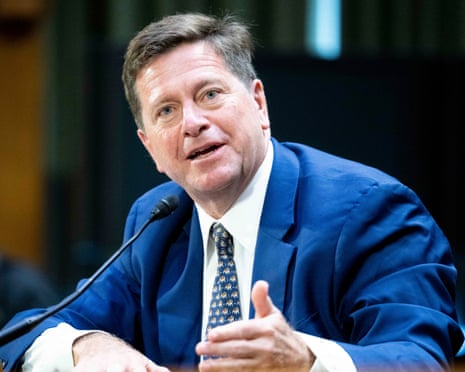
The Senate intelligence committee on Tuesday advanced the nomination of Jay Clayton to serve as the US intelligence director, despite criticism from Democrats.
Donald Trump had nominated Clayton, now the top federal prosecutor in the southern district of New York, for the role of the director of national intelligence (DNI) last month after the departure of Tulsi Gabbard.
Intelligence committee members questioned Clayton at a hearing last week, and its Republican chair, Tom Cotton, announced that it had reported his nomination favorably by a 9-8 vote, teeing him up for a future vote on his confirmation by the full Senate.
“Jay Clayton is a highly qualified nominee with a deep experience combatting a wide range of national security threats,” Cotton said in a statement.
“I’m pleased that the Senate Intelligence Committee voted to advance his nomination to be Director of National Intelligence,” he added.
Cotton did not provide a breakdown of how lawmakers voted. The committee is composed of nine Republicans and eight Democrats, and a spokesperson for the Democratic vice-chair, Mark Warner, said he had opposed the nomination.
At his hearing last week, members of the Democratic minority criticized Clayton, a former Wall Street attorney who served as chair of the Securities and Exchange Commission (SEC), for refusing to say that Joe Biden won the 2020 election. He also faced questions about previous statements he made echoing Trump’s claim that US elections have been marred by fraud, and concerns about politicization at the office of the DNI, which serves to coordinate the nation’s intelligence agencies.
At the Senate Appropriations Committee hearing, Dan Caine, the chairman of the joint chiefs of staff, was asked by senator Jack Reed, a Rhode Island Democrat and veteran who previously taught economics and international relations at West Point, whether Iran can be deterred and defeated by “air strikes alone”.
“I think, academically, as you look across the totality of history, air power’s got limits, and we always have to be mindful of those,” Caine responded.
He went on to say that the US is combing military power with “the totality of the diplomatic, informational and economic” measures. “There’s a loot of that work going on, sir,” Trump’s hand-picked joint chiefs chair added.
Reed then asked if Caine anticipates the next step in escalation: ground troops.
“Sir, I think it would be unhelpful for me to opine on hypotheticals,” Caine replied. He added that the Pentagon’s job was to develop military options, and understand the risks associated with them. “My main job is to always ensure that leaders understand those options and the risks,” Caine added.
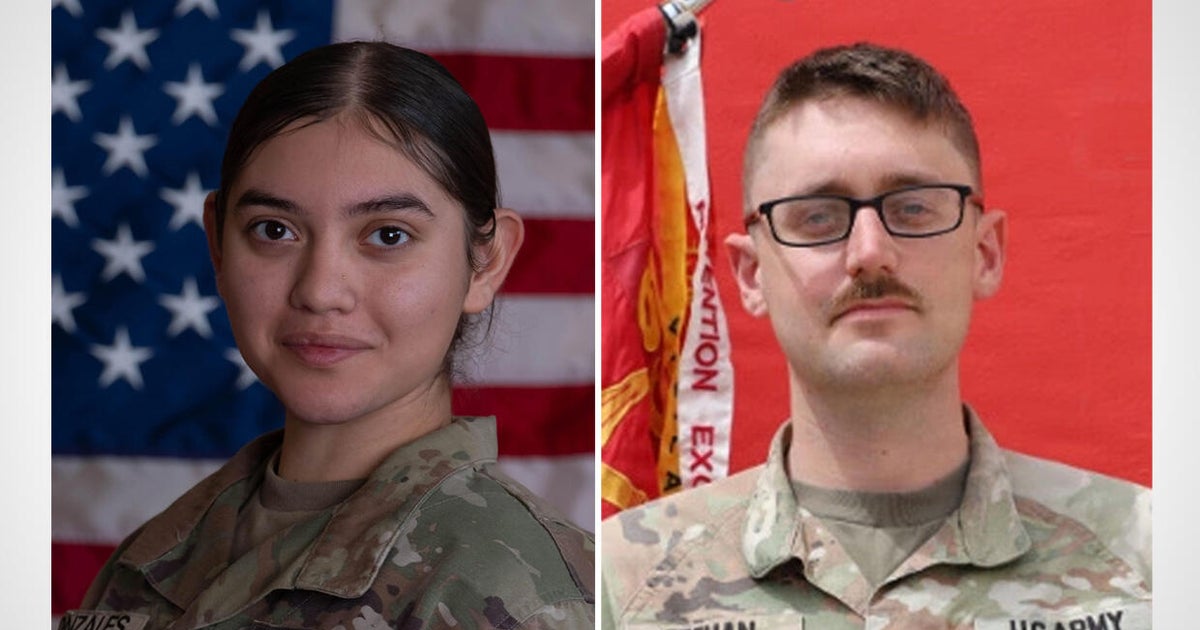
Hegseth has yet to make reference to the deaths of the three US service members last week in the Iran conflict.
In his opening remarks Dan Caine, the chairman of the joint chiefs of staff, asked the senators and American public to “never forget our fallen and their families, who continue to show us what courage, tenacity, grit, and commitment to the nation looks like”.
The defense secretary’s remarks come despite the fact that both chambers have passed a war powers resolution that urges the president to seek congressional authorization to continue military operations in Iran.
While answering questions by Republican senator Lisa Murkowski of Alaska, Hegseth said that his department thinks “standalone Article II authorities exist for us to conduct this operation on behalf of the defense of the American people”. The defense secretary evaded the lawmaker’s question about whether he would use the approval of any supplemental funding as a “substitute for explicit congressional authorization”.
Hegseth responded to a question from Senator Susan Collins – the chair of the appropriations committee – about the impact on military exercises if the supplemental funding is not provided.
The defense secretary said that current and future training “would have to be curtailed” if the Pentagon does not get its budget needs met urgently.
“This $1.5tn dollar budget with this supplemental being part of it is how we catch up and get ahead, and ensure in the process we’re putting soldiers and sailors and airmen first, marines first … So rather than trying to play catch up and make sure we’re not losing training. We should be ahead of that curve,” Hegseth added.
-
Defense secretary Pete Hegseth and joint chiefs of staff chairman Dan Caine are now testifying in front of lawmakers on the Senate appropriations committee about Trump’s $88bn supplemental funding request, which would help pay for the war in Iran. Hegseth, said that without the funds he is requesting from Congress today, the Pentagon will face “critical shortfalls” that threaten our ability to “pay our service members, rapidly replenish equipment and munitions, and sustain vital operations without disruption”.
-
In the Oval Office today, Donald Trump defended the new 50% tariffs on most Canadian goods. “Canada has been very, very tough on us over the years,” Trump said. “In all fairness to them, they need us to survive. Without us, there’s no way they can survive.” Mark Carney, Canada’s prime minister, said that he spoke with Trump earlier on Tuesday. “We agreed to intensify negotiations in the coming weeks, and the team and myself look forward to doing that,” Carney told reporters.
-
During the same appearance, while meeting with Lebanon’s president Joseph Auon, Trump continued to give mixed-messages about the status of the Iran conflict. He noted that the US has decimated Tehran’s military capabilities, but the conflict will not end soon.“We have done damage that will take them 25 years to recover from. So, if we left tomorrow, we had a big success. But we’re not leaving tomorrow,” Trump said.
-
The Trump administration has paused more than $1bn in Medicaid funding to California and Minnesota, citing “suspected fraud and noncompliance”. “If those states want that money, they need to provide documentation that these payments are legitimate,” said Robert F Kennedy Jr, secretary of the Department of Health and Human Services (HHS), said at a press conference on Tuesday. The pause includes more than $867m for California and about $200m for Minnesota.
Pete Hegseth, said that without the funds he is requesting from Congress today, the Pentagon will face “critical shortfalls” that threaten our ability to “pay our service members, rapidly replenish equipment and munitions, and sustain vital operations without disruption”.
He explained that this supplemental request is not a “substitute” for the $1.5tn the Pentagon is asking for in the next fiscal year.
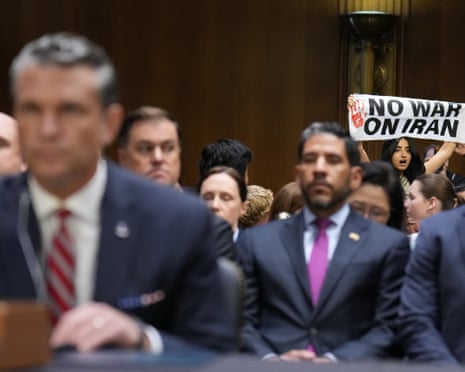
Pete Hegseth’s testimony before Senate lawmakers was quickly interrupted, on a number of occasions, by anti-war protesters in the hearing room.
Collins paused the proceedings as a result, and called on the Capitol police to remove those interrupting the hearing.
Patty Murray, the top Democratic senator on the appropriations committee, has slammed the latest White House funding request for the Iran war.
“Our country is no safer or better off than before the war. In fact, we are considerably less safe,” Murray said. “Our stockpiles have been depleted, and it will take years of production to fully replenish them … and we are now much further away from a long-term solution to halt Iran’s nuclear program than we were before Trump ripped up the deal that President Obama negotiated, which secured actual, measurable commitments and progress without ever starting a costly war.”
Murray noted that in the five months since the war began, the strait of Hormuz– which was open prior to the conflict – is still closed.
“This war is now spiraling out of control again. The president is threatening escalation and war crimes, and suggesting this could be another forever war,” she said. “[Trump] has told us over 40 times now that a deal is ‘near’ and the war will ‘be over soon’. But now he is asking for 70 billion dollars more, and for us to just trust him.”
The hearing where defense secretary Pete Hegseth and chairman of the joint chiefs of staff Dan Caine will testify before Senate appropriations lawmakers, and explain their request for $80bn in supplemental funding for the Iran, has started.
The committee chair – Republican senator Susan Collins – kicked off by noting that “irrespective of our differing views about the military operations”, there are “must-pay bills and urgent requirements facing the department that affect the ability of our troops to be well trained”.
Collins – a noted moderate who is facing a reelection battle in her state of Maine – also pointed to “deeply troubling” reports that dozens of senior officers removed from promotion lists, many of whom appear to women and people of color. “This is likely to discourage well-qualified women and individuals of color from joining our armed forces, thus depriving us of their talent, dedication, and patriotism,” Collins said in her opening remarks. “The United States military is one of the greatest meritocracies in the free world. We need to make sure that it stays that way.”
Later today we can also expect a vote on Jay Clayton’s nomination to lead the national intelligence agencies.
A reminder that Clayton – who serves as the US attorney for the southern district of New York – testified before lawmakers on the Senate intelligence committee last week. During the hearing Trump’s pick to be the country’s next intelligence chief refused to say that Joe Biden won the 2020 election. He also evaded questions about his previous election integrity claims and whether or not a White House official asked him to subpoena a group of New York Times journalists as part of an alleged national security investigation.
On Sunday, the intelligence committee’s top Democrat, Mark Warner, said he would vote against Clayton as the nation’s top spy, to officially replace acting director Bill Pulte – who has received backlash from lawmakers on both sides of the aisle for his lack of experience in the intelligence community.
“I’ve known Jay for a long time. I like Jay. I worked well with him when he was at the SEC [Securities and Exchange Commission]. But I was bitterly disappointed by his performance in front of my committee,” Warner told CBS News.
The Trump administration has paused more than $1bn in Medicaid funding to California and Minnesota, citing “suspected fraud and noncompliance” – withholding of funding that follows a $243m pause in Medicaid payments to Minnesota earlier this year.
“If those states want that money, they need to provide documentation that these payments are legitimate,” said Robert F Kennedy Jr, secretary of the Department of Health and Human Services (HHS), said at a press conference on Tuesday.
Officials relied on AI to identify potential fraud, Kennedy said. “We used AI, advanced analytics, and other cutting-edge tools to identify suspicious activity and potential fraud.”
The pause includes more than $867m for California and about $200m for Minnesota.
In California, most of the suspected fraud was in in-home services, he said. Kennedy has several times singled out in-home care provision, which can be a lifeline for disabled individuals – rhetoric that has worried families and angered lawmakers.
Vice-President JD Vance threatened in March to withhold funding to states if they did not cooperate with a new fraud taskforce, headed by Vance and established by a White House executive order.
The Guardian wp:paragraph
هلدینگ کاسپین استانبول | خرید ملک در ترکیه | صرافی معتبر ایرانی در ترکیه | خرید و فروش طلا در ترکیه | مهاجرت به ترکیه | واردات و صادرات در ترکیه | نیازمندیهای ترکیه | اخبار ترکیه | اخبار جهانی | توریست ایران | خدمات توریستی در ایران | تورهای گردشگری ایران | هلدینگ اول | خدمات کاریابی و فریلنسری و شغل | مرجع اطلاعات ایران (همه چیز در ایران) | کیف پول و خدمات مالی و پرداخت یار | اخبار ایران | تابلو زنده قیمت ارز در ترکیه و استانبول | صرافی آنلاین ترکیه | قیمت طلا و نقره در ترکیه | سرمایه گذاری در ترکیه | جواهرات در ترکیه | نرخ لحظه ای ارزها در استانبول | قیمت دلار امروز در ترکیه | قیمت دلار استانبول امروز | قیمت لحظه ای دلار | اخبار روز ترکیه استانبول | اپلیکیشن ISTEX | اپلیکیشن قیمت لحظه ای دلار و یورو و لیر و ارزها در ترکیه
/wp:paragraph wp:paragraph /wp:paragraph
About the Author