Quitobaquito Springs in south-west Arizona has been called a biological wonderland with few equals.
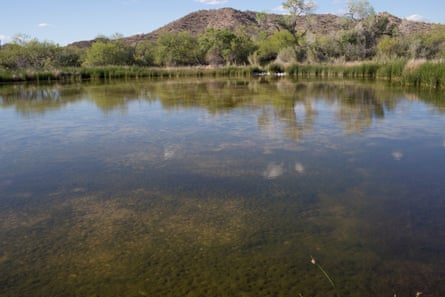
The springs are an oasis in the vast Sonoran desert along the US-Mexico border, held sacred by the O’odham people, who call it A’al Vaipia. Here, water flows out of an aquifer at the bottom of a hill, runs along a short concrete channel and collects in a pond.
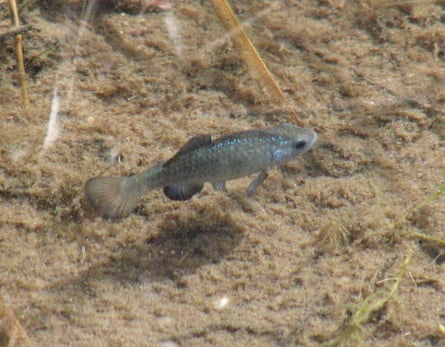
The pond is home to Sonoyta pupfish, which are small and silvery, with upturned jaws. In the channel are found small mollusks the size of chia seeds known as springsnails. This is the only place on Earth where these two species live in the wild. It’s also the only US habitat for the Sonoyta mud turtle, a reptile with a domed shell and the ability to survive amid scarce desert water sources.
The spring, located within Organ Pipe Cactus national monument, provides one of the only reliable bodies of water for about 100 miles in any direction, making it vital for wildlife in the area and for humans who have lived here for millennia.
But the spring is in trouble.
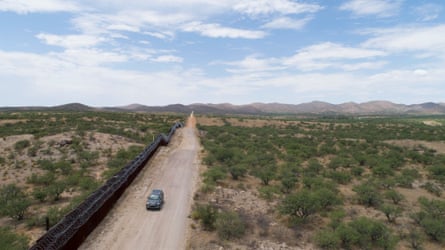
In 2020, the Trump administration completed a 30ft-tall (9 meters) border wall in this remote area, during which time the spring flow dipped to an all-time low, and the pond partially dried up after its lining cracked. Now, plans are under way to build a second massive section of the wall, just 90-150 feet north of the existing one.
That’s despite border crossings in the area being negligible – the vast majority of people who cross into the country in such remote areas intend to be apprehended so they can apply for asylum, immigration experts report.
The planned secondary wall will be made of steel beams, or bollards, also 30ft tall. Similarly designed stretches of secondary or primary fencing are currently under construction at about six other locations on the Arizona-Sonora border, according to Erick Meza, borderlands coordinator with the Sierra Club. “I’ve never seen something of this magnitude,” Meza said. “It’s unbelievable.”
Researchers, environmentalists and Indigenous leaders warn the project will cause untold damage to this fragile, remote wilderness and the animals that call it home.
The southern edge of the pond lies 190ft from the border with Sonora, meaning part of the pond would likely be destroyed by heavy machinery necessary for putting up the barrier.
Even closer to the line is a grove of mesquite trees, which is part of the federally recognized critical habitat for the mud turtle, where the animals often burrow. That would likely be leveled by construction.
Putting up a second wall in this place could be catastrophic, said Tara Harris, director of conservation and science at the Phoenix Zoo, who fears the planned construction “could destroy the last remaining habitat for multiple imperiled species”.
Illegal immigration in the area of Organ Pipe has been extremely minimal since 2025, according to local residents.
In 2023 and 2024, tens of thousands of immigrants seeking asylum came through the wall into Organ Pipe, showing that this barrier doesn’t stop determined people. But those numbers dwindled to almost nothing after the Biden administration sharply limited asylum-seeking.
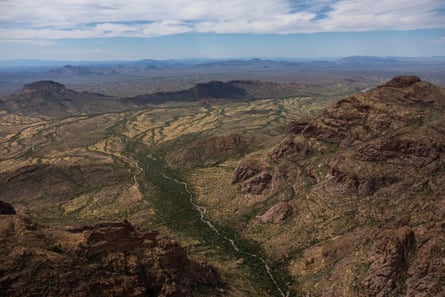
Already, 34 miles (54km) of secondary barriers have been completed along the US-Mexico border, much of that in Arizona, creating a line of two 30ft walls right next to each other. Another 390 miles of these barriers are under construction, and 155 miles have been awarded contracts, including the stretch in Organ Pipe Cactus, according to the Department of Homeland Security’s Customs and Border Protection (CBP).
This kind of construction would normally require extensive consultations and studies to adhere with laws including the Native American Graves Protection and Repatriation Act, the Endangered Species Act and the National Environmental Policy Act. But the 2005 Real ID Act gives the head of the Department of Homeland Security the authority to waive these and many other laws.
The specialness of A’al Vaipia cannot be overstated, said Wynona Larson Yazzie, an O’odham elder and community organizer: it has been a home, gathering place and sacred site for water and ceremonies since time immemorial.
The plans to build these barriers throughout the area are “sickening”, she said.
A race to save rare turtles and fish
DHS awarded a contract in late May to a company called Sundt Construction to build the new wall section in Organ Pipe Cactus, according to the agency, and work could begin at any moment. Locals have observed contractors surveying the area and setting up flagging and other signs the construction may begin soon.
Now, researchers are urgently making plans to save the area’s wildlife.
Michael Bogan, an aquatic ecologist with the University of Arizona, leads the recovery team for the Sonoyta mud turtle, and is collaborating with researchers including Harris. Right now, the team is evaluating every option, including the most dire, in which as many of the animals as possible would be taken out, and housed in artificial habitats. The pond is home to about 250 turtles, he said.
The only current backup population for the turtle lives at the Arizona-Sonoran Desert Museum, which has 20 of the turtles, said Tom Weaver, the herpetology curator. Their institution is being asked to take up to 50 turtles if need be, which the organization said they’re willing to do, despite the enormous work involved.
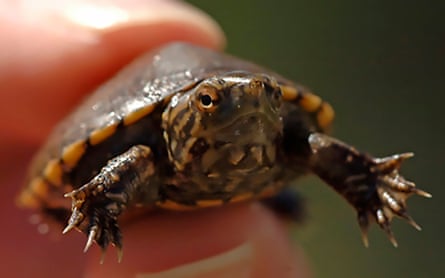
The Phoenix Zoo said they would also take turtles. The organization currently has a population of Quitobaquito springsnails housed in two tanks – the species’ only backup population. The size of their only wild habitat, at the spring, “could fit into the area of three parking spaces. So they’re just incredibly vulnerable,” Harris said.
As for the pupfish, there are about five captive backup groups, including in a pond by a learning center in Tucson.
While animals can be held temporarily, researchers emphasized that this is not a long-term solution. “Our main concern is that there’s a place for them to go back to,” said Debra Colodner, director of conservation science at the Arizona-Sonoran Desert Museum.
The area has already suffered damage from the first wall’s construction in 2020.
The existing barrier has cut off important wildlife corridors, where animals from jaguars to black bears to deer pass between the US and Mexico. During the 2020 construction, the bottom of the pond cracked and much of it dried up. The pond had to be re-lined, during which time some of the aquatic wildlife were temporarily moved by researchers, including Bogan. The flow of the springs also declined to the lowest measure on record. Many blame the digging, heavy traffic and water pumping and worry the impacts this time will be much worse, Bogan said.
Contractors use massive quantities of groundwater to create cement for the base of the wall. CBP previously estimated that a single mile of fencing built nearby in 2008 used 710,000 gallons of water; the current project might use more since the new structures are larger.
The aquifer that feeds the springs is likely fed both by extremely old groundwater and water from the Rio Sonoyta to the south, according to a thesis by hydrologist Hector Zamora. So groundwater pumping nearby could deplete the aquifer, and if the water table declines to a level below where water exits the spring, it will run dry.
“That’s the concern that keeps me up,” Bogan said.
John Mennell, a spokesperson for CBP, said in a brief statement that the agency was “working with the US Fish and Wildlife Service and National Park Service to avoid Quitobaquito Springs and minimize impacts to sensitive resources”. But CBP declined to respond to any follow-up questions. When asked about the environmental concerns, Sundt Construction and the national park service, which runs the monument, both referred questions to CBP.
CBP said they will not pump within five miles of the springs; they said the same in 2020. But there is no data to suggest that this will be enough to protect it, and indeed, a significant portion of the water probably comes from farther away than that, according to Zamora.
Aaron Cooper, executive director of the International Sonoran Desert Alliance, a non-profit group that works to protect the cultural resources and ecology of the borderlands, said that CBP had provided almost no information about what it was planning, even as workers had been seen on the border seeming to make preparations for the work.
“I have never seen anything with so little planning and oversight, of this scale and scope,” Cooper said. “No outreach, no messaging, no comment periods, absolutely nothing. Radio silence.”
‘Reckless behavior could destroy that place’
Beyond the environmental concerns, many fear more damage to a sacred and historically important Indigenous site.
As recently as the 1950s, the area was home to members of the Hia-Ced O’odham, a subset of the larger O’odham community, who were pushed out when the land was purchased by the national park service.
The springs have always served as a way station on the traditional O’odham route to the Sea of Cortez, where people go to gather salt, according to Christina Bell Andrews, a Hia-Ced O’odham leader and the director of the Wassaja Center for Native American Health at the University of Arizona. Andrews said that building a second wall there would destroy much of the on-site cemetery, and desecrate more than 40 gravesites.
In April, Larson Yazzie was leading a group of O’odham people on a prayer run along the border. The group spent the night at the springs, and headed west. A couple days later, they witnessed a bulldozer clearing land in a protected area, a sacred earthwork known as an intaglia, which is 200ft long, 1,000 years old and shaped like a fish, pointing south toward the sea.
They soon realized that contractors had destroyed a big chunk of the intaglia.
“Some people took that as a sign of what could happen at Quitobaquito. Such reckless behavior could destroy that place,” said Russ McSpadden, a conservation advocate at the Center for Biological Diversity.
O’odham people regularly visit the spring, including for spiritual ceremonies. The only feasible way to access the site for most vehicles is a road that runs parallel to the current border wall, Puerto Blanco Drive. The secondary wall is likely to block off this access road, which might force people to use a much longer route along a primitive road that requires a high clearance vehicle, Cooper said, turning an hour’s journey from the visitor’s center into an all-day one.
Already, construction-related traffic has made traveling more difficult than before. “It’s total chaos,” Bogan said.
Federal officials have told people in the area that the road could be closed as soon as next week to accommodate contractors working on border barriers, both in Organ Pipe Cactus national monument and to the west in Cabeza Prieta national wildlife refuge.
“It’s too much for us right now. It’s overwhelming,” said Larson Yazzie. “And everybody needs to know what’s happening.”
The Guardian wp:paragraph
هلدینگ کاسپین استانبول | خرید ملک در ترکیه | صرافی معتبر ایرانی در ترکیه | خرید و فروش طلا در ترکیه | مهاجرت به ترکیه | واردات و صادرات در ترکیه | نیازمندیهای ترکیه | اخبار ترکیه | اخبار جهانی | توریست ایران | خدمات توریستی در ایران | تورهای گردشگری ایران | هلدینگ اول | خدمات کاریابی و فریلنسری و شغل | مرجع اطلاعات ایران (همه چیز در ایران) | کیف پول و خدمات مالی و پرداخت یار | اخبار ایران | تابلو زنده قیمت ارز در ترکیه و استانبول | صرافی آنلاین ترکیه | قیمت طلا و نقره در ترکیه | سرمایه گذاری در ترکیه | جواهرات در ترکیه | نرخ لحظه ای ارزها در استانبول | قیمت دلار امروز در ترکیه | قیمت دلار استانبول امروز | قیمت لحظه ای دلار | اخبار روز ترکیه استانبول | اپلیکیشن ISTEX | اپلیکیشن قیمت لحظه ای دلار و یورو و لیر و ارزها در ترکیه
/wp:paragraph wp:paragraph /wp:paragraph
About the Author