When the late Republican Senator John McCain ran for president in 2008 against former U.S. President Barack Obama, he had to tame some of his supporters who harbored brazenly racist and particularly Islamophobic views. Despite McCain’s own bigotry and his extremely hawkish foreign policy, which itself required at least an implicit form of racism, even he was baffled by just how unhinged his voter base was.
At one of his campaign rallies, a woman in the audience stood up and expressed grave concern, lamenting that she “can’t trust Obama.” And the reason was really quite simple: “I have read about him, and he’s not … He’s an Arab.” As she finished her sentence, her voice cracked, the prospect that “an Arab” might become president almost bringing her to tears.
McCain had to intervene at this point, saying, “No, ma’am. He’s a decent family man, a citizen, that I just happen to have disagreements with on fundamental issues, and that’s what this campaign is about.”
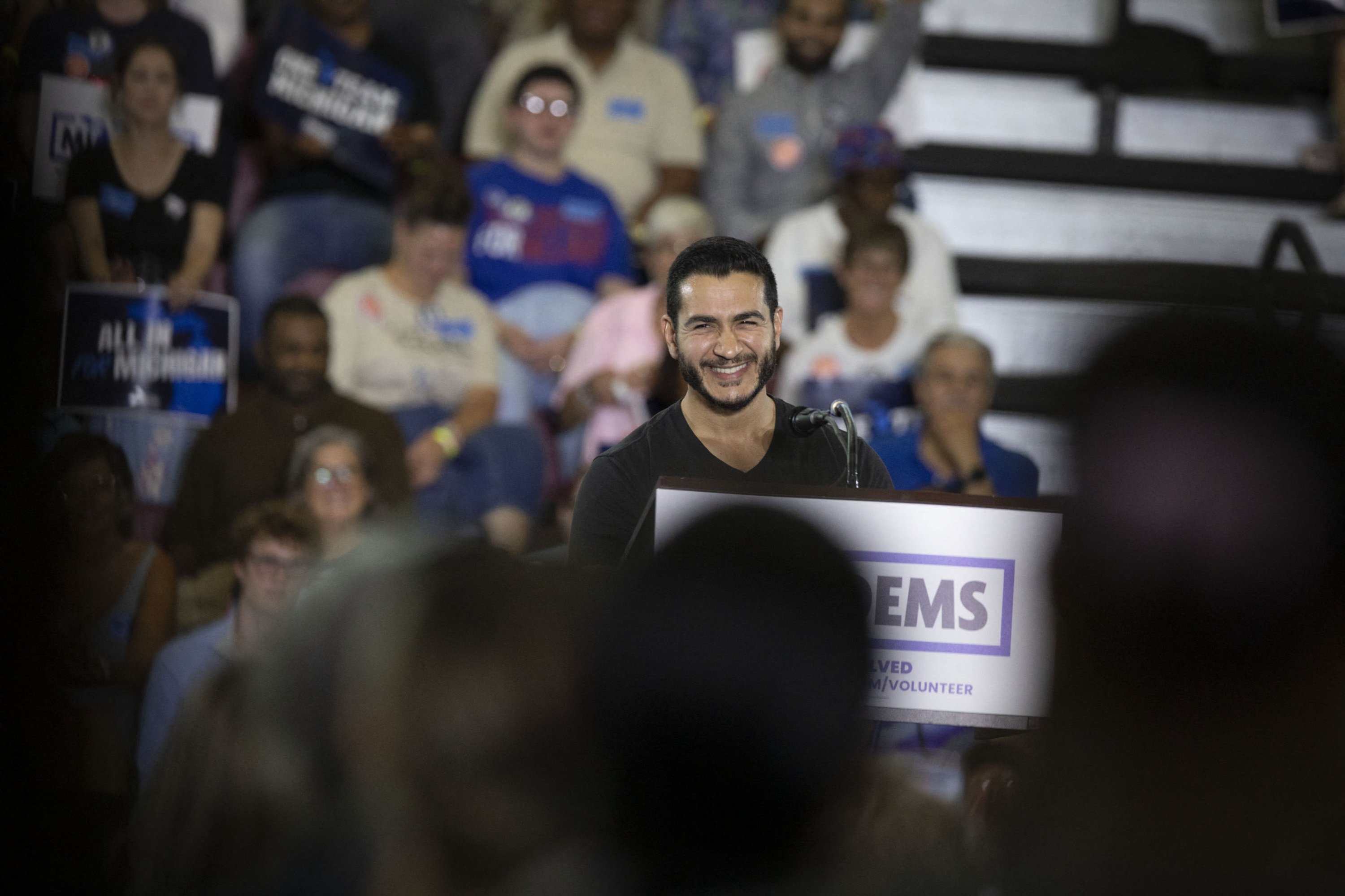
Nowadays, however, election campaigns in the U.S., by and large, seem to be exactly about things that that woman was so clearly concerned about. It is for this reason, for example, that Senate Republicans chose to attack the Democratic Party candidate for Senate in Michigan, Abdul El-Sayed, by simply drawing attention to his name: “Michigan socialist finally introduces himself with his full name: Abdulrahman Mohamed El-Sayed.”
Of course, what this was supposed to imply was left entirely to the imagination of their already heavily propagandized and prejudiced voters. If “an Arab” becoming president was a concern, then a “Mohamed” becoming president would presumably be even worse.
Indeed, the attacks on El-Sayed have been so vicious that high-profile political figures have not hesitated to label him a “terrorist.” His Republican rival in the race, Mike Rogers, boasted in this context that he had spent his life “hunting terrorists.”
In the same spirit, Republican Congresswoman Nancy Mace, with both El-Sayed and New York City Mayor Zohran Mamdani in mind, complained thus: “Can we stop electing terrorists into office in America?” Her follow-up comment made what she meant by “terrorists” even clearer: “Every single Muslim holding public office in America is a Trojan horse, and a threat to both national security and our republic.”
Comments like these are abundant, coming from both politicians and political commentators. When Mamdani’s father, Mahmood Mamdani, wrote his influential book “Good Muslim, Bad Muslim,” one could at least have hoped that there was such a thing as being a “good Muslim” in the eyes of the decision-makers, that by denouncing “extremism,” one could escape the attacks.
Today, unless one absolutely hates Islam, there seems to be no hope at all. In fact, even that might not be enough to stop the smears. The fact that someone like former CIA Director Mike Pompeo can so casually call El-Sayed a “Hamas supporter” shows that the requirements extend even further.
One such requirement is devotion to Israel, a requirement that El-Sayed’s primary opponent, Haley Stevens, had no difficulty fulfilling. She had previously revealed that Israel would come to her in her dreams. In contrast, El-Sayed has been vocal in his criticism of that country for its genocide in Gaza.
This, too, appears to be part of the increasingly narrow definition of what constitutes a “good Muslim” in American political life, if such a category exists at all. One must not only distance oneself from “extremism,” but also refrain from opposing Israel in any meaningful way.
The connection is hardly a secret. The neoconservative par excellence Robert Kagan recently admitted as much when he said: “America is broadly Islamophobic, and so any enemy of Islam is a friend of ours for many Americans. I think Islamophobia is a reality in the U.S., and Israel is supposed to be the bulwark against Islam.” And, importantly, this logic does not stop at Muslims. To criticize that “bulwark against Islam” can also make one a “bad Jew.”
One of the most prominent Israel activists, Alan Dershowitz, recently attacked those “bad Jews” who dare to support candidates like El-Sayed and Mamdani. “The real problem are the Jews,” he declared, referring to what he called “these idiot Jews” who “have no idea what they are doing.” According to Dershowitz, “Any Jew who votes for Mamdani is a self-hater.” He was joined in this sentiment by U.S. Ambassador to Israel Mike Huckabee, who as a gentile described himself as “a much more effective Jewish leader” than those “bad Jews” who “do not say what Mamdani is, and that is an anti-Semite.”
Note that this phenomenon is not uniquely American either. Violinist Michael Barenboim has observed that “In Germany, Jews who reject Zionism are seen as not really Jewish,” while the British Jewish Chronicle published an article asking, “So just how Jewish is Ed Miliband?” The message is remarkably consistent across the West: Being a “good Muslim” or a “good Jew” apparently requires not only unwavering devotion to Israel, but hostility toward those Muslims who oppose its genocidal actions.
DAILYSABAH
هلدینگ کاسپین استانبول | خرید ملک در ترکیه | صرافی معتبر ایرانی در ترکیه | خرید و فروش طلا در ترکیه | مهاجرت به ترکیه | واردات و صادرات در ترکیه | نیازمندیهای ترکیه | اخبار ترکیه | اخبار جهانی | توریست ایران | خدمات توریستی در ایران | تورهای گردشگری ایران | هلدینگ اول | خدمات کاریابی و فریلنسری و شغل | مرجع اطلاعات ایران (همه چیز در ایران) | کیف پول و خدمات مالی و پرداخت یار | اخبار ایران | تابلو زنده قیمت ارز در ترکیه و استانبول | صرافی آنلاین ترکیه | قیمت طلا و نقره در ترکیه | سرمایه گذاری در ترکیه | جواهرات در ترکیه | نرخ لحظه ای ارزها در استانبول | قیمت دلار امروز در ترکیه | قیمت دلار استانبول امروز | قیمت لحظه ای دلار | اخبار روز ترکیه استانبول | اپلیکیشن ISTEX | اپلیکیشن قیمت لحظه ای دلار و یورو و لیر و ارزها در ترکیه
About the Author