In 1985, an engineer in his mid-50s was taking stock of his career. He had spent most of his life in the United States. He had left his homeland, studied at some of the world’s finest universities, and risen through the ranks of Texas Instruments, one of the pioneering companies of the semiconductor industry. His technical expertise, managerial experience, and reputation within the sector were beyond question. Yet he felt that something was missing.
For years, he had contributed to the growth of the American technology industry. However, he believed that he had never truly gained access to the highest levels of corporate decision-making. For many people, his career would have seemed extraordinarily successful. For Morris Chang, it was different. He no longer wanted to be a manager advancing within a system built by others. He was searching for an opportunity to turn his own vision into reality.
At that moment, an unexpected phone call arrived. It did not come from Silicon Valley, but from Taiwan, a small island whose place in the international system was itself contested. The Taiwanese administration was pursuing an ambitious strategy to transform its economic future. Unable to compete with China militarily, limited by its population, and increasingly isolated diplomatically, Taiwan sought another path: becoming indispensable in a technology the world would one day desperately need. To realize that vision, it needed the right leader, and Morris Chang accepted the challenge.
TSMC’s story begins
When he arrived, no technology giant was waiting for him, only government support, research institutions, talented engineers and a long-term vision. Chang added the missing piece. At a time when technology companies both designed and manufactured their own chips, he proposed a radically different model: a company devoted exclusively to manufacturing semiconductors. Many dismissed the idea as unrealistic, yet that decision would ultimately reshape the global semiconductor industry.
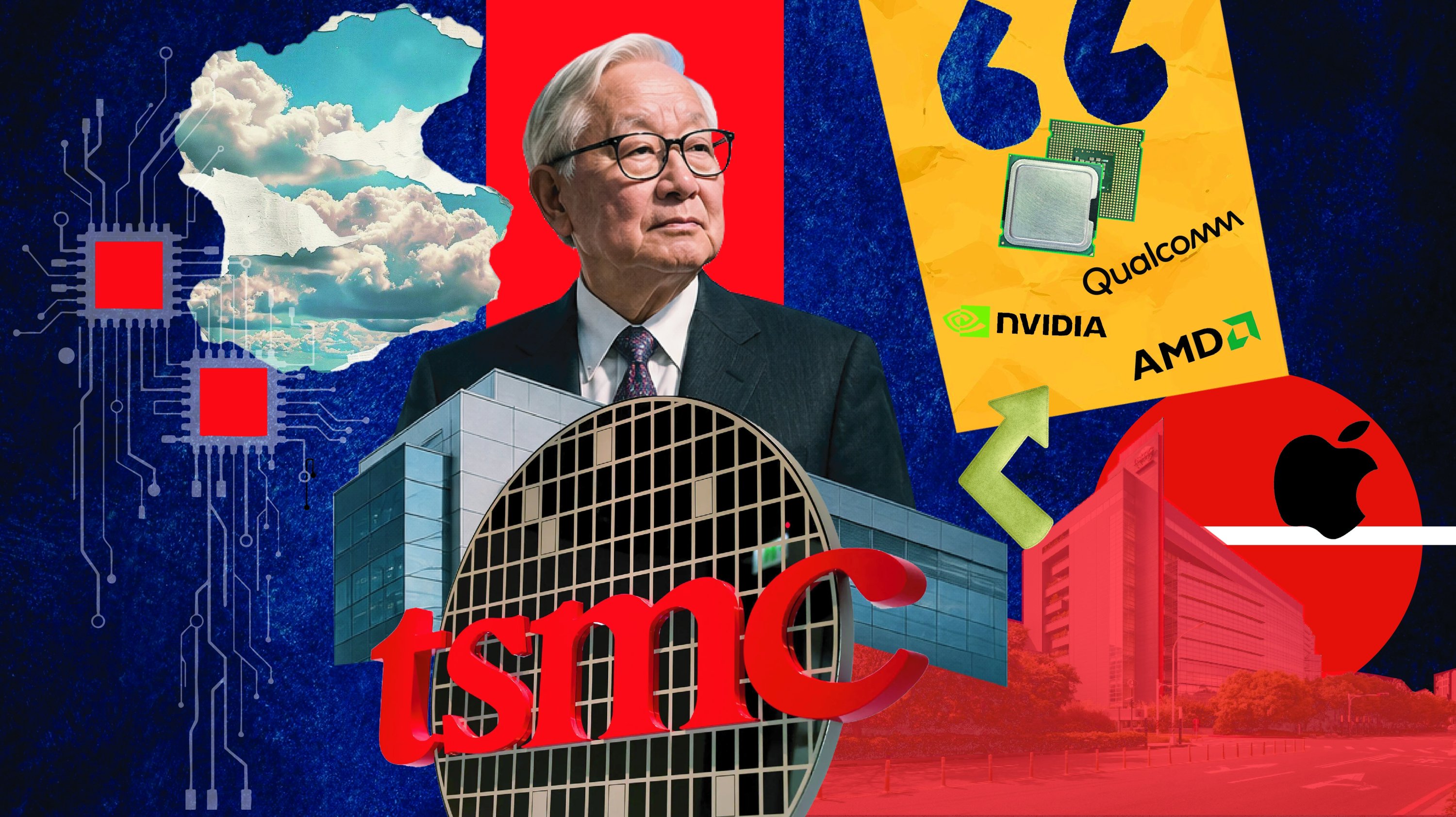
In 1987, the Taiwan Semiconductor Manufacturing Company, or TSMC, was founded. Rather than creating its own consumer products, the company focused exclusively on manufacturing semiconductors. At first, the strategy seemed unremarkable. Yet as chip production became increasingly complex and capital-intensive, more technology firms chose to concentrate on design while outsourcing manufacturing to specialized foundries. TSMC was perfectly positioned to meet that demand.
Throughout the 1990s, a growing number of companies turned to Taiwan to manufacture their chips. The full significance of Chang’s model, however, became evident in the 2000s. As Apple began designing its own processors, it needed a manufacturer capable of producing increasingly sophisticated chips without competing in the consumer electronics market. TSMC offered exactly that. What began during the Steve Jobs era and expanded under Tim Cook evolved into one of the most important partnerships in modern technology. Apple’s growing demand enabled TSMC to invest in ever more advanced manufacturing technologies, while TSMC’s capabilities helped Apple develop increasingly powerful processors.
The partnership proved transformative for both companies. Apple developed some of the world’s most powerful and energy-efficient processors, while TSMC used Apple’s enormous demand to expand its manufacturing capacity, invest in cutting-edge technologies, and pull ahead of its competitors.
Soon, NVIDIA, AMD, Qualcomm, and many other technology giants followed the same path. Many of the processors driving today’s artificial intelligence revolution are produced through the manufacturing model that Morris Chang established decades ago.
This is why Chang’s story is not merely the biography of a successful engineer or the history of a company founded in the 1980s. It is the story of a production model that continues to shape today’s technological and geopolitical competition. Although many of the world’s most advanced processors are designed by American companies, their production still depends heavily on the manufacturing expertise concentrated in Taiwan.
Taiwan used what U.S. left
U.S. President Donald Trump has repeatedly claimed that Taiwan “stole” America’s semiconductor industry. Yet Morris Chang’s story reveals something very different.
Taiwan did not steal an industry that the U.S. was determined to preserve. It built a new manufacturing model in a field that many American companies were increasingly abandoning. As semiconductor fabrication became more expensive and technically demanding, many firms chose to focus on design while outsourcing production to specialized manufacturers. Taiwan saw an opportunity where others saw a burden.
The decisive transformation was therefore not an act of theft, but the conversion of one engineer’s disappointment in America into a national ambition in Taiwan. The U.S. gave Chang his education, professional experience and deep understanding of the semiconductor industry. Taiwan gave him the opportunity to build something entirely new. Backed by government support, engineering talent and long-term industrial planning, Chang transformed a personal career disappointment into one of the most consequential industrial achievements of the modern era.
Today, Taiwan accounts for more than 60% of global semiconductor foundry revenue and over 90% of the world’s leading-edge chip manufacturing. This position makes TSMC indispensable to companies ranging from Apple and NVIDIA to AMD and Qualcomm. It is not simply another technology company, but the manufacturing backbone of the global digital economy. Without its production capacity, many of the world’s most advanced chip designs would remain little more than blueprints.
Taiwan’s silicon shield
As a result, any serious disruption in Taiwan would extend far beyond the island itself. A conflict, blockade, or prolonged interruption affecting TSMC’s facilities would quickly ripple through industries ranging from automobiles and telecommunications to artificial intelligence and defense. The semiconductor shortages during the COVID-19 pandemic offered only a glimpse of this vulnerability.
Although TSMC is expanding production in the U.S., Japan, and Europe, its most advanced facilities and its unique ecosystem of engineers, suppliers, research institutions and manufacturing expertise remain concentrated in Taiwan. This concentration has made the island both strategically indispensable and strategically vulnerable.
For this reason, Taiwan’s semiconductor dominance is often described as its “silicon shield.” The concept does not suggest that chips can replace military power or guarantee Taiwan’s security. Rather, it reflects a simple geopolitical reality: because so much of the world’s advanced semiconductor production depends on Taiwan, any conflict in the Taiwan Strait would immediately affect the economic and strategic interests of nearly every major power.
That may be Chang’s greatest achievement. He did not merely build a successful company or transform Taiwan into a technological powerhouse. He created a manufacturing model that made the island indispensable to the global economy and gave it something that military strength and diplomatic recognition alone could never provide: a compelling strategic reason for the world to care about its stability.
Perhaps that is the most fascinating part of the story. An engineer who felt he had reached the limits of his career in America returned to Taiwan and did far more than establish a new company. He built the manufacturing infrastructure upon which much of the modern digital economy now depends. In this story, what changed the course of history was neither a great military commander nor a political leader. It was the unfinished dream of an engineer. That dream became Taiwan’s economic engine, its global identity, and ultimately one of its most important lines of defense.
The views and opinions expressed in this article are solely those of the author. They do not necessarily reflect the editorial stance, values or position of Daily Sabah. The newspaper provides space for diverse perspectives as part of its commitment to open and informed public discussion.
DAILYSABAH
هلدینگ کاسپین استانبول | خرید ملک در ترکیه | صرافی معتبر ایرانی در ترکیه | خرید و فروش طلا در ترکیه | مهاجرت به ترکیه | واردات و صادرات در ترکیه | نیازمندیهای ترکیه | اخبار ترکیه | اخبار جهانی | توریست ایران | خدمات توریستی در ایران | تورهای گردشگری ایران | هلدینگ اول | خدمات کاریابی و فریلنسری و شغل | مرجع اطلاعات ایران (همه چیز در ایران) | کیف پول و خدمات مالی و پرداخت یار | اخبار ایران | تابلو زنده قیمت ارز در ترکیه و استانبول | صرافی آنلاین ترکیه | قیمت طلا و نقره در ترکیه | سرمایه گذاری در ترکیه | جواهرات در ترکیه | نرخ لحظه ای ارزها در استانبول | قیمت دلار امروز در ترکیه | قیمت دلار استانبول امروز | قیمت لحظه ای دلار | اخبار روز ترکیه استانبول | اپلیکیشن ISTEX | اپلیکیشن قیمت لحظه ای دلار و یورو و لیر و ارزها در ترکیه
About the Author