Home – CBSNews.com
Iran’s parliament passed a resolution early this week that would increase punishments for Iranians who interact in any way with foreign media outlets, organizations or individuals.
If the legislation is approved by higher authorities as expected, any contact with U.S. media entities, foreign embassies or institutions — whether it takes place inside or outside Iran — could land an Iranian in prison for up to two years unless they first obtain explicit written permission from the Ministry of Foreign Affairs, according to state media.
There are already very strict laws in Iran against sending information to exiled, foreign-backed Iranian media outlets, such as Iran International, or the U.S. and U.K. government-funded VOA Farsi and BBC Farsi. But the new legislation would go further, imposing extensive punishment on Iranians for any written or verbal contact with foreigners — especially foreign media.
The legislation would also ban educational and research activities linked to foreign entities, with a possible 10-year prison sentence for any person found to be involved in activities deemed “incompatible with Iranian culture.”
Badr bin Hamad Al Busaidi and Abbas Araghci, the respective foreign ministers for Oman and Iran, spoke over the phone on Friday as the region and its biggest issue — navigation through the Strait of Hormuz — remain at a standstill.
The two leaders discussed “ways to create favorable conditions for resuming dialogue and negotiations, and developments regarding navigation in the Strait of Hormuz,” according to the state-owned Oman News Agency.
The talks held earlier this month on who would control passage through the strait and under what conditions have gone silent in recent days. President Trump was even critical of Oman earlier this week, apparently because he was unhappy with a deal Oman planned to agree to over management of the waterway, two regional officials told The Associated Press on Tuesday. Mr. Trump openly threatened to bomb Oman in comments on Monday.
The phone call Friday was apparently light on specifics and more targeted at continuing the negotiations.
“They emphasized the importance of continuing discussions to reach practical understandings that support the resumption of free and smooth navigation, as well as the region’s security and stability,” according to Omani officials.
The World Bank on Friday projected Lebanon’s economy would contract by 6.4% this year, as the latest Israel-Hezbollah war derailed the country’s efforts at recovery.
Lebanon has been dealing with an unprecedented financial crisis since 2019 and was still reeling from the 2024 Israel-Hezbollah war when the Iran-backed group drew it into the Middle East conflict by attacking Israel in March.
Israel responded with a heavy air campaign and ground invasion that Lebanese authorities say have killed more than 4,300 people.
Due to the war, “real GDP is projected to contract by 6.4 percent in 2026, reflecting the collapse in tourism, weaker consumption, disrupted supply chains, heightened insecurity, and prolonged displacement,” the World Bank said in a report.
Inflation is also expected to rise to 17.5% this year, according to the report.
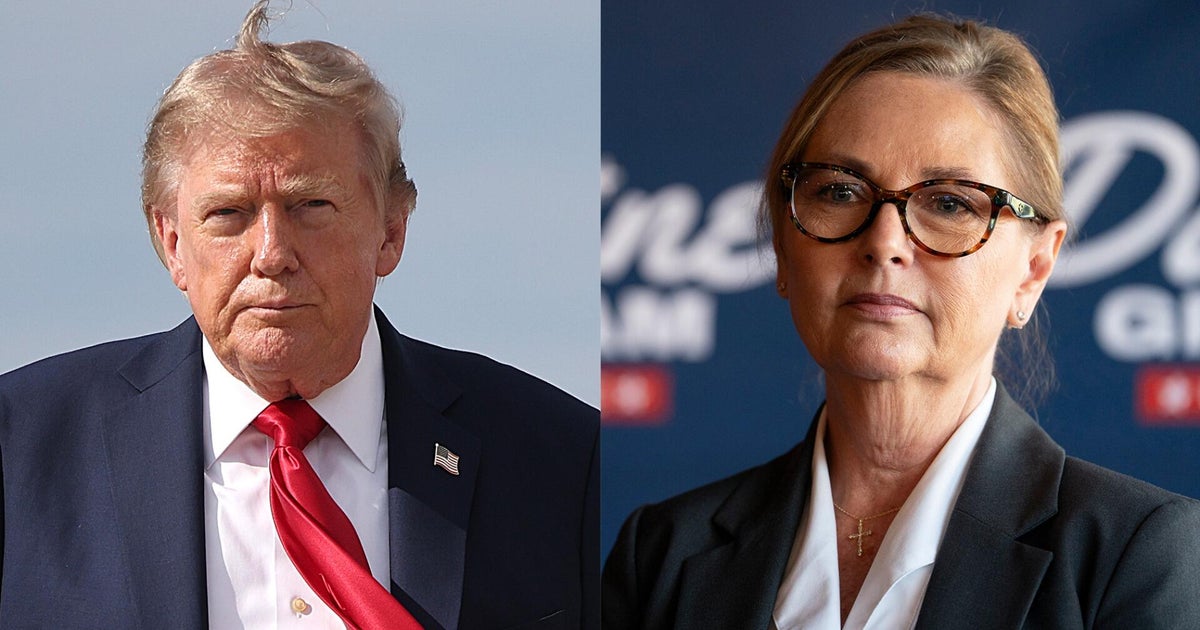
President Trump threatened this week to wield an “unprecedented” level of economic warfare against Iran, and Treasury Secretary Scott Bessent vowed to “collapse” the Islamic Republic regime with the “toughest sanctions in history.”
But the effectiveness of a bolstered economic campaign against Iran may rest largely on one close U.S. ally in the Persian Gulf, the United Arab Emirates.
The Emirati city of Dubai, the Middle East’s leading financial center, has long had a reputation as a hub for opaque economic activity. For Iran in particular, the city has offered ways to skirt international sanctions and gain access to vital funds from its sale of oil to countries like China.
“About 80% of Iran’s foreign currency exchange is done in Dubai. So Dubai has served as a major source for Iran’s foreign currency,” Miad Maleki, a former U.S. Treasury official, told CBS News on Friday.
Iranian Foreign Minister Abbas Araghchi is the latest prominent leader in the country to scoff at threats of U.S. sanctions, outlining a history of threats that failed to live up to their promise.
Araghchi highlighted pressure campaigns in 2012 and 2018 that failed, even highlighting a quote from Joe Biden, as well as the U.S. hopes for an “unconditional surrender” five months ago. He then mocked the latest “economic D-Day” threat as “Bound to fail.”
“We have seen this movie before. Same bull. Different bullies,” Araghchi wrote on X.
Vice President JD Vance said Thursday that “the most effective tool that we have is the economic pressure that we can apply” on Iran.
The Israel Defense Forces said a strike on Friday hit a building in the portion of southern Lebanon that Israel has occupied in recent months to kill “several suspects” who “posed a threat to IDF soldiers.”
The IDF said forces identified the suspects entering the “Security Zone,” an area stretching about six miles into Lebanon, from which Israel has expelled all residents, in the Baraashit area, where they “entered a structure, and posed a threat to IDF soldiers.”
“Following the identification, the IDF carried out a strike on the structure,” the military said, adding that it would “not allow the Hezbollah terrorist organization to harm the civilians of Israel and its soldiers, and will continue to operate in order to remove immediate threats.”
The statement said the IDF “continues to remain committed to the agreement between Israel and Lebanon,” referring to a shaky cease-fire brokered by the U.S. that has eased, but not stopped fighting between Israel and Iranian-backed Hezbollah militants based in Lebanon.
Lebanon’s Health Ministry says Israel’s military operations have killed more than 4,340 people since they began in early March. Israel launched its offensive against Hezbollah after the group fired rockets at Israel from Lebanon in support of its benefactor Iran, soon after the U.S. and Israel launched their joint war against Iran.
Iran’s Deputy Defense Minister, Brig. Gen. Shahrukh Shahram, was quoted on Friday by state TV as saying the country’s production of advanced weapons continued without interruption, claiming that Israel and the United States had miscalculated Iran’s military industrial capabilities.
Shahram said Iran’s foes had mistakenly believed that striking several Defense Ministry facilities would disrupt the country’s military supply chain, failing to understand that the domestic defense industry is supported by a broader network of domestic industries and technology companies.
Shahram claimed Iran had relocated key military assets and facilities ahead of the conflict and that weapons production had even increased in response to the war launched by the U.S. and Israel on Feb. 28.
Without providing any detail, Shahram said Iran’s defense industry had moved beyond reverse engineering foreign weapons to developing domestic systems.
He said Iranian military scientists killed during the war by Israel and the U.S. were being replaced by a new generation of young engineers and researchers, and he vowed that Iran would retaliate for the deaths of its personnel.
In testimony to Congress in May, the head of the U.S. military’s Central Command Adm. Brad Cooper said the U.S. had damaged or destroyed more than 85% of Iran’s ballistic missile, drone and naval industrial base through more than 1,450 strikes on weapons-manufacturing facilities. He told senators it would take Iran “a generation” to rebuild its navy and years for its drone and missile production to recover.
Iranian police said Friday that border guards had thwarted an attempt by a well-armed group to enter the country through the southeast province of Sistan and Baluchestan. The police said in their statement that one alleged militant was killed during the operation.
Police spokesman Brig. Gen. Saeed Montazer al-Mahdi said border guards in Saravan, which sits near the border with Pakistan, detected the group’s movements overnight after receiving intelligence that they intended to cross into Iran and carry out sabotage operations.
The police did not identify any organization suspected of being behind the alleged infiltration attempt.
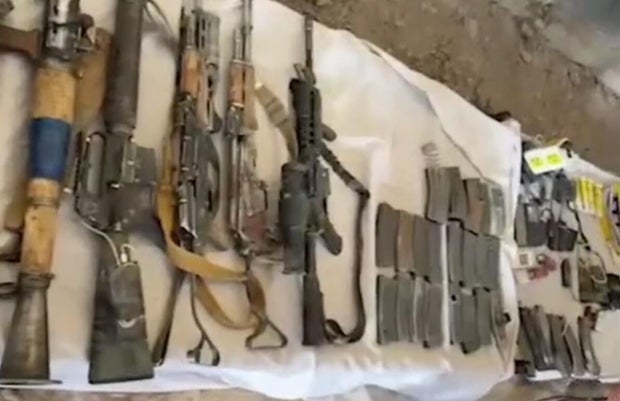
Iranian police handout
A video released by the police showed one dead body on the ground, and what the force said were rifles and other weapons, along with communications equipment, seized during a search of the area following the operation.
The police said all other members of the infiltrating group fled back across the border.
Iran’s Hezbollah allies in Lebanon dismissed on Friday the group’s designation as a terrorist organization by the U.S. government and the U.S. assertion that the militia is controlled by the Iranian military.
In a statement issued by Hezbollah, the group said the U.S. pressure was aimed at “protecting the security of the Israeli enemy, entrenching its occupation of southern Lebanon, and paving the way for it to implement its expansionist projects and ambitions in the region.”
The group said the U.S. Treasury’s decision to extend sanctions against Hezbollah showed the U.S., “which has become accustomed to using sanctions as a means of imposing its power and will on states and peoples, continues to deal with Lebanon from a position of tutelage.”
Iranian President Masoud Pezeshkian said Friday that the war with the U.S. must eventually come to an end, and “it is better to end the war today, while we are strong and honored, while the entire world acknowledges our victory and emphasizes that America, contrary to all regulations, attacked our schools, hospitals and infrastructure and is hated around the world.”
Speaking at the 31st General Assembly of the Islamic Association of Iran’s Medical Community, Pezeshkian also gave a nod to public dissatisfaction in Iran, where extreme economic malaise exacerbated by the war has made it difficult for normal people to buy even basic goods.
“If there is dissatisfaction or grievance in society, it means that we have not acted as we should have,” he said.
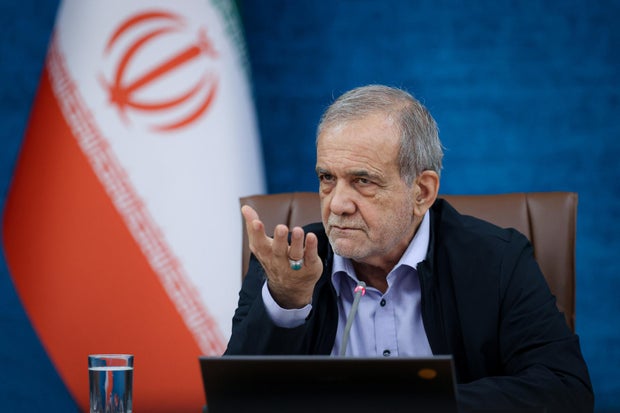
Iranian Presidency/Anadolu/Getty
Pezeshkian acknowledged economic pressure created by sanctions and the U.S. naval blockade of Iran’s ports and associated vessels, which he said had disrupted imports and exports.
He questioned the sustainability of Iran’s government fuel subsidies, saying: “Who said the government should buy gasoline at 130,000 tomans ($ 0.10) and then sell it for 1,500 tomans ($0.0011)?”
Such policies, he argued, could leave the government struggling to fund other vital programs such as food subsidies and insurance, which he warned could endanger the livelihoods of workers, retirees and civil servants.
An assessment by the U.K. Navy’s Maritime Trade Operations center shows the dramatic fall in commercial shipping through the Strait of Hormuz over the first 23 weeks of the U.S.-Israeli war with Iran.
Only 21 full inbound and 18 outbound transits were recorded in the latest week reflected in the data, which was the week ending Aug. 7. Since then, UKMTO has continued to report very few vessels openly transiting the waterway, over which both Iran and the U.S. have imposed restrictions while asserting unilateral control.
The strait is the only way for ships carrying energy products from some major Mideast producers to reach global markets beyond the Persian Gulf, and while inbound and outbound transits ramped up for several weeks during a shaky ceasefire between the U.S. and Iran in June, they quickly tapered off again as fighting resumed.
Traffic remained at only about 4% of the pre-conflict average by the end of the first week of August.
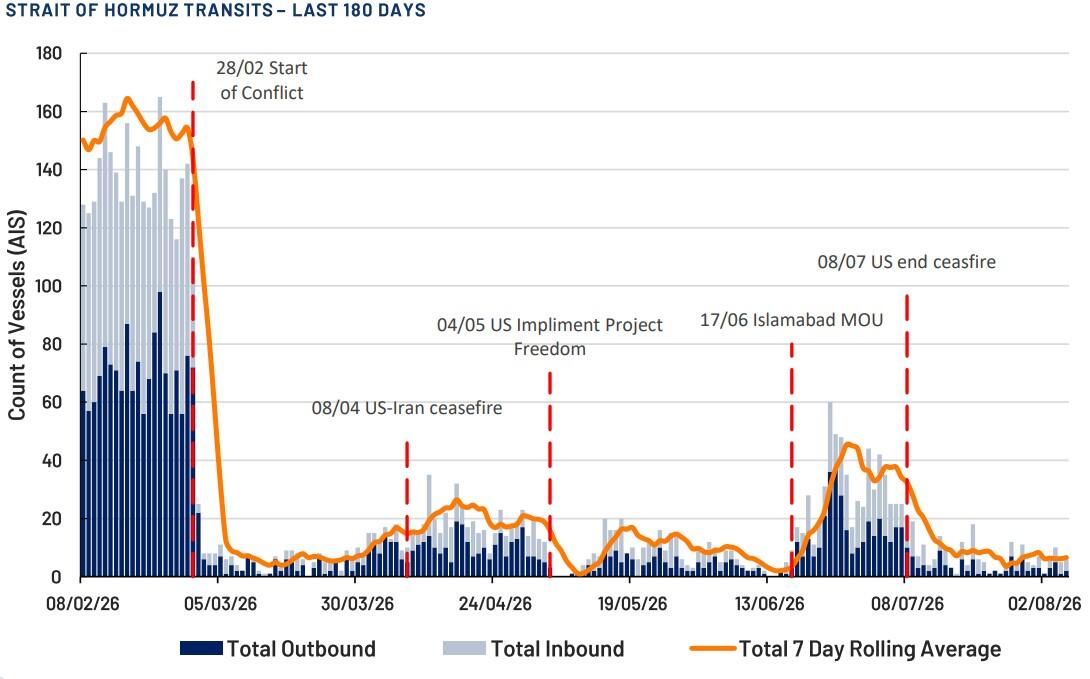
UKMTO
Shipping operators appear to be actively avoiding a higher-risk southern route close to Oman, which the Trump administration insists is safe and open despite Iranian threats, and opting more often for the northern route, which Iran controls.
While major attacks by Iran and the U.S. have largely stopped, yielding to economic warfare amid the standoff over the strait, UKMTO still assesses the risk to the mariners in the waterway to be severe.
Tehran’s grocery stores are well-stocked, but many families can barely afford the basics. Unemployment is soaring and those with jobs are working more hours for money worth half as much as a year ago, putting food, medicine and everything else — except for heavily subsidized gasoline — further out of reach.
“We have virtually given up on many things,” said Ahmad Karimi, 52, a taxi driver and father of two who has been working 15-hour days to make ends meet. “We’re cutting out fruit, we’re cutting out protein, we’ve given up leisure, we even work on weekends.”
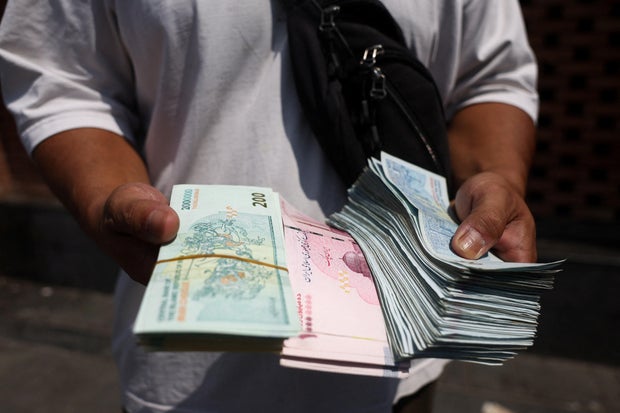
Majid Asgaripour/WANA
Nearly six months into the war with the United States and Israel, the Iranian economy is taking a beating under the force of sanctions and a naval blockade that is making it extremely difficult for the country to export oil, its most valuable product.
Since the war began, Iran has been attacking oil-rich neighbors and U.S. bases in the region, and disrupting shipping in the Strait of Hormuz, its biggest strategic advantage.
Iran is trying to use this retaliatory pressure — driving up energy prices globally — to bring the war to an end on the best terms possible. It is pressing for sanctions relief, and seeking enough control over the strait to demand payment from ships passing through to deliver energy and other goods.
The Trump administration — fighting over a waterway in a war that was launched to curb Iran’s nuclear program — is promising even tougher sanctions to squeeze the Islamic Republic into submission. But experts say President Trump may be underestimating how long Iran can hold out.
Iran has been subject to Western sanctions for years and has become deft at partially circumventing them. It has expanded domestic production, used informal cross-border trade networks, bought restricted goods through third countries, and used a shadow fleet to transport its oil.
“Iran’s resistance capacity not only avoids collapse, it also prevents the economic pain from translating into the political pressure and changes that the U.S. expects,” said Hadi Kahalzadeh, an expert on Iran’s economy at Brandeis University.
Iran’s Chief of Staff of the Armed Forces, Major General Abdolrahim Abdollahi, said Friday that the country’s military was prepared to deliver a “devastating” response to any conventional or emerging threat from its adversaries.
In a message marking National Defense Industry Day, Abdollahi said in a post on the Telegram messaging app that Iran’s armed forces maintained a comprehensive, modern readiness across land, sea, air and cyber domains, warning that any “miscalculation” by Iran’s enemies would be met with “revolutionary, crushing, regret-inducing, and devastating” retaliation.
Iran’s acting Defense Minister, Brigadier General Seyed Majid Ibn al-Reza, was quoted Friday by state media as stressing the link between national security and economic stability. He said Iran’s defense industry had become one of the key pillars of its national security and deterrence against threats.
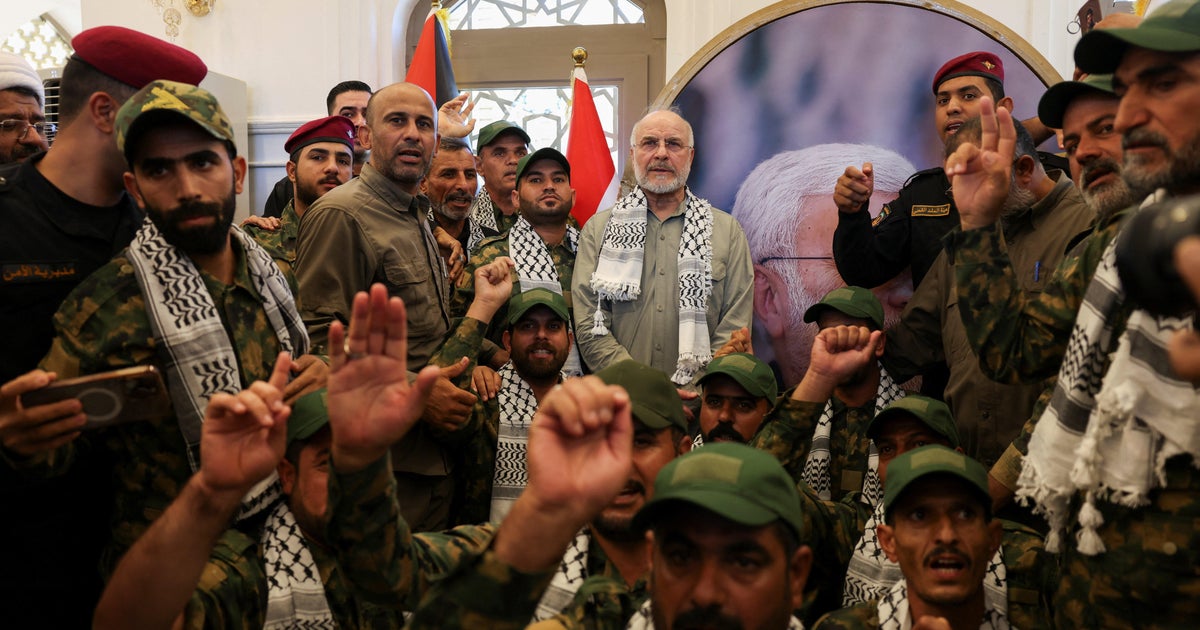
Iranian Parliament Speaker Mohammad Bagher Ghalibaf called on Iran and Iraq to strengthen economic cooperation and prepare for what he described as “unjust sanctions,” warning that the United States and Israel had shifted toward economic warfare after failing to defeat the two countries militarily.
Speaking to Iranian and Iraqi businesspeople at the Iranian Embassy in Baghdad on Thursday, Ghalibaf said the two countries should develop mechanisms to withstand sanctions and reduce their dependence on the U.S. dollar.
“If you look at the resources and raw materials of Muslim countries, you will realize that our enemies come to plunder them,” Ghalibaf said, according to a post on his channel on the Telegram messaging app. He called for plans to overcome sanctions and argued that Iran and Iraq could conduct trade using their own national currencies.
“Today, it is possible to conduct trade exchanges using national currencies and strike at the mouth of the U.S. dollar,” he said.
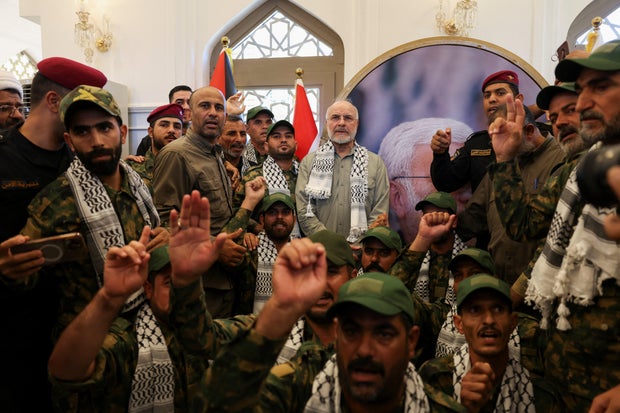
Ahmed Saad/REUTERS
Ghalibaf also stressed the close link between economic strength and security, describing them as “two wings of the same bird.”
Ghalibaf said the U.S. and Israel had recognized that they could not overcome Iran and Iraq through conventional military warfare and had therefore turned to “cognitive and economic warfare.”
“You are now the soldiers and commanders of this battlefield,” he told the business community.
Iran has finalized a preferential trade agreement with Oman, according to the Islamic Republic’s official Trade Promotion Organization.
The agreement, which Oman has not yet confirmed, still requires approval by Iran’s parliament and other authorities.
The announcement, relayed by Iranian state media, came two days after President Trump heralded a shift in U.S. tactics in the nearly six-month war to a “crushing economic operation,” and seemingly away from the heavy weapons used during the first phase of the conflict.
Vice President JD Vance said Thursday “the most effective tool that we have is the economic pressure that we can apply” on Iran, as Treasury Secretary Scott Bessent underlined in an interview with CNBC that Washington expects both allies and rivals to join the ramped-up campaign against Iran.
“This is going to be the greatest coordinated economic isolation in the history of the world,” he said, adding that the Trump administration was saying to all nations “you are either with us or against us.”
Oman has discussed taking future joint control of the Strait of Hormuz with Iran for weeks, and those talks — which have included the notion of fees being charged for commercial ships to use the maritime route — have drawn stern warnings from the White House about interfering in Mr. Trump’s push for a deal to end the war.
The Iranian trade office on Friday called the agreement with Oman part of Tehran’s broader push to strengthen economic ties with regional partners through trade diplomacy and improved logistics infrastructure.
In addition to the Oman agreement, Iran is pursuing renewed preferential trade talks with Turkey, reopening border markets with Iraq and Turkey, and expanding its network of commercial centers and trade advisers across the region as part of a wider strategy to boost non-oil exports and regional economic cooperation.
China said on Friday that U.S. “sanctions and pressure” wouldn’t resolve the Middle East conflict, after Washington urged governments including Beijing to join efforts to isolate Iran’s economy.
“Sanctions and pressure will not help resolve the issue,” Chinese foreign ministry spokesman Lin Jian told reporters at a news briefing, calling on “all relevant parties to take responsible measures and resolve the problem through political and diplomatic means.”
President Trump threatened Iran with “economic D-Day” on Wednesday, vowing to wield “Economic Warfare and Isolation on an unprecedented scale.” Iran quickly dismissed the threat as a distraction and said it would backfire.
Treasury Secretary Scott Bessent underlined in an interview with CNBC on Thursday that Washington expects both allies and rivals to join the ramped-up campaign against Iran.
“This is going to be the greatest coordinated economic isolation in the history of the world. And we are going to them and saying you are either with us or against us,” he added in a message to allies.
Asked whether the United States would pressure China, Bessent said “many conversations are best to have in private,” but called on Beijing to “get with the program.”
CBS/AFP
Six European countries along with Canada condemned the latest development in a contentious Israeli settlement project near Jerusalem that would effectively cut the occupied West Bank in two.
Israel’s Ministry of Construction and Housing issued a tender for constructing several compounds with more than 1,200 homes in total in an open tract of land east of Jerusalem. It’s the latest step in a project under consideration for more than two decades, which critics say would prevent the establishment of a contiguous Palestinian state in the territory.
The joint statement from the leaders of the U.K., France, Germany, Italy, the Netherlands, Norway and Canada said international law is clear the settlement is illegal and noted “unprecedented levels of violence by settlers against civilians.”
“We urge the government of Israel to retract these plans immediately and end its expansion of settlements in the West Bank. Not only will they take us further from peace, but they further undermine Israel’s international standing,” the countries wrote.
Egypt and Jordan also condemned Israel’s move.
Israeli Foreign Minister Gideon Saar responded on Thursday by defending “the historic right of the Jewish people to reestablish their national home in the Land of Israel — including in the area in question.”
Saar criticized the U.K. government for “blaming only Israel while ignoring Palestinian extremism.”
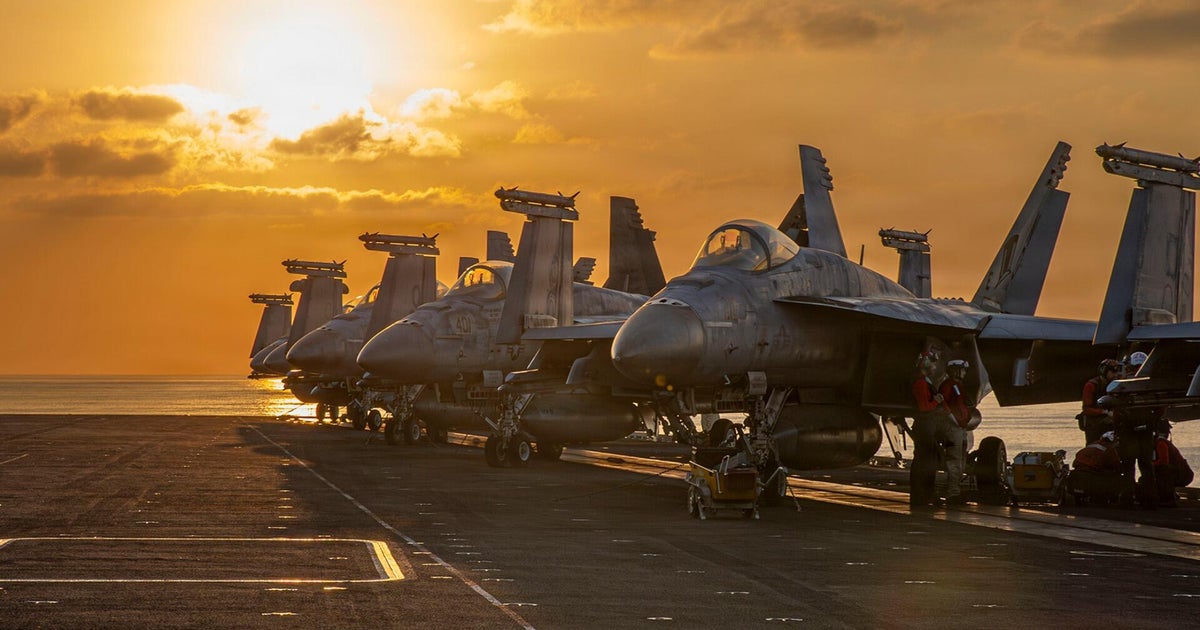
A U.S. official confirmed to CBS News that the USS Abraham Lincoln aircraft carrier is headed home after a nine-month deployment. It could still take several weeks for it to get back to its home port in San Diego, California.
The USS George Washington arrived in the Middle East Wednesday.
In recent weeks, family members of Lincoln service members voiced worries about deteriorating mental health conditions aboard the ship, as well as sanitary conditions and food shortages.
Vice President JD Vance on Thursday said the war with Iran had entered a “new phase where the most effective tool that we have is the economic pressure that we can apply to them.”
In an interview on “The Clay Travis & Buck Sexton Show,” Vance noted the “delicate dance” involved.
“We apply economic pressure to them, they’re going to try to apply economic pressure to us,” the vice president said. “But what has been true over the last couple of weeks is they felt a lot more pressure than we have. We’re going to keep that going because we think that’s the best way to ultimately accomplish the final objective here.”
Earlier Thursday, Iran’s foreign minister dismissed President Trump’s threat from the previous day to wield “Economic Warfare and Isolation on an unprecedented scale,” calling it a diversion from the burgeoning U.S. national debt and a “doubling down on failed policies.”
Mr. Trump threatened Iran on Wednesday with “an economic D-Day.”
wp:paragraph
هلدینگ کاسپین استانبول | خرید ملک در ترکیه | صرافی معتبر ایرانی در ترکیه | خرید و فروش طلا در ترکیه | مهاجرت به ترکیه | واردات و صادرات در ترکیه | نیازمندیهای ترکیه | اخبار ترکیه | اخبار جهانی | توریست ایران | خدمات توریستی در ایران | تورهای گردشگری ایران | هلدینگ اول | خدمات کاریابی و فریلنسری و شغل | مرجع اطلاعات ایران (همه چیز در ایران) | کیف پول و خدمات مالی و پرداخت یار | اخبار ایران | تابلو زنده قیمت ارز در ترکیه و استانبول | صرافی آنلاین ترکیه | قیمت طلا و نقره در ترکیه | سرمایه گذاری در ترکیه | جواهرات در ترکیه | نرخ لحظه ای ارزها در استانبول | قیمت دلار امروز در ترکیه | قیمت دلار استانبول امروز | قیمت لحظه ای دلار | اخبار روز ترکیه استانبول | اپلیکیشن ISTEX | اپلیکیشن قیمت لحظه ای دلار و یورو و لیر و ارزها در ترکیه
/wp:paragraph wp:paragraph /wp:paragraph
About the Author