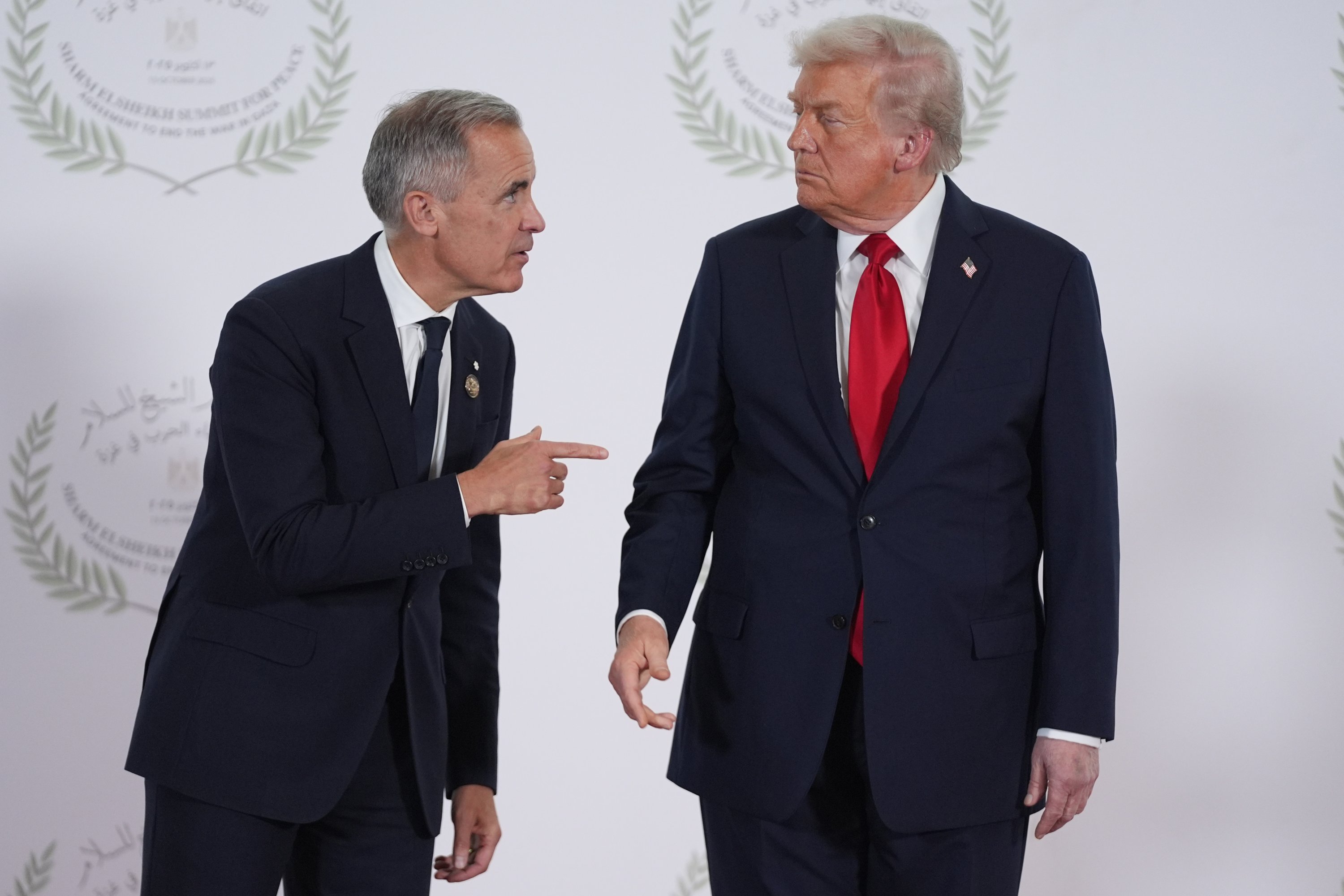
The United States imposed 50% tariffs on about $20 billion worth of Canadian goods Saturday after days of negotiations between the two longtime allies broke down, escalating tensions between President Donald Trump and Canadian Prime Minister Mark Carney.
The new duties, which took effect shortly after midnight, represent just over 5% of Canada’s exports to the United States. They target a range of products, including cement, furniture, clothing, fishing equipment and hockey gear, while adding to existing U.S. tariffs on Canadian steel, aluminum, lumber and automobiles.
The economic impact of the latest measures may be limited compared with broader U.S.-Canada trade, but the political consequences could be more significant. The dispute threatens to complicate negotiations over the future of the United States-Mexico-Canada Agreement, the North American trade pact that has underpinned billions of dollars in cross-border commerce.
Carney said Canada had suspended trade negotiations with Washington after the United States made last-minute changes to its proposed terms.
“I have decided to suspend trade negotiations with the U.S. and have directed Canada’s negotiators to return to Ottawa,” Carney said in a statement.
He said Canadian negotiators had worked “in good faith” to protect the country’s interests but argued that the final U.S. demands were unfair and economically damaging.
Canada will respond with matching tariffs, Carney said, promising to retaliate “dollar for dollar” against the new U.S. duties.
The breakdown came after three days of talks in Washington between Canadian Trade Minister Dominic LeBlanc and U.S. Trade Representative Jamieson Greer. Just hours before the tariffs took effect, the two sides appeared close to an agreement that could have reduced duties on Canadian steel, aluminum and automobiles and potentially restored American alcohol products to Canadian liquor stores.
But the deal fell apart at the final stage.
“Tonight, Canada declined to finalize the trade deal under the terms agreed earlier this week,” Greer said during a White House briefing.
Greer described the collapse as a missed opportunity for Canada to strengthen its economic relationship with the United States, which he called the fastest-growing economy in the Group of Seven.
A senior Trump administration official said the U.S. proposal would have given Canada a more favorable tariff position than any other major exporter to the United States. The official said Ottawa nevertheless sought further concessions on steel, aluminum, automobiles and softwood lumber.
No additional negotiations were scheduled as the tariffs took effect.
A new breach in North American trade
The latest duties are particularly significant because some of the affected Canadian products had previously benefited from preferential treatment under the United States-Mexico-Canada Agreement.
Richard Ouellet, a professor of international economic law at Quebec’s Laval University, described the development as a breach in the protection provided by the trade agreement.
“Until now, the USMCA acted as kind of a shield. The Americans are opening a breach,” Ouellet said.
Trump declined to renew the USMCA on July 1, leaving the agreement subject to annual reviews and adding uncertainty to the future of North American trade.
The latest tariffs cover about $20 billion in Canadian goods, including products such as hockey sticks and cement. While that represents only a small portion of Canada’s overall exports to the United States, the duties expose several already vulnerable industries to higher costs, weaker demand and possible job losses.
Previous U.S. tariffs on steel, aluminum, lumber and automobiles have already weighed heavily on Canadian manufacturers and workers. The effects, however, have largely remained concentrated in those sectors.
Royal Bank of Canada has said the latest 50% tariffs are unlikely to significantly alter Canada’s broader economic growth because they affect a relatively small share of total trade. About 80% of Canadian goods would still enter the United States without tariffs, according to the bank.
Still, the move underscores Canada’s deep dependence on its southern neighbor.
Canada looks beyond the U.S.
About 70% of Canada’s exports go to the United States, making the country exceptionally vulnerable to changes in American trade policy.
Carney has made reducing that dependence a central part of his economic strategy since taking office in March 2025. His government has pursued new markets overseas, sought to remove barriers to trade between Canadian provinces and promoted major infrastructure and resource projects at home.
“Canada has what the world wants,” Carney said after the trade talks collapsed. “We will not allow any nation to determine our future.”
Carney has traveled to China, India and Saudi Arabia while strengthening ties with European countries in an effort to broaden Canada’s economic partnerships.
Canada reached a preliminary agreement with China in January covering imports of electric vehicles, while relations with Europe have also deepened. In July, Ottawa selected German defense company TKMS to build a new fleet of submarines for the Canadian navy.
The Canadian government has also pointed to signs that exporters are already adapting to U.S. protectionism by finding customers elsewhere.
According to a report from Canada’s international trade minister, the value of Canadian exports to non-U.S. markets rose 11% in 2025 and at one point reached 33% of total exports, the highest level in more than four decades.
Turning inward
Carney is also betting that Canada can reduce its exposure to U.S. trade pressures by strengthening its own domestic market.
One of his government’s early initiatives was legislation aimed at reducing barriers to trade between Canada’s provinces and territories. Although provincial governments have been reluctant to eliminate some of their own restrictions, economists say domestic commerce has gained renewed attention as the trade dispute with Washington has intensified.
Carney has also established a Major Projects Office designed to speed up approvals for major infrastructure and resource developments.
The government has promoted port expansions in Montreal and Vancouver, new mines focused on critical minerals and a proposed oil pipeline linking Alberta to the Pacific coast.
Ottawa has unveiled plans for roughly 115 billion Canadian dollars ($83 billion) in infrastructure spending and an additional 82 billion Canadian dollars for defense over the coming years.
Those investments could help create new markets and strengthen domestic economic capacity, but replacing the scale of the U.S. market will not be easy.
DAILYSABAH
هلدینگ کاسپین استانبول | خرید ملک در ترکیه | صرافی معتبر ایرانی در ترکیه | خرید و فروش طلا در ترکیه | مهاجرت به ترکیه | واردات و صادرات در ترکیه | نیازمندیهای ترکیه | اخبار ترکیه | اخبار جهانی | توریست ایران | خدمات توریستی در ایران | تورهای گردشگری ایران | هلدینگ اول | خدمات کاریابی و فریلنسری و شغل | مرجع اطلاعات ایران (همه چیز در ایران) | کیف پول و خدمات مالی و پرداخت یار | اخبار ایران | تابلو زنده قیمت ارز در ترکیه و استانبول | صرافی آنلاین ترکیه | قیمت طلا و نقره در ترکیه | سرمایه گذاری در ترکیه | جواهرات در ترکیه | نرخ لحظه ای ارزها در استانبول | قیمت دلار امروز در ترکیه | قیمت دلار استانبول امروز | قیمت لحظه ای دلار | اخبار روز ترکیه استانبول | اپلیکیشن ISTEX | اپلیکیشن قیمت لحظه ای دلار و یورو و لیر و ارزها در ترکیه
About the Author