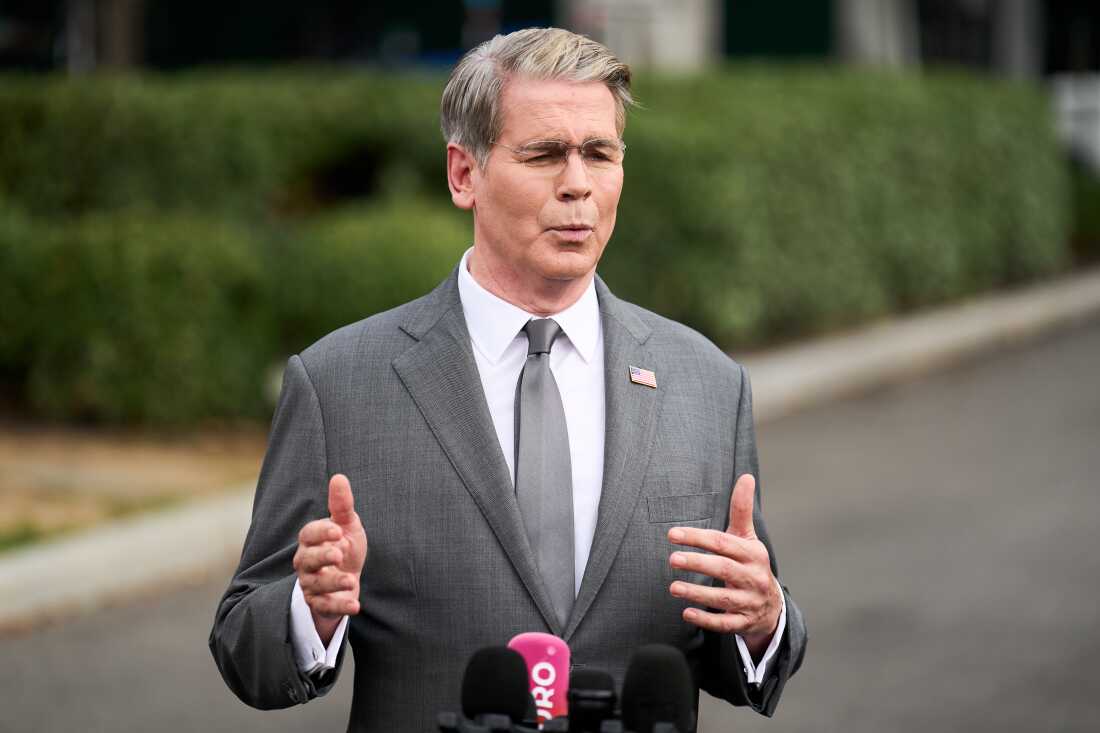
Treasury Secretary Scott Bessent speaks to members of the media outside the White House in Washington, Thursday, Aug. 20, 2026.
Jacquelyn Martin/AP
Jacquelyn Martin/AP
Treasury Secretary Scott Bessent is expected to unveil a new round of economic sanctions on Iran on Monday, in what he has described as the “single greatest financial offensive ever.”
President Trump has called it an “economic D-Day” and pledged to go after other countries who extend an economic lifeline to Tehran.
In anticipation, the Iranian currency, the Rial, has plunged to a record low.
What are these new sanctions and how much more pressure can they pile on?
The U.S. already has extensive sanctions on Iran, some stretching back almost 50 years, and as recently as June had imposed further penalties for entities that helped Iran evade existing financial restrictions. There has also been a months-long U.S. naval blockade of Iran, which has cut off most goods to Iran from the outside world.
This latest suggestion from President Trump and Secretary Bessent appears to be focused on putting more pressure on the countries and governments — not just the businesses — that host the entities providing cashflow for Iran.
In an editorial for the Financial Times published overnight, Bessent wrote, “our objective is to sever every economic lifeline that sustains the tyrannical regime until Tehran stands alone.” He appeared to reference countries that still trade with Iran, saying they should “consider the consequences of doing so.”
That includes China, Iran’s biggest oil customer, which Bessent criticized last week for historically buying about 90 percent of Iran’s oil.
But some analysts question the actual utility of fresh economic sanctions.
Alan Eyre, a former American diplomat who was part of the U.S. negotiating team over Iran’s nuclear program until 2015, told NPR’s Emily Feng that the U.S. has already targeted “the low-hanging fruit, the mid-hanging fruit, the high-hanging fruit, the tree,” and that “there are no new sanctions that are effective.”
Iran vows a “seismic” retaliation to any sanctions
Iran’s new security chief, Mohsen Rezaei, said in an interview on state TV over the weekend that Iran would retaliate in a “seismic manner” to Trump’s latest attempt at economic warfare. Rezaei, a hardliner who used to lead Iran’s Revolutionary Guards, is now a military adviser to Iran’s Supreme Leader, Ayatollah Mojtaba Khamenei.
Rezaei warned Gulf states that any countries partnering in these new economic restrictions would be considered an enemy of — and a target for — Iran.
Since the U.S. and Israel launched their war on Iran nearly six months ago, Iran has attacked U.S. bases in Jordan and Gulf countries including the United Arab Emirates, Kuwait and Saudi Arabia. Several have led to serious injuries and fatalities.
Rezaei said Iran would retaliate by further targeting oil tankers that are transiting the Persian Gulf on the Omani side of the Strait of Hormuz, warning that “not even a single drop of oil will leave the region.”
Iran is not currently interfering in these routes, so such actions could further hamper oil supplies. Energy exports from the Gulf region have already suffered the biggest disruption in their history because of the war and Iran’s closure of the Strait of Hormuz.
Gulf countries that invested billions on pipelines that can help avoid the Strait of Hormuz, have not yet commented on the U.S. plans for fresh sanctions.
New sanctions will make a dire economic situation worse for ordinary Iranians
Iran has weathered some U.S. sanctions for almost half a century, since the Islamic Revolution of 1979, with ordinary Iranians bearing the brunt of the subsequent economic pain.
The Iranian economy was already struggling when the U.S. and Israel launched this war against Iran in February, with double-digit inflation and currency devaluation. According to the Iranian government agency, the Statistical Centre of Iran, inflation is now at almost 90 percent.
NPR spoke to one 30-year-old Iranian woman, who said most ordinary Iranians are now buying food using a credit system because they do not have enough cash.
“Since I am in debt to the grocery store, I couldn’t even buy tomato paste to cook pasta,” she told NPR’s Hadeel Al-Shalchi. She did not want to be named for fear of retaliation from the Iranian government.
She said lifesaving medicines like insulin have become too expensive for many, and that daily life is becoming increasingly difficult, with frequent power cuts and unemployment rising.
Economic pain and the high cost of living were among the factors driving Iranians to protest on the streets earlier this year, in demonstrations that were met with a deadly government crackdown.
NPR Topics: News wp:paragraph
هلدینگ کاسپین استانبول | خرید ملک در ترکیه | صرافی معتبر ایرانی در ترکیه | خرید و فروش طلا در ترکیه | مهاجرت به ترکیه | واردات و صادرات در ترکیه | نیازمندیهای ترکیه | اخبار ترکیه | اخبار جهانی | توریست ایران | خدمات توریستی در ایران | تورهای گردشگری ایران | هلدینگ اول | خدمات کاریابی و فریلنسری و شغل | مرجع اطلاعات ایران (همه چیز در ایران) | کیف پول و خدمات مالی و پرداخت یار | اخبار ایران | تابلو زنده قیمت ارز در ترکیه و استانبول | صرافی آنلاین ترکیه | قیمت طلا و نقره در ترکیه | سرمایه گذاری در ترکیه | جواهرات در ترکیه | نرخ لحظه ای ارزها در استانبول | قیمت دلار امروز در ترکیه | قیمت دلار استانبول امروز | قیمت لحظه ای دلار | اخبار روز ترکیه استانبول | اپلیکیشن ISTEX | اپلیکیشن قیمت لحظه ای دلار و یورو و لیر و ارزها در ترکیه
About the Author