Home – CBSNews.com
Add CBS News on Google
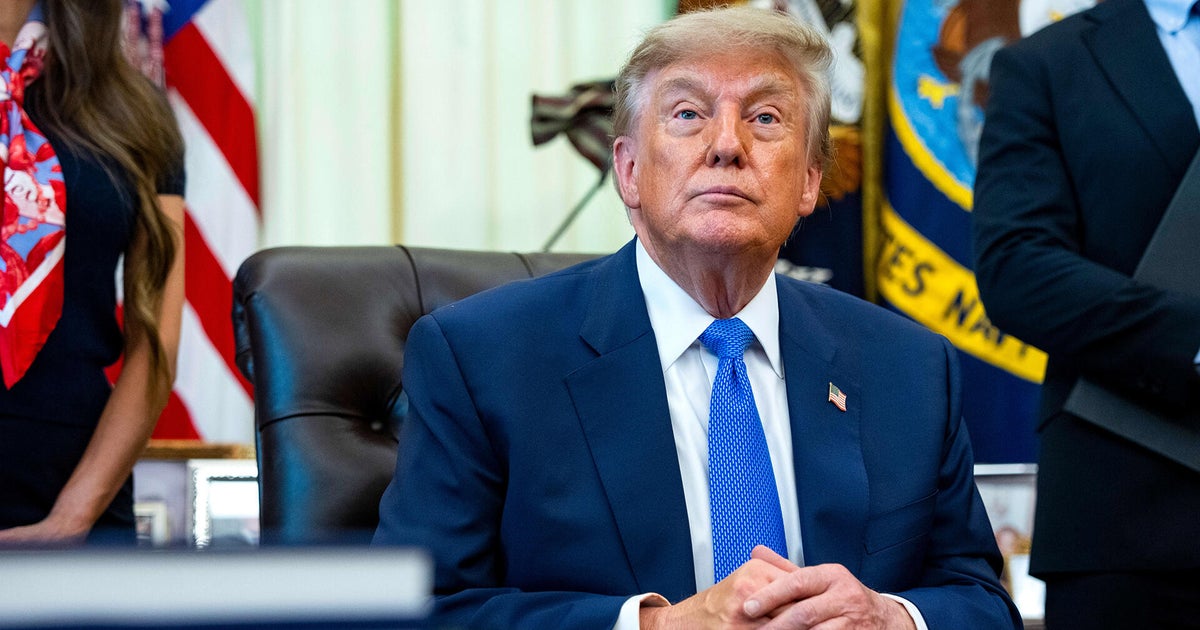
Washington — The Supreme Court on Monday allowed President Trump’s administration to move ahead with implementing key portions of an executive order that seeks to tighten the rules for mail voting ahead of the November midterm elections.
In a 6-3 ruling, the high court granted a request for emergency relief sought by the Trump administration late last month in a case involving 23 Democratic-led states. The Justice Department had asked the Supreme Court to lift a lower court’s injunction that stopped agencies from carrying out parts of Mr. Trump’s directive, which involves the Department of Homeland Security and U.S. Postal Service, in those states and the District of Columbia.
The high court said in its unsigned decision that the states filed their lawsuit too soon.
“The Court’s disposition of this application does not mean that any measure taken by the Government to implement the Order will necessarily be lawful,” the Supreme Court said in an unsigned decision. “On that score, time will tell. But the Order itself does not harm the States, so the District Court lacked jurisdiction to bar the Government from trying to implement it.”
The move from the high court clears the way for the Department of Homeland Security to move forward with a proposal to create lists of residents in each state who are eligible to vote.
In a separate case involving voting-rights groups, U.S. District Judge Indira Talwani issued an order earlier this month that prevents the Trump administration from implementing the executive order’s provisions that direct the Postal Service to develop new procedures for mail ballots for the upcoming elections. But the Justice Department will likely argue the Supreme Court’s decision applies to that case, too.
The emergency appeal before the Supreme Court, meanwhile, arose after Talwani sided with the group of states that challenged Mr. Trump’s executive order and ruled the Constitution does not grant the president the authority to order changes to how they administer federal elections.
The Supreme Court’s order does not preclude the states from filing lawsuits that challenge the policies finalized and ultimately put in place by the administration in response to Mr. Trump’s directive. Some states are set to begin sending mail ballots to voters for the upcoming midterms in the coming weeks.
The three liberal justices dissented from the Supreme Court’s ruling. Justice Sonia Sotomayor, joined by Justice Elena Kagan, noted that the decision “merely postpones adjudication” of challenges to Mr. Trump’s policies.
“Today’s decision does not address whether the President’s attempts to interfere with States’ administration of the November 2026 elections are lawful,” Sotomayor wrote in a dissenting opinion. “Nor does it suggest that the Executive Branch has any constitutional or statutory authority to implement the President’s directives.”
Trump’s executive order
Since returning to the White House for his second term, Mr. Trump has sought to exert control over aspects of federal elections. As part of those efforts, the president signed in March an executive order that he said aims to protect the integrity of U.S. elections in part by ensuring noncitizens are not casting ballots. Mr. Trump’s directive came just months before the November midterm elections, which will determine which party controls the House and Senate.
The provisions at issue in the case direct DHS to compile “state citizenship lists” using federal databases and call for the Postal Service to deliver mail ballots cast only by individuals who are on its own voter-eligibility lists. The directive also lays out certain design requirements for mail ballot envelopes and instructs the attorney general to prioritize investigations and prosecutions of state and local officials who issue ballots to noncitizens or others who are not eligible to vote in federal elections.
The Postal Service published a final rule Friday putting in place some of the plans laid out in Mr. Trump’s executive order. The rule lays out required design elements for federal mail ballot envelopes and directs state election officials to submit specific data to an online portal, including the names and addresses of voters they intend to send mail ballots to.
Using that information, the Postal Service will then generate and send state-specific “Mail-In and Absentee Participation Lists” to states’ chief election officials on Election Day. The new rule said the lists are “primarily intended to assist election officials and law enforcement to understand who may have been mailed a ballot, in order to identify potentially anomalous incidents that may merit further investigation.”
The Postal Service “will not play any role in determining voter eligibility, maintaining voter rolls, or counting ballots,” it said.
The agency said it would act immediately to implement the new rule for the November midterms once the government obtained relief from lower-court injunctions.
The legal challenge to Trump’s directive
Days after the president signed the executive order in March, Democratic officials from the 23 states and D.C. filed a lawsuit seeking to block the proposals. The states argued that the president has no power to restrict voter eligibility or mail voting, and said the executive order attempts to interfere with their administration of elections in violation of the Constitution.
A separate group of 12 Republican-led states intervened in the lawsuit and, with the Trump administration, argued it should be dismissed.
But Talwani ruled in June that under the Constitution, only the states determine voter-eligibility requirements, and the president lacks any role in that area. The judge held that the provisions of the executive order governing DHS and the Postal Service are unconstitutional, and she blocked the Trump administration from implementing those portions for the Nov. 3 elections in the 23 states that sued.
The Justice Department appealed the ruling, arguing that the states’ lawsuit is premature. But in a 2-1 decision late last month, the U.S. Court of Appeals for the 1st Circuit declined to let federal agencies move forward with implementing Mr. Trump’s executive order as litigation continues.
The Trump administration then asked the Supreme Court to intervene. The Justice Department called the district court’s injunction “extraordinary” and “indefensible” because federal agencies are still considering how to implement the president’s executive order.
In filings with the high court, Solicitor General D. John Sauer did not defend the legal merits of the president’s plans. Instead, he argued that the 23 states filed their lawsuit too soon. Federal agencies, Sauer said, are still implementing Mr. Trump’s directive, so the states are not harmed by “hypothetical future actions.”
The executive order “functions as an internal directive from the President to subordinate officials and agencies to engage in future policymaking,” he wrote. “Respondents’ real concern is not with the Order itself — which does not require anyone outside the government to do (or refrain from doing) anything — but with possible harms that may arise depending upon what specific actions the agencies ultimately decide to take in implementing the President’s directives.”
Sauer argued that it is the government that is harmed by the district court’s injunction, especially with mail voting starting in some states in just weeks.
“Every day that the district court’s injunction remains in place, it blocks the government’s ability to finalize and implement the President’s proposed policies to promote election integrity for the upcoming federal elections in November,” he wrote.
In response to the administration’s request, the Democratic-led states warned that allowing the president’s executive order would lead to confusion and risks disenfranchising millions of voters who rely on mail ballots.
Granting the administration emergency relief “would allow the federal government to rush out an unprecedented, legally indefensible voter-verification and ballot-interception program that would, among other things, give the U.S. Postal Service far-reaching new powers and responsibilities,” the state attorneys general wrote in a filing.
They also argued that the states are harmed by the executive order because it forces them to take steps to comply with its policies for the upcoming November elections.
Without the injunction from the lower court, the state and local election administrators would be forced to divert time and resources away from election-preparation work “to compile and convert voluminous data for submission to USPS, train elections officials, educate voters, and change their ballot envelopes,” the attorneys general said.
In addition to the 23 states, a coalition of Democratic campaign committees filed a lawsuit challenging Mr. Trump’s mail voting executive order. But in that dispute, filed in Washington, D.C., lower courts rebuffed Democrats’ request to prevent the directive’s implementation.
In an unsigned decision last month, a unanimous panel of three judges on the U.S. Court of Appeals for the District of Columbia Circuit said that the case is not yet ripe for review.
“If the defendant agencies take steps to implement the Executive Order in a manner that violates federal law or the Constitution, Plaintiffs can promptly seek relief,” the D.C. Circuit panel found.
Mr. Trump has long criticized mail voting and asserted that significant numbers of noncitizens are voting in federal elections, though he has not provided evidence in support of that claim. It is illegal under federal law for noncitizens to cast ballots in U.S. elections, and instances of noncitizen-voting are rare.
Still, with the midterm elections fast approaching, the president is pressing Congress to significantly curb mail voting and impose new requirements for voter registration. His administration has also overhauled a federal database maintained by DHS to verify citizenship and immigration status.
But a different federal judge blocked the administration’s use of the centralized clearinghouse and found it had been used by some states to incorrectly remove U.S. citizens from their voter rolls.
Meanwhile, the Justice Department has sued dozens of states to obtain their voter rolls, though judges have rebuffed those efforts.
wp:paragraph
هلدینگ کاسپین استانبول | خرید ملک در ترکیه | صرافی معتبر ایرانی در ترکیه | خرید و فروش طلا در ترکیه | مهاجرت به ترکیه | واردات و صادرات در ترکیه | نیازمندیهای ترکیه | اخبار ترکیه | اخبار جهانی | توریست ایران | خدمات توریستی در ایران | تورهای گردشگری ایران | هلدینگ اول | خدمات کاریابی و فریلنسری و شغل | مرجع اطلاعات ایران (همه چیز در ایران) | کیف پول و خدمات مالی و پرداخت یار | اخبار ایران | تابلو زنده قیمت ارز در ترکیه و استانبول | صرافی آنلاین ترکیه | قیمت طلا و نقره در ترکیه | سرمایه گذاری در ترکیه | جواهرات در ترکیه | نرخ لحظه ای ارزها در استانبول | قیمت دلار امروز در ترکیه | قیمت دلار استانبول امروز | قیمت لحظه ای دلار | اخبار روز ترکیه استانبول | اپلیکیشن ISTEX | اپلیکیشن قیمت لحظه ای دلار و یورو و لیر و ارزها در ترکیه
/wp:paragraph wp:paragraph /wp:paragraph
About the Author