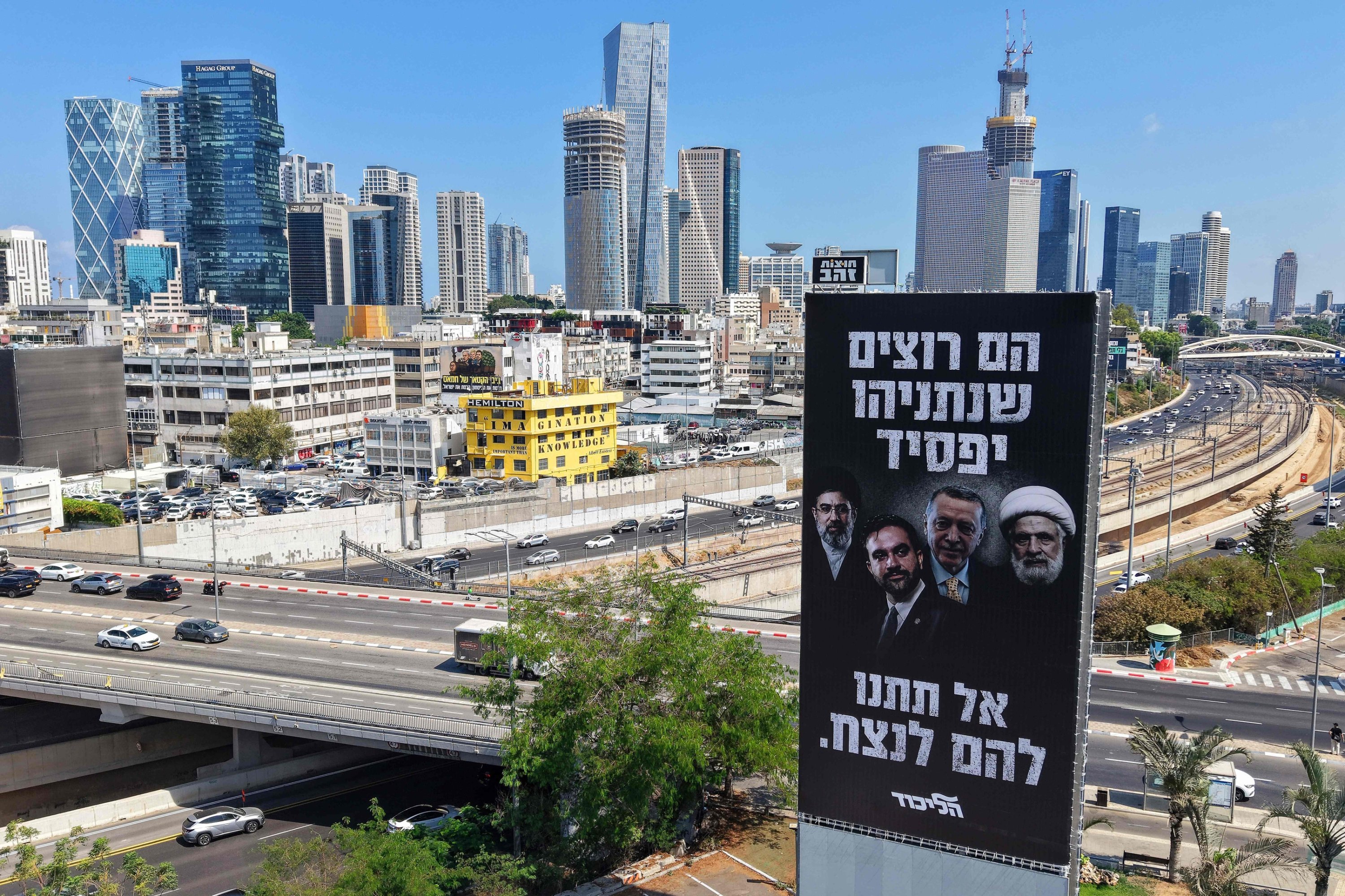
In recent days, Israel’s actions have increasingly raised the risk of tension and conflict across the Middle East. The extent to which this has evolved into a deliberate “politics of threat” ahead of Israel’s Oct. 27 elections is certainly noteworthy. Yet, are elections the only factor shaping Netanyahu’s policy? In my view, they are not.
The broader issue lies in the changing power dynamics across the Middle East and, more broadly, the emerging geopolitical balance throughout Afro-Eurasia. From this perspective, Israel’s Aug. 18 strikes on Syria’s Abu al-Duhur air base should be considered within a much wider geopolitical framework. The attack is particularly significant because the base had been out of service for a considerable period. Israel was therefore not targeting an active military capability; rather, it was targeting a potential capability that could emerge in the future with Türkiye’s support. Israel claimed that Syria was preparing to allow the deployment of Turkish troops at the facility.
Damascus rejected this claim, while Syrian Foreign Minister Asaad al-Shaibani stated that Abu al-Duhur was being rehabilitated for the Syrian Air Force and that there were no plans to establish a permanent Turkish military base there. Nevertheless, the Netanyahu government’s portrayal of Türkiye’s growing presence in Syria as an unacceptable security threshold is highly significant. Although the Abu al-Duhur strike may appear to be a conjunctural military move, a larger question lies behind it: Is Israel primarily concerned with what exists at Abu al-Duhur today, or with an emerging regional power and security architecture in which Türkiye is becoming increasingly central?
Netanyahu’s electoral strategy
Netanyahu is facing an increasingly difficult domestic political environment. The opposition has long criticized him, particularly over the security failure of Oct. 7, the Gaza war, and his government’s broader policies. Recent election polls have further exposed this political vulnerability. With opposition parties gaining ground and Likud potentially remaining within the low-to-mid 20-seat range, Netanyahu faces growing uncertainty over his political future after the elections. If he fails to secure the electoral outcome he seeks, two major consequences could follow.
The first concerns his domestic political future. His ongoing corruption trial would once again become a central issue shaping his political position. A loss of political power could therefore make Netanyahu’s ongoing legal challenges increasingly significant.
The second dimension concerns foreign policy and international law. As is well known, the International Criminal Court (ICC) has issued an arrest warrant for Netanyahu in connection with the Gaza war. Although Israel and the United States reject the ICC’s jurisdiction over Netanyahu and oppose the warrant, the question of enforcement remains relevant for states that are parties to the court. Consequently, any future foreign travel by Netanyahu could continue to involve significant legal and diplomatic constraints.
Netanyahu therefore faces legal pressure on two fronts: internationally, in relation to the Gaza war and the ICC process, and domestically, through the cases continuing before Israeli courts.
It is precisely within this context that Netanyahu’s attempt to construct a powerful “external threat” ahead of the elections becomes particularly significant. Türkiye has increasingly become one of the actors through which this narrative is being concretized. This instrumentalization is also being debated within Israel. Opposition circles have long criticized Netanyahu for using external security challenges to reinforce his own political position.
Instrumentalizing foreign policy
Three major developments warrant consideration at this point. The first and most immediate is Syria’s reconstruction. The fundamental question is why Israel is so concerned about Syria rebuilding its own military capacity. Following the fall of the Assad regime, Israel gained considerable operational freedom in Syrian airspace.
From Türkiye’s perspective, strengthening Syria, rebuilding state capacity, restoring territorial integrity, and eliminating the operational space available to terrorist organizations are fundamental matters of stability. Stability, like conflict, tends to spread and therefore constitutes one of the essential conditions for regional peace.
In short, the restoration of Syrian state capacity would mean a gradual narrowing of the operational space in which Israel has so far pursued aggressive and unilateral policies on Syrian territory.
The second development is the “Mecca agreement.” The emerging security framework between Türkiye, Saudi Arabia and Pakistan represents the formation of a significant new center of power in the region. Yet this should not be understood solely in terms of military capabilities. It offers a much broader regional vision extending from defense and energy to food security and economic cooperation, based on a fundamentally different approach from Israel’s predominantly security-centered regional policies.
Palestine constitutes another important dimension of this divergence. Türkiye, Saudi Arabia and Pakistan all support the establishment of an independent Palestinian state based on the 1967 borders. Their growing strategic cooperation therefore represents not only a potential shift in the military balance but also the emergence of a political center capable of developing a more coordinated position on the Palestinian question.
The third development concerns the changing geography of regional connectivity, particularly through the Development Road and discussions about reviving the Hejaz Railway. Power competition in the Middle East is no longer conducted solely through territory and military capabilities. It increasingly involves energy networks, railways, ports and trade corridors.
Israel has long sought to position itself as a central actor in the corridor competition across the Eastern Mediterranean and the Middle East. IMEC, together with Israel’s growing energy and connectivity relations with Greece and the Greek Cypriot administration, forms part of this geopolitical strategy.
In contrast, the Development Road, a potentially revived Hejaz Railway, and Syria’s reintegration into regional transportation networks could create an alternative Afro-Eurasian connectivity architecture centered increasingly on Türkiye. Such a transformation could reshape existing routes by connecting the Gulf to Türkiye and, from there, to the Black Sea, the Caucasus, the Mediterranean and Europe.
Israel’s increasingly confrontational approach toward Türkiye should therefore not be interpreted solely through bilateral tensions or Netanyahu’s electoral strategy. Syria’s reconstruction, the new center of power emerging around the “Mecca agreement,” and the development of Türkiye-centered energy and trade corridors are different dimensions of the same geopolitical transformation.
DAILYSABAH
هلدینگ کاسپین استانبول | خرید ملک در ترکیه | صرافی معتبر ایرانی در ترکیه | خرید و فروش طلا در ترکیه | مهاجرت به ترکیه | واردات و صادرات در ترکیه | نیازمندیهای ترکیه | اخبار ترکیه | اخبار جهانی | توریست ایران | خدمات توریستی در ایران | تورهای گردشگری ایران | هلدینگ اول | خدمات کاریابی و فریلنسری و شغل | مرجع اطلاعات ایران (همه چیز در ایران) | کیف پول و خدمات مالی و پرداخت یار | اخبار ایران | تابلو زنده قیمت ارز در ترکیه و استانبول | صرافی آنلاین ترکیه | قیمت طلا و نقره در ترکیه | سرمایه گذاری در ترکیه | جواهرات در ترکیه | نرخ لحظه ای ارزها در استانبول | قیمت دلار امروز در ترکیه | قیمت دلار استانبول امروز | قیمت لحظه ای دلار | اخبار روز ترکیه استانبول | اپلیکیشن ISTEX | اپلیکیشن قیمت لحظه ای دلار و یورو و لیر و ارزها در ترکیه
About the Author