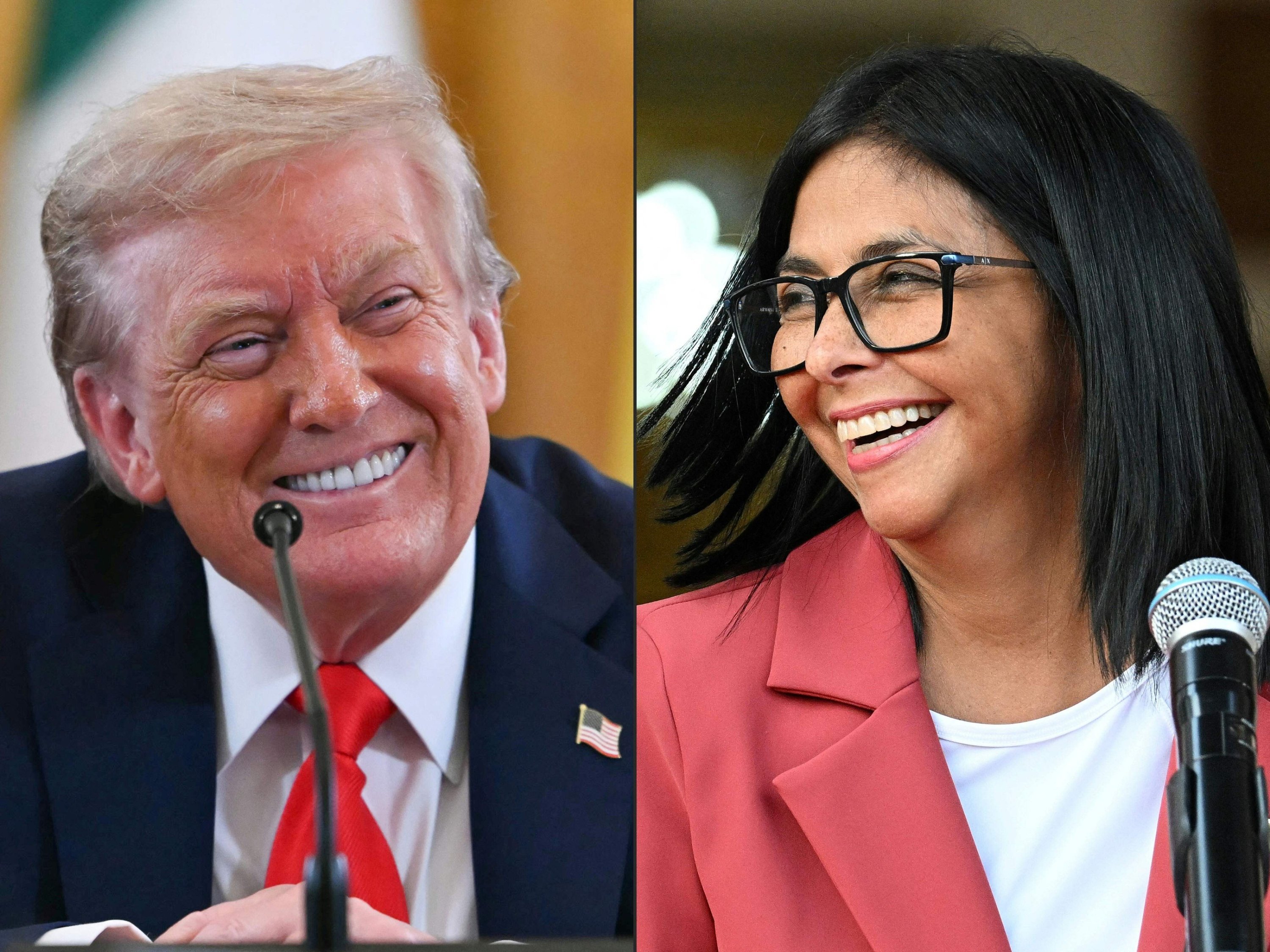
Venezuela’s interim leader Delcy Rodriguez sought to reassure the public on Saturday that Caracas would control its oil under a new agreement that allows the U.S. significant access to it.
The U.S. will have majority control of 65 billion barrels of Venezuela’s proven reserves in what President Donald Trump described Friday as “the biggest oil deal in world history.”
“One thing must be absolutely clear: Venezuela retains ownership and sovereignty over its resources,” Rodriguez said in a speech on state television.
The agreement with the U.S. aims to turn “cold, inert” resources underground to “a source of social and economic well-being for the people of Venezuela,” she said.
In a late night address, she hailed the accord as a “historic” deal that would help revive the economy and boost government revenue, saying it would help shape the country’s future.
“This 25-year bilateral project envisages the development of 17 strategic oilfields with a production target of more than 1.5 million barrels per day,” Rodriguez said on state broadcaster VTV.
Caracas says the deal involves $100 billion in private investment aimed at revitalizing the industry in a country with the world’s largest proven oil reserves.
But a lack of transparency is raising concerns among Venezuelans, including supporters of the government. A flood of social media comments decried loss of sovereignty, meager benefits and political costs.
“We don’t know who this will benefit – whether it’s Venezuela or (the United States),” said Jesus Salazar, a 68-year-old security guard.
“I have my doubts, but we’ll have to wait and see what happens.”
Venezuela’s government has operated under intense pressure from the Trump administration since American forces ousted and captured longtime President Nicolas Maduro in January.
Washington allowed Rodriguez, his vice president, to stay on as interim leader.
Venezuela’s ruling party said Saturday it supports economic measures that “prioritize national interests and make it possible to overcome the impact of more than a decade of economic sanctions, unilateral coercive measures, and unjust blockades.”
The party consistently blames U.S. sanctions for the collapse of Venezuela’s economy.
Petrol, poverty
Rodriguez has pushed through reforms in Venezuela’s mining and petroleum industries, opening once tightly controlled sectors to private capital and foreign investment.
Washington, for its part, has eased sanctions imposed on Venezuela’s oil sector under the Maduro government.
Oil production rose by 29.8% between January and July, reaching 1.2 million barrels per day (bpd) – but still well below the 3 million barrels per day produced a quarter of a century ago.
The U.S. deal aims to restore production to those levels, but analysts agree it would take time.
“The increase in production won’t be seen for at least three or four years,” said engineer Oswaldo Felizzola, a professor at the Institute of Higher Studies in Administration (IESA) in Caracas.
He welcomed the U.S. acting as a “guarantor” for investments in Venezuela, which has failed to attract significant capital for more than a decade.
“Without this, these fields would not be developed over the next 10 or 15 years,” because state-owned Petroleos de Venezuela (PDVSA) “does not have the financial resources to do so.”
An initiative of this magnitude could accelerate long-awaited economic recovery in Venezuela, a country still reeling from the brutal 80% contraction between 2014 and 2021 that plunged millions of Venezuelans into poverty.
Many survive on a monthly minimum wage equivalent to $0.16, plus government subsidies that can reach $240 per month – still far short of the estimated $730 needed to buy basic food necessities for a family of five.
Doubt, optimism
Carlos Baco, a 74-year-old government employee, hopes oil revenues will start flowing under the new deal, but said he hasn’t felt the effects of the increase in oil production over the past few months.
“Consumer goods and food are more expensive … the dollar is rising and prices are going up,” he said. “It’s impossible here.”
Rodriguez has promised more than $204 billion in tax revenue from the deal, without providing details.
For analyst Elias Ferrer of the Orinoco think tank, the investment is good news, even without specifics.
“It’s undoubtedly better than before. Before, this oil wasn’t being extracted; if no one extracts it, no one pays royalties, and no one profits from it,” he said.
“If everything is done correctly … this will be a great opportunity for Venezuela to see its oil sector revived,” said attorney Dolores Dobarro, Venezuela’s former deputy minister of energy.
DAILYSABAH
هلدینگ کاسپین استانبول | خرید ملک در ترکیه | صرافی معتبر ایرانی در ترکیه | خرید و فروش طلا در ترکیه | مهاجرت به ترکیه | واردات و صادرات در ترکیه | نیازمندیهای ترکیه | اخبار ترکیه | اخبار جهانی | توریست ایران | خدمات توریستی در ایران | تورهای گردشگری ایران | هلدینگ اول | خدمات کاریابی و فریلنسری و شغل | مرجع اطلاعات ایران (همه چیز در ایران) | کیف پول و خدمات مالی و پرداخت یار | اخبار ایران | تابلو زنده قیمت ارز در ترکیه و استانبول | صرافی آنلاین ترکیه | قیمت طلا و نقره در ترکیه | سرمایه گذاری در ترکیه | جواهرات در ترکیه | نرخ لحظه ای ارزها در استانبول | قیمت دلار امروز در ترکیه | قیمت دلار استانبول امروز | قیمت لحظه ای دلار | اخبار روز ترکیه استانبول | اپلیکیشن ISTEX | اپلیکیشن قیمت لحظه ای دلار و یورو و لیر و ارزها در ترکیه
About the Author