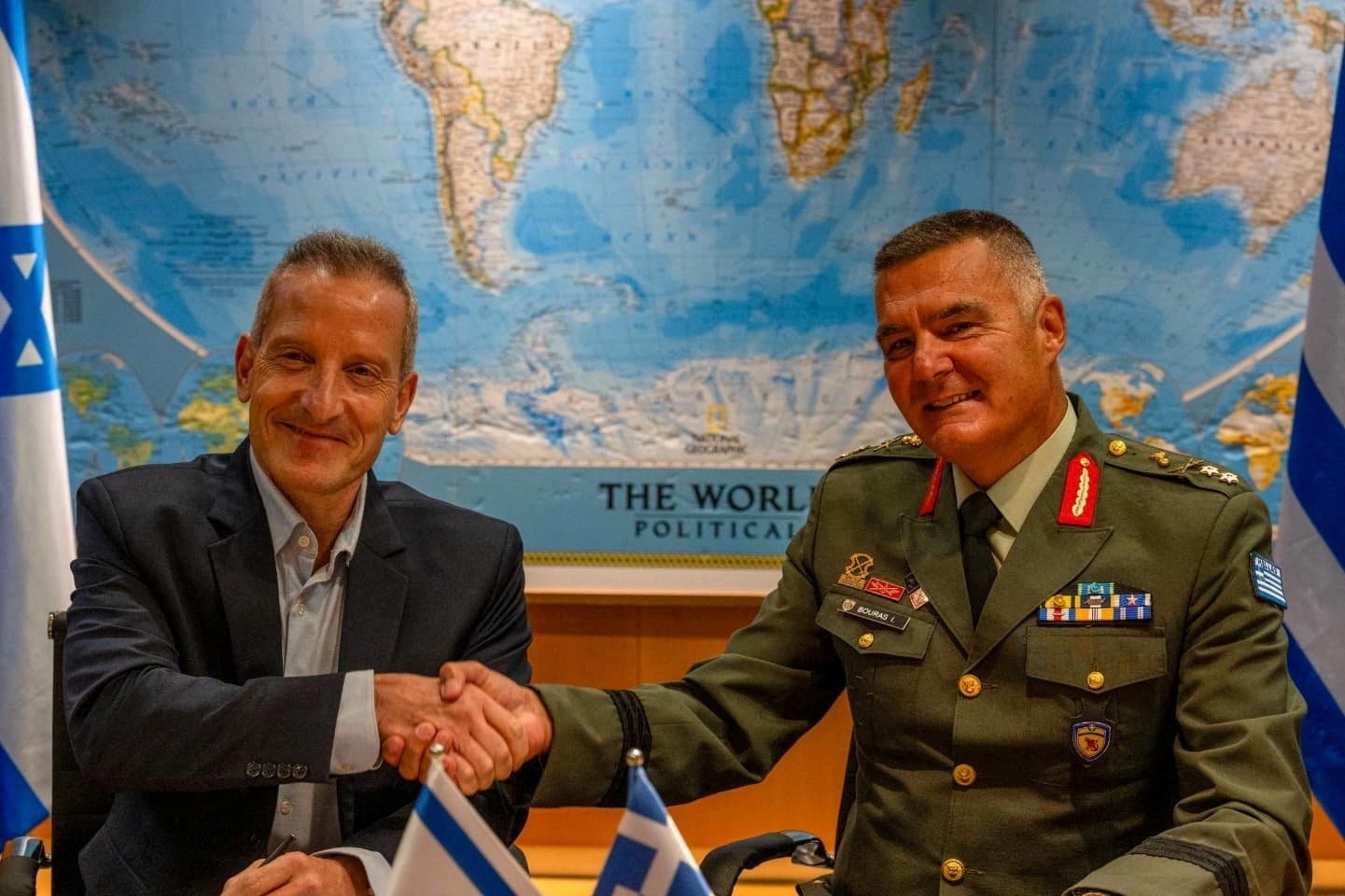
One year to the next election and, amid growing public anger against Israel’s genocidal campaign in Gaza, the Mitsotakis government of Greece appears to be gambling away political fortunes with a major deal with Israel. The deal, signed on Monday, is one of the biggest for Israel and will reinforce Greece’s “Achilles Shield” aerial defense system. For Mitsotakis, however, it may be his Achilles’ heel in the 2027 election. A survey released by Pew Research Center in June shows that although the Greek public is still warm toward Israel, only 30% of the nation has a positive opinion of the country after the start of a new round of Palestine-Israel conflict in 2025.
Since 2025, Greece has been the scene of pro-Palestine demonstrations, denouncing genocide in Gaza. Earlier this month, a major protest was held in Piraeus as an Israeli cruise ship docked there. The protest has called on Greece to cease cooperation with Israel, but Athens responded with the 3 billion euros deal on Monday. “The security agreement signed today with Greece, one of the largest in the country’s history, is a direct continuation of the Eastern Mediterranean alliance we forged a decade ago with Greece and (southern) Cyprus. It serves as further proof of the tremendous capabilities of Israel’s defense and technological industries,” Prime Minister Benjamin Netanyahu said. “This move expresses Israel’s strength, the confidence in our defense exports, and the strengthening of regional alliances.”
“Deeply ashamed that, despite a sizeable majority of Greeks opposing the genocidal Apartheid state, we have allowed our ruling class to taint Greece through this despicable deal,” Greece’s former Finance Minister Yanis Varoufakis said in a social media post on Monday.
Varoufakis’ former party Syriza was also quick to denounce the government over the deal. Syriza said in a statement on Monday that the deal deepens Greece’s defense/military dependence on the “genocidal government of Israel,” “which violates international law.” Syriza said the government portrayed the deal as a triumph, but questions remained over how the country would remain independent in its air defense network. “Is our country really gaining greater strategic autonomy or is it integrating its defenses into the Israeli-American security system?” Syriza asked in its statement.
The Communist Party of Greece (KKE) termed the deal as a “dangerous decision” by the Mitsotakis government, “to accelerate war preparations and deepen the involvement of our country in imperialist wars and plans.”
“Strategic relations with the murderous state of Israel and joint war preparations add fuel to the imperialist plans in the region,” a statement by the party on Monday said.
For Israel, it is an alliance against “shared regional challenges,” as Israeli Defense Minister Israel Katz put it in a statement. Both countries are at odds with Greece’s neighbor Türkiye, and Katz, without naming Türkiye openly, said Israel and Greece would deepen their defense and strategic cooperation at a time “when actors with hegemonic ambitions are seeking to expand their influence.” Israel, which repeatedly carried out attacks in Syria since the fall of the Baathist regime in 2024 there, has recently bombed a military base under the pretext of preventing so-called Turkish plans to establish a foothold there.
Adonis Georgiadis, Greece’s health minister, was more blunt in defense of the deal’s target. Georgiadis, who was once denounced as anti-Semitic by Israeli circles, has been a champion of relations with Israel, defining the country as “a true miracle of humanity” in a social media post in May. In response to the opposition’s criticism, Georgiadis was quoted by the Greek media praising the deal. “It secures the freedom of Greece against a Turkish threat,” he was quoted.