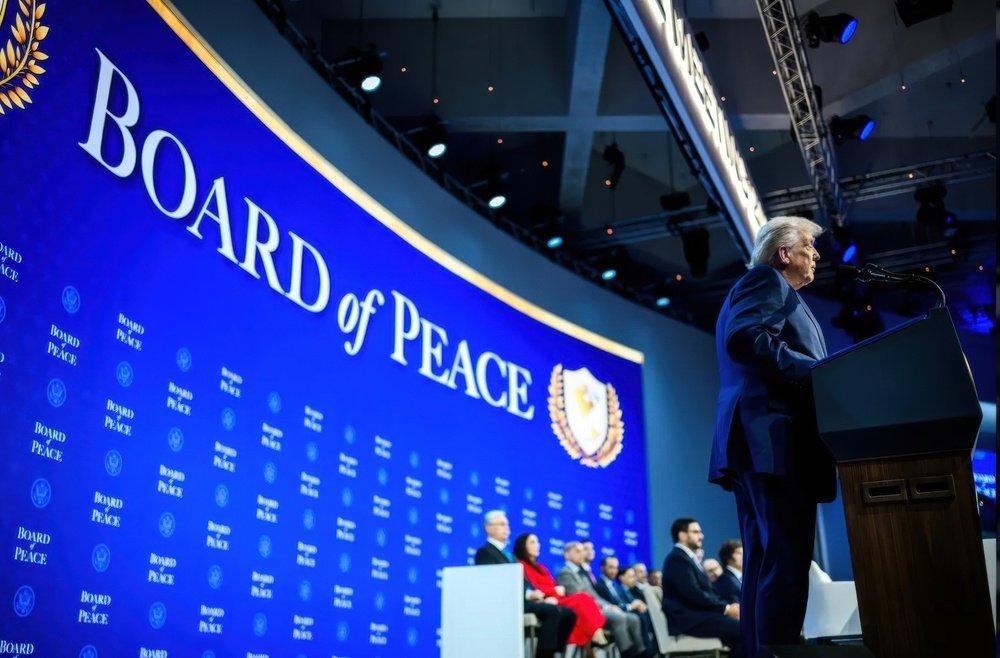
The establishment of the Board of Peace (BoP) by U.S. President Donald Trump represents far more than an attempt to manage the aftermath of the Israeli genocidal war on Gaza. Months after its establishment, it has become clear that it is nothing more than a tool to pressure the oppressed in favor of the oppressor, replicating the same old U.S. approach that is far from the standards of international justice, laws and United Nations resolutions, just as it has in the handling of the Palestinian issue.
Yet, the idea of the BoP goes far beyond addressing the aftermath of the Israeli destructive war on Gaza, as it represents the Trump administration’s ambition to preserve a de facto U.S.-led world order through mechanisms that serve its interests alone, excluding even its Western allies, while seeking to systematically topple the role of the U.N. and the remaining respect for international law. What has become increasingly clear is that the board is designed not for peace, but for hegemony, setting a new, dangerous precedent in the post-World War II world order.
Feudal body in global cloth
The BoP, on its face, was approved by the U.N. Security Council in November 2025 through Resolution 2803 as a means to manage the fragile cease-fire in Gaza. However, its “charter,” circulated to dozens of countries after its establishment, makes absolutely no mention of Gaza. Instead, the document frames the board as a permanent fixture, a “more nimble and effective international peace-building body” with “the courage to depart from approaches and institutions that have too often failed.” The reference to “failed institutions” is a clear exclusionary attack on the U.N. itself and a prelude to its attempt to replace the agreed-upon international structures.
This is not an international organization. It is a “Trump-dominated pay-to-play club,” as described by Western media. The rules are stark: membership is by invitation only, with a three-year term for most, but a permanent seat can be bought for a $1 billion “life membership” fee. The chair, Donald Trump, the only person named in the charter, is granted absolute power. He can select and terminate members at will, set the agenda, issue resolutions unilaterally, and even appoint his own successor. As one observer put it, this creates an “imperial court” where “vassal states pay cash and vie for the ear of the orange emperor.” It sets a dangerous precedent for the “rule of the jungle,” unbound by international law.
Europe first to criticize
Western media and political establishments were early and vocal in their condemnation of this project, recognizing it for what it is: a blatant attempt to bypass the international order established since 1945. The criticism was swift and sharp. The Guardian famously described it as a “global version of his Mar-a-Lago court aimed at supplanting the U.N. itself” and compared it to a “feudal system.” The BBC also earlier reported that the plan “resembles, at its heart, a colonial solution imposed over the heads of the Palestinians.” The Financial Times called it “an idiosyncratic rival to the U.N.”
This sentiment was echoed by dozens of Western think tanks, with Chatham House’s program director for international law noting that the U.S. sought U.N. legitimacy “while trying to keep U.N. influence and control over the operation as small as possible.” The board’s charter, with its echoes of the U.N. Charter but devoid of any principles of self-determination or equal rights of nations, was seen as a subversion of the growing multilateral system.
The BoP has also become a stark reflection of the increasing rift between the United States and its European allies. European nations have largely distanced themselves from what they see as a U.S. imperial project. Only a small number of EU countries, such as Bulgaria and Hungary, have signed on, while major powers like France and the U.K. have declined, citing contradictions with the U.N. Charter.
Belgium, a country that often champions small-state representation, expressed fear that the board undermines the balance of equal representation and diminishes the role of smaller nations. The EU’s foreign policy chief, Kaja Kallas, accused Trump of using the board as a tool for his personal interests, highlighting the “glaring discrepancy” between the Security Council resolution and the board’s structure. At the Munich Security Conference, she emphasized that the new statute does not reflect the original mandate for Gaza. Europe’s overarching fear is that the board will exclude it from participating in critical global decisions, undermining a multilateral system that, despite its flaws, provided a framework for European influence.
World is bigger than BoP
Türkiye has long championed the principle that “the world is bigger than five,” a call for a more just and inclusive global order that moves beyond the veto-dominated framework of the U.N. Security Council. That principle remains as urgent as ever. But the emergence of the BoP demands that we go a step further. For if the world is bigger than five permanent members, it is certainly bigger than a single imperial-minded leader and a board that he alone controls.
Day after day, it becomes clearer that this project is the embodiment of an imperialist idea that abandons the equal basis the U.N. seeks to preserve. While the U.N. system has been grossly malfunctioning, its failures to prevent injustices, particularly in Palestine, are undeniable; it still offers a semblance of a rules-based order. It is, without a doubt, a safer alternative than the Board of Peace, which is “everything but peace.”
Even if the Palestinian people, under the crushing pressure of Israeli genocide, find themselves compelled to deal with this entity, it must not be allowed to prosper. To do so would be to lay the foundation for the rule of a strong global order where might makes right. It is not the Palestinians’ responsibility to dismantle this project; it is a common responsibility for the entire world.
While several countries in the past two decades launched initiatives for a more enhanced international system, greater justice, fairness and multilateralism, including the most famous one of Türkiye “the world is bigger than five,” the U.S. not only resisted these ideas but sought, as in the Board’s idea, to consolidate its grip on the world order, pushing us to say back that the world is bigger than this board.
The views and opinions expressed in this article are solely those of the author. They do not necessarily reflect the editorial stance, values or position of Daily Sabah. The newspaper provides space for diverse perspectives as part of its commitment to open and informed public discussion.
DAILYSABAH
هلدینگ کاسپین استانبول | خرید ملک در ترکیه | صرافی معتبر ایرانی در ترکیه | خرید و فروش طلا در ترکیه | مهاجرت به ترکیه | واردات و صادرات در ترکیه | نیازمندیهای ترکیه | اخبار ترکیه | اخبار جهانی | توریست ایران | خدمات توریستی در ایران | تورهای گردشگری ایران | هلدینگ اول | خدمات کاریابی و فریلنسری و شغل | مرجع اطلاعات ایران (همه چیز در ایران) | کیف پول و خدمات مالی و پرداخت یار | اخبار ایران | تابلو زنده قیمت ارز در ترکیه و استانبول | صرافی آنلاین ترکیه | قیمت طلا و نقره در ترکیه | سرمایه گذاری در ترکیه | جواهرات در ترکیه | نرخ لحظه ای ارزها در استانبول | قیمت دلار امروز در ترکیه | قیمت دلار استانبول امروز | قیمت لحظه ای دلار | اخبار روز ترکیه استانبول | اپلیکیشن ISTEX | اپلیکیشن قیمت لحظه ای دلار و یورو و لیر و ارزها در ترکیه
About the Author