Home – CBSNews.com
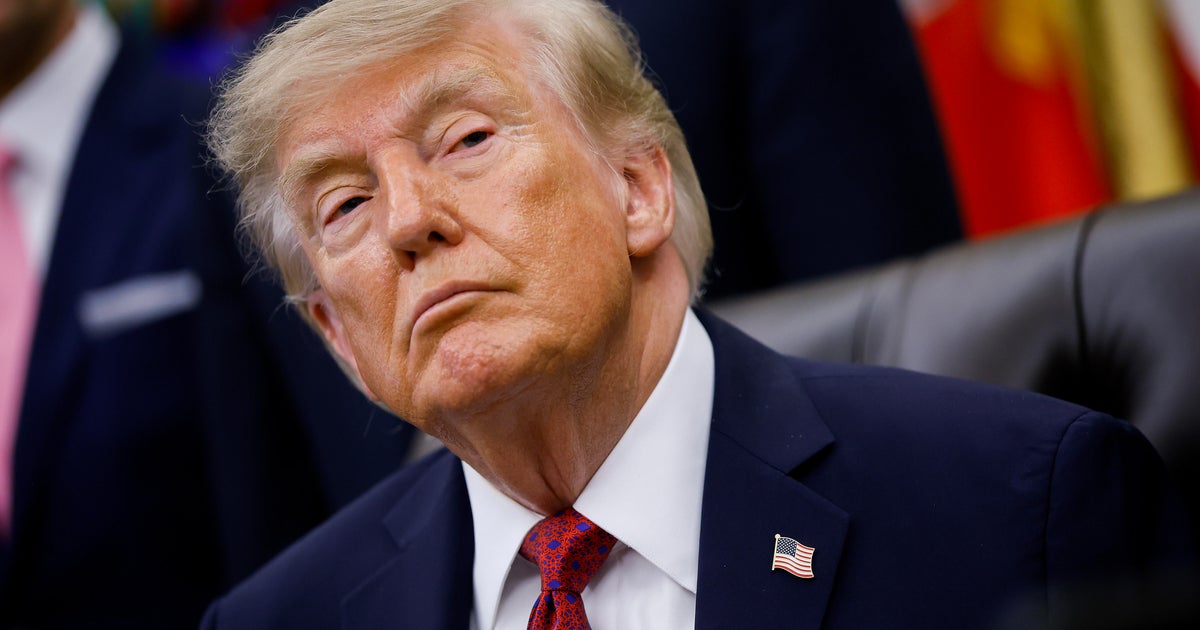
President Trump told reporters he’s considering striking Pickaxe Mountain, a subterranean site in Iran that some analysts believe could be part of the country’s nuclear program — reiterating a threat the president has made for months.
“Iran will not have a nuclear weapon. We’ve stopped them from having. We may hit Pickaxe very soon because if there was anything going on with Pickaxe,” the president told reporters. “We know everybody that’s moving at Pickaxe. We know everybody that’s moving everywhere all over Iran, and if anything goes bad, we hit them. We hit them hard.”
President Donald Trump said Friday the Iran war was “small potatoes” for the United States, a day after Vice President JD Vance said he wouldn’t describe the conflict as a war.
“A lot of people don’t call it a war. I call it a military conflict because it’s small potatoes for us. It’s not a big thing. We did Venezuela, and we did this,” Trump told reporters when asked about Vance’s comments.
In a post on Truth Social on Friday morning, though, Mr. Trump referred to it as a war multiple times.
Asked if the war would be over by the midterm elections, Vance disputed whether the conflict was still a war.
“I wouldn’t call it a war,” Vance said Thursday during a White House news briefing. “Right now, there is no active shooting. I recognize there have been places where this has flared up.”
The vice president also said major combat operations ended after about six weeks. An Air Force email from August, obtained by CBS News, shows the Pentagon was instructing personnel to stop referring to the ongoing U.S. military operations in Iran as “Operation Epic Fury” — three months after the Trump administration declared it had ended.
CBS/AFP
An Israeli strike in southern Lebanon killed two people on Friday, Lebanese official media said, despite a truce with Iran-backed Hezbollah.
Lebanon’s state-run National News Agency reported the strike hit near the strategic Ali al-Taher ridge, which the Israeli army said it had captured, though Hezbollah did not confirm losing it.
Two young men were “targeted while riding a motorcycle” in the city of Nabatieh, NNA said, adding that rescuers transported their bodies to a local hospital.
Israel announced on Thursday it had taken control of the ridge, Defense Minister Israel Katz said the military would work to “prevent the enemy from re-establishing itself in the area.”
Imran Riza, the U.N. humanitarian coordinator for Lebanon, said Friday on X that families returning to Nabatieh following the truce “face widespread destruction, lack of basic services, ongoing insecurity and uncertainty.” More than 4,300 people have been killed in Lebanon since Israel began attacks on March 2, according to the Lebanese health ministry.
The U.S. Embassy in Beirut called the decision by Israel to release prisoners from Lebanon a “positive step” as the two sides work to fulfill a deal bartered by the U.S. earlier this summer.
“We welcome Israel’s release of prisoners as part of the Lebanon-Israel Trilateral Framework,” the embassy said on X. “This is a positive step. We urge both sides to continue to build on this momentum ahead of the next round of talks.”
Israel freed four prisoners from Lebanon on Friday, one day after freeing the first prisoner as part of the trilateral agreement signed between the U.S., Israel and Lebanon in late June. The 13th point in the 14-point agreement agreed both sides would “pledge to work towards the search for and return of remains and the release of detainees.”
In return for the prisoners released by Israel, Lebanon said it would search for the bodies of Jewish Lebanese citizens from the Lebanese civil war fought in the 1970s and ’80s.
The implementation of key provisions in the trilateral agreement have been slow to come to reality. The biggest objective was for Israeli forces to exit southern Lebanon and hand over security to the Lebanese army. However, this would only occur once the Iran-backed Hezbollah militia in the country surrendered its weapons and exited the security zone.
Hezbollah, which was not party to the trilateral agreement, has not disarmed and has continued to carry out occasional attacks on Israeli soldiers, largely making the agreement moot.
The U.S. issued sanctions Friday against a Turkish financial firm that the U.S. Treasury alleges is connected to Iran’s Revolutionary Guard.
Golden Global Yatirim Bankasi Anonim Sirketi, which is based in Turkey, allegedly has facilitated tens of millions of dollars in transactions to the Islamic Revolutionary Guard Corps, according to the Treasury.
The Treasury called the bank a “critical financial lifeline” for the Iranian regime.
“Financial institutions continue to find out the hard way that we are serious about Operation Economic Outcast,” Treasury Secretary Scott Bessent said in a statement. “While we hope no more banks will need to be sanctioned, that ultimately depends on how quickly the international community comes to its senses and ceases support of the murderous Iranian regime. We know who you are, we know where you are, and we will continue to take action together with our allies and partners until we have buried the head of the Iranian snake.”
The Trump administration recently sanctioned the United Arab Emirates branches of Banque Misr, which is based in Egypt. The sanctions only target the ones based in the UAE, which the U.S. also accused of being a lifeline to Iran’s economy.
President Trump’s top economic adviser attempted to downplay the rising prices at the gas pump this Labor Day weekend — including a record high for the holiday — and said he constantly updates the president on how much oil is getting out of the Strait of Hormuz.
“It’s a very short-term thing,” National Economic Council Director Kevin Hassett told Fox News Channel on Friday. “I get an update, just so you know, because the president wants us watching this every day, I get an update every morning about how much oil is making it through the straits, how much oil is going.”
“The Saudis have lifted the amount of oil going through their pipeline that goes to the Red Sea, and so we’re getting updates every day and thinking of everything we could do to make prices lower at the pump,” Hassett continued.
The cost of a gallon of regular is currently $4.15, according to AAA. Gas has never cost more than $4 a gallon on Labor Day. The price has gone up about 6 cents in the last week, and just shy of $1 since a year ago.
Diesel, which affects the cost of every item that needs to be shipped around the country and world, also crossed an all-time high on Friday.
Iranian President Masoud Pezeshkian told Iranian state TV that the government “is not seeking to impose any order or decision on the people” when it comes to managing growing economic concerns for Iranians.
Pezeshkian said the public should be prepared to manage energy consumption and said the government is not currently planning to raise gas prices. He said fuel consumption would instead be managed through non-pricing measures.
“The government’s policy is to manage and control consumption using mainly non-price tools and policies, and under no circumstances should decisions in this area be made in a way that exposes society to sudden and shocking behavior,” Pezeshkian told Iranian state TV.
“Every amount of savings and revenue resulting from reduced gasoline consumption will be spent on strengthening the electronic food voucher program, and no other use will be considered for these resources,” he said.
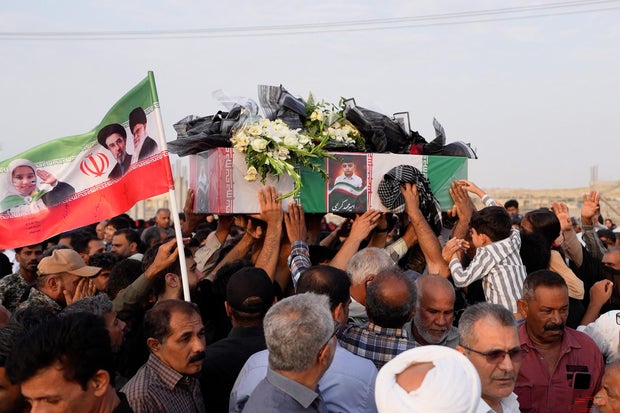
Video aired by Iranian media outlets and shared widely on social media showed thousands of mourners and local officials attending the funeral on Thursday of 4-year-old Amir Mohammad Karimi, who was among at least four people Iranian officials say were killed Tuesday when a U.S. airstrike allegedly hit a wedding party in a home in the city of Kuhestak.
A coffin bearing a photo of the young boy was carried through the streets of Kuhetsak, in Iran’s southern Hormozgan Province, before being buried, photos and video from Iranian and international media showed.
Morteza Akhondi/Getty
The U.S. military’s Central Command has said it is looking into the reports that an American strike hit the wedding, though Vice President JD Vance said Thursday he was “extremely skeptical” of the Iranian allegations.
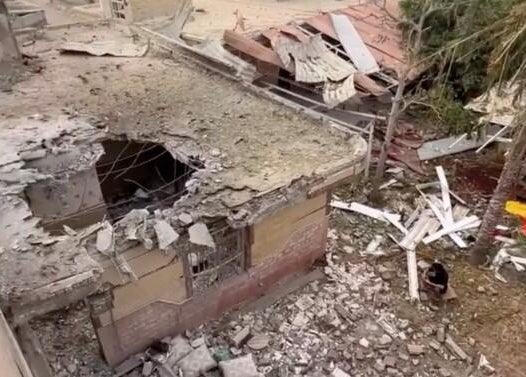
Iranian officials have said a U.S. missile crashed through the roof of the home Tuesday evening, and the Reuters news agency said four military weapons experts, after reviewing video and photos of the aftermath, determined that it appeared to have been a likely “direct hit with a U.S. munition,” rather than a ricochet or some other indirect fire.
Iranian Red Crescent Society/Handout/REUTERS
CENTCOM spokesman Capt. Tim Hawkins stressed earlier this week that the “U.S. military does not target civilians.”
Vance reiterated that point to reporters at the White House on Thursday, adding: “Unfortunately, obviously, sometimes things happen, but in this particular case, I don’t think that we have any information one way or the other.”
“We’re investigating it because obviously we care, we want to know,” Vance said.
Iranian army spokesman Brig. Gen. Mohammad Akrami-Nia argued Friday that the U.S. and Israel had failed to achieve their primary objectives in the war.
“The enemy had set many objectives in its attack on Iran, including the destruction of missile and nuclear capabilities, overthrowing the system and, of course, the partition of Iran. But it failed to achieve all of these objectives,” he declared in a statement relayed by state news agency IRNA.
Akrami-Nia said Iran’s enemies had made several miscalculations, including “not correctly understanding the Iranian people” and “not correctly understanding the military capabilities of the Islamic Republic of Iran.”
He also said the U.S. had failed to anticipate Iran’s ability to control the globally crucial shipping lanes through the Strait of Hormuz, and had failed to secure support from its NATO and other allies ahead of the war.
An Iranian government spokeswoman acknowledged Friday that the country is facing economic pressure and shortages, insisting that officials do not deny the difficulties confronting regular Iranians.
Fatemeh Mohajerani, speaking at the opening of a 64-bed hospital in the western Ilam Province, said U.S. sanctions had impacted the implementation of infrastructure projects across the country.
“The government does not deny the economic pressure on the people and the shortages, and whenever we have spoken to the people honestly and transparently, the people have also cooperated with the officials,” she said, according to Iran’s state news agency IRNA.
She said delays in completing infrastructure projects “should not be attributed to the inefficiency of managers, because the severe sanctions have affected the process of securing resources and implementing projects.”
Mohajerani said Iran’s government would continue efforts to complete unfinished projects despite the constraints.
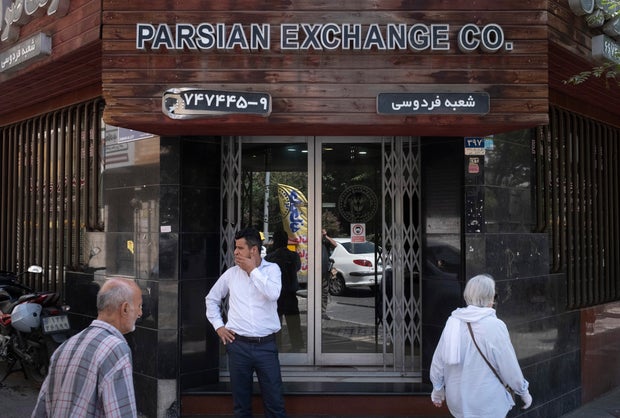
Iran’s Central Bank Governor Abdolnaser Hemmati, meanwhile, was quoted on Friday as telling state television that the bank would intervene in the foreign currency exchange market “in a timely and forceful manner” when necessary, acknowledging that the war with the U.S. had caused “abnormal fluctuations in the market.”
Morteza Nikoubazl/NurPhoto/Getty
“Whenever rates move away from economic realities, intervention will take place so that market traders do not regard the fluctuations as one-way,” he said, without laying out any specific plans.
The value of Iran’s currency, the rial, has been falling for years under foreign sanctions pressure, and the U.S. military blockade of Iranian oil exports has depleted it further and sent inflation to record levels in the Islamic Republic. As of Friday, one U.S. dollar was worth a record 2.2 million rials on the black market, which is how most Iranians and visitors to the country access foreign currency.
There is a sharp gap between that rate, however, and the official rate determined by the government, which, as of Friday, put the rial at about 42,000 to the dollar. The vast gulf in the official exchange rate and the rate paid by virtually all normal Iranians has fueled concern over currency volatility and the rising cost of imports and other goods inside the country.
Lebanese President Joseph Aoun thanked President Trump and the U.S. for “all the efforts and initiatives” that on Friday “led to the release of the first group of Lebanese detainees held by the Israeli government.”
Israel handed over one former detainee on Thursday and four more Friday, the International Committee of the Red Cross, which acted as an intermediary for the transfers, confirmed in a statement Friday.
The five were among about 30 people from Lebanon who have been detained by Israel before and during its war against the Iran-backed Hezbollah group, according to reports by The Times of Israel and the BBC.

Houssam Shbaro/Anadolu/Getty
“Many families in Lebanon are still waiting for answers about the fate of loved ones who may be detained, deceased or otherwise unaccounted for,” the ICRC said in its statement, noting that it “continues to engage with the families themselves and remains determined to clarify the fate of their loved ones.”
The ICRC also said it had not been given access to “detainees held in Israeli places of detention, including Lebanese nationals,” since the war in Gaza started in October 2023, and it reiterated “the requirement to receive information on conflict-related detainees and to be granted access to them.”
In his statement, Lebanon’s president called the release of the five nationals this week a first step to reaffirm “the effectiveness of the firm Lebanese position” as his government works toward “the restoration of full Lebanese sovereignty.”
Israel’s government announced the release on Thursday, saying interrogations determined the five former detainees were “civilians who are not members of any terrorist organization, have not engaged in terrorism, and there is no reason to continue holding them in Israel.”
Israeli forces have occupied a strip of land stretching about 6 miles into Lebanese territory from Israel’s border. Israeli officials have said the troops will remain in the “security zone,” and not allow the thousands of Lebanese residents forced to evacuate from it return until the threat posed by Hezbollah is eliminated.
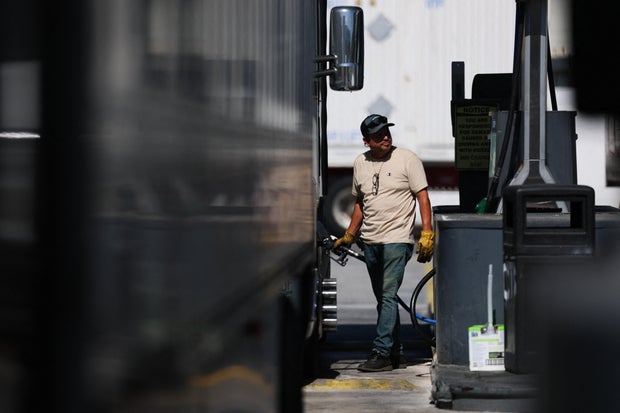
U.S. gas prices surged ahead of Labor Day weekend, with diesel hitting a record of $5.85 a gallon Friday, eclipsing its prior mark of $5.81, set in June 2022.
The AAA has predicted that travelers will face the highest pump prices on record for the holiday weekend as the ongoing war with Iran keeps traffic through the vital shipping lanes of the Strait of Hormuz severely impinged, pushing up global oil prices.
The national average for regular gasoline reached almost $4.15 a gallon Friday, up about 6 cents from a week earlier, according to AAA data. Gas prices have never topped $4 per gallon on Labor Day, the motor club noted.
“Even though gasoline demand decreases this time of year, typically bringing down gas prices, this year is different due to the high cost of crude oil,” AAA said in a report.
Patrick T. Fallon/AFP/Getty
After climbing steadily for about a week, since hostilities between the U.S. and Iran resumed, the price of international benchmark Brent crude has plateaued over the last several days at around $95 a barrel, about 45% more than it was selling for a year ago, before the war.
Ship traffic through the Strait of Hormuz remains well below pre-war levels due to the risk of Iranian attack if ships do not comply with an Iranian vetting regime. The decline is in sharp contrast to the unhindered navigation before the war.
Last week there were 102 transits, compared with 126 the week before, according to shipping data company Lloyd’s List Intelligence. That compares with 130 or more per day before the war.
Significant amounts of oil, however, continue to flow through the strait due to a shuttle trade in which tanker operators risk going through a southern route near the coast of Oman under the guidance of U.S. forces.
Israeli Prime Minister Benjamin Netanyahu on Thursday voiced confidence that Iran’s regime could soon fall, saying it was weaker than ever after the United States resumed its attacks over last weekend.
“This regime is currently teetering. It is weaker than ever. It is fighting for its survival,” Netanyahu said at an event with Israeli military leaders. “I am convinced that we can remove this threat once and for all, that is, to overthrow this regime. That is the central task that still lies ahead of us, but it is close. It is not impossible. It is within reach.”
Netanyahu’s remarks come ahead of the Oct. 27 general elections in which some polls show him trailing as opposition leaders accuse him of failing on Iran.
“If they’re not attacking us, it is not by chance. They attack everyone, but not us,” Netanyahu said of Iran. “They know our power, the strength of our arms, and our determination.”
President Trump has, at times during the war the U.S. launched jointly with Israel on Feb. 28, called regime change a U.S. objective. He has also claimed that, despite the new Iranian supreme leader being the son of the former leader killed on the first day of U.S.-Israeli strikes, and widely considered even more hard-line, there has already been a regime change.
Most recently Mr. Trump has portrayed the U.S. objective in the war as being entirely focused on preventing Iran, which he dismisses as a “failed nation,” from ever obtaining a nuclear weapon.
CBS/AFP
Vice President JD Vance wouldn’t say Thursday when Americans might see lower prices at the pump, telling reporters at the White House that “gas, frankly, could have been much, much higher were it not for our efforts” in the Iran war.
The vice president said he also “wouldn’t call it a war,” and ruled out any new negotiations with Iran until it halts attacks on ships in and around the Strait of Hormuz.
“Right now, there is no active shooting,” Vance said, two days after the U.S. hit Iran with another round of airstrikes, and President Trump threatened to order much larger attacks in what he referred to as “a relatively little war.”
Asked if the war would be over by the time of the U.S. midterm elections in November, Vance said it was essentially a question for Iran: “When will the Iranians stop shooting at ships? I think the reality is I don’t know the answer to that question. You would have to ask the Iranians.”
Vice President JD Vance said he was “extremely skeptical” of Iranian allegations that the U.S. hit a wedding party during American strikes earlier this week.
Iranian officials said four civilians were killed and dozens more were wounded in the attack. The U.S. military said it was looking into the allegations.
“I will say that the Iranian state media has not been a very good scribe about what’s happened in the conflict thus far, so I’m extremely skeptical of this,” Vance told reporters during a White House news briefing.
The vice president reiterated what the U.S. military has been saying, which is that civilians are not targeted.
“Unfortunately, obviously, sometimes things happen, but in this particular case, I don’t think that we have any information one way or the other,” Vance said. “We’re investigating it because obviously we care, we want to know.”
wp:paragraph
هلدینگ کاسپین استانبول | خرید ملک در ترکیه | صرافی معتبر ایرانی در ترکیه | خرید و فروش طلا در ترکیه | مهاجرت به ترکیه | واردات و صادرات در ترکیه | نیازمندیهای ترکیه | اخبار ترکیه | اخبار جهانی | توریست ایران | خدمات توریستی در ایران | تورهای گردشگری ایران | هلدینگ اول | خدمات کاریابی و فریلنسری و شغل | مرجع اطلاعات ایران (همه چیز در ایران) | کیف پول و خدمات مالی و پرداخت یار | اخبار ایران | تابلو زنده قیمت ارز در ترکیه و استانبول | صرافی آنلاین ترکیه | قیمت طلا و نقره در ترکیه | سرمایه گذاری در ترکیه | جواهرات در ترکیه | نرخ لحظه ای ارزها در استانبول | قیمت دلار امروز در ترکیه | قیمت دلار استانبول امروز | قیمت لحظه ای دلار | اخبار روز ترکیه استانبول | اپلیکیشن ISTEX | اپلیکیشن قیمت لحظه ای دلار و یورو و لیر و ارزها در ترکیه
/wp:paragraph wp:paragraph /wp:paragraph
About the Author