Texas education officials have approved a sweeping rewrite of high school social studies standards that Muslim students, civil rights advocates and some academic advisers say embeds anti-Muslim bias into public school classrooms, including language linking so-called “radical Islam” to the 9/11 attacks and portraying early Islamic history through warfare and slavery.
The Republican-controlled State Board of Education finalized the standards after days of contentious debate, brushing aside calls from Muslim Texans to revise language they warned could stigmatize students and reinforce stereotypes about Islam.
Among the most disputed provisions is a requirement for students to learn that “radical Islam” motivated the Sept. 11, 2001, terrorist attacks.
Muslim speakers urged the board to focus more specifically on al-Qaida, Osama bin Laden and the terrorists responsible for the attacks rather than language they said risks associating Islam itself with terrorism.
The objections also highlighted that Muslims were among the victims and first responders killed on 9/11, including Muslim-American emergency medical technician Salman Hamdani, who died while trying to help others at the World Trade Center.
Another provision directs students studying early Islam to examine Prophet Muhammad through descriptions of military campaigns against Jewish and Christian tribes, slavery and the taking of female captives.
Muslim Texans told the board that such a presentation singles out Islam for hostile treatment while stripping events from their wider historical context.
Some of the board’s own appointed experts also questioned the historical basis for the wording.
Andrea Hutchison, a social studies curriculum coordinator for Prosper Independent School District, warned that elements of the portrayal did not hold up under close historical scrutiny.
Robert Koons, a philosophy professor at the University of Texas at Austin, also questioned the reliability of sources underlying some of the claims.
“I would warn us about including things that are not based on well-established secular sources,” Koons told the board.
Despite the objections, the Republican majority retained much of the disputed language, including rejecting an effort to remove the word “brutal” from a description of early Islamic military campaigns.
The board also did not restore previously proposed material addressing Muslim contributions to fields such as algebra and astronomy.
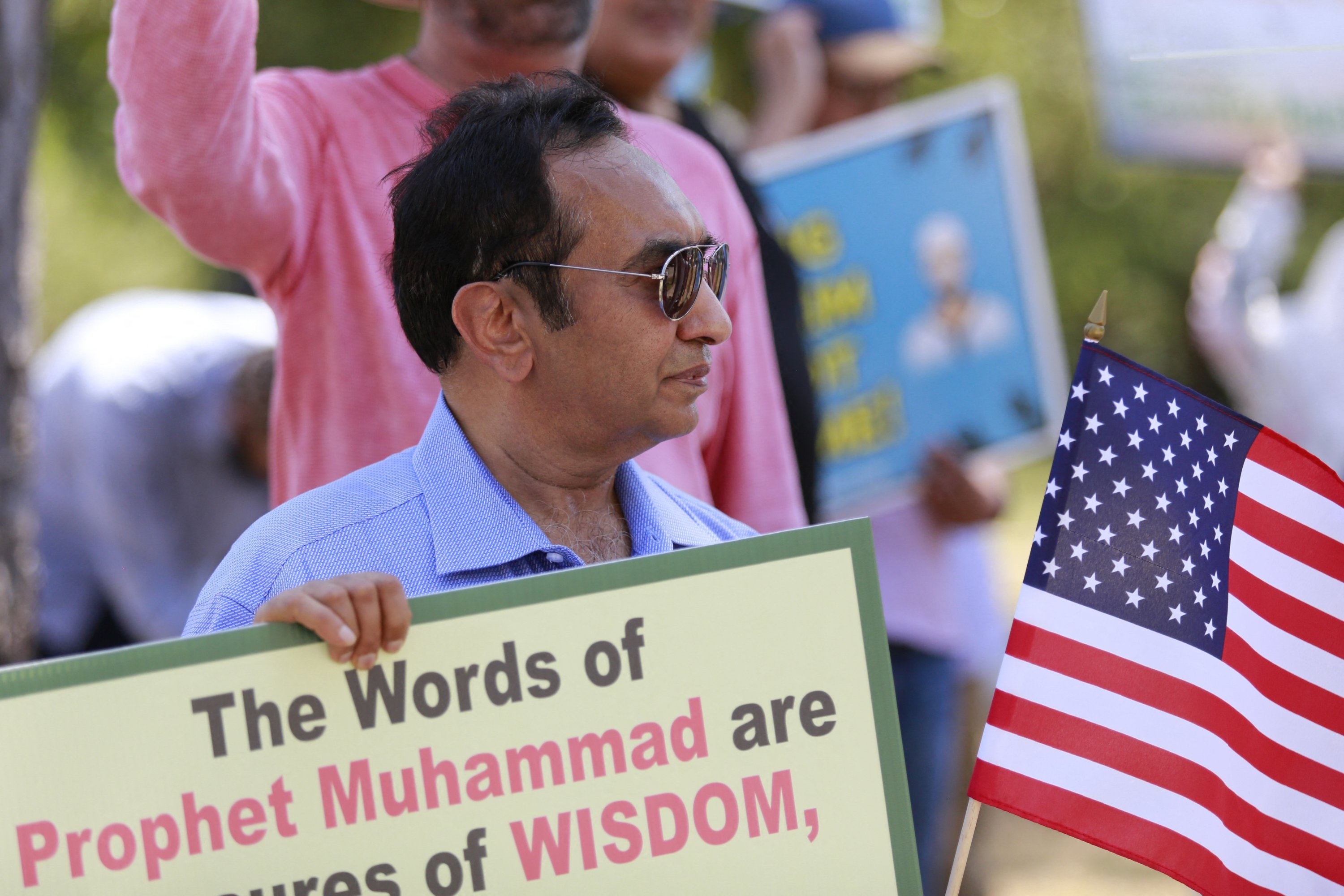
That omission became another major point of criticism among Muslim students and parents, who argued that Texas classrooms would present students with negative portrayals of Islam while giving far less attention to the contributions of Muslim civilizations to science, mathematics and global history.
“I feel attacked, as if my religion doesn’t belong,” 15-year-old Habiiba Quresh told the board. “I shouldn’t have to defend my religion in the middle of history class because of one sentence someone on this board wrote.”
The Texas chapter of the Council on American-Islamic Relations (CAIR) strongly condemned the adopted standards, saying the revisions would institutionalize prejudice in classrooms.
“The board has turned our classrooms into a place where prejudice is taught as fact and entire communities are written out of their own history,” CAIR-Texas said.
The organization said the dispute extended beyond Muslims, arguing that the standards also reduce or reshape coverage of Black and Palestinian history.
Board Chair Aaron Kinsey rejected criticism that the overhaul unfairly targeted communities, defending the final framework as balanced.
“There’s been a lot said out of this room, particularly to sensationalize all these topics and to make them seem more divisive than they actually are,” Kinsey said.
He said the 15-member board worked through the competing proposals democratically and described the overall result as an “exceptional job.”
The controversy over anti-Islam propaganda forms part of a much broader conservative restructuring of social studies education in Texas.
The board previously approved revisions for younger students and a required reading list that includes biblical stories. The new framework also places greater emphasis on Christianity, Western civilization and the ideas the Republican majority says shaped the United States.
Under the high school standards, students will be expected to study connections between biblical imagery, principles of equality and justice in the Declaration of Independence and Martin Luther King Jr.’s “I Have a Dream” speech.
Critics argued during public testimony that such treatment presents Christianity primarily through its positive influence while Islam is disproportionately discussed alongside warfare, terrorism and slavery.
Some speakers also challenged what they saw as an uneven treatment of slavery.
An 11-year-old student identified as Sarah reminded board members that slavery existed across civilizations and argued that emphasizing slavery in Islamic history without comparable discussion of Christian justifications for the transatlantic slave trade creates a distorted picture.
“Slavery existed for thousands of years before Islam,” she said. “It is unfair to label slavery as Islamic without also discussing the Christian role in the slave trade to the Americas.”
The U.S. history standards have generated separate criticism over their treatment of American slavery.
The framework describes slavery as an institution that “existed in many societies throughout history,” wording Democratic members and some advisers said could obscure the distinctive racial system of slavery that developed in the United States.
“Slavery is foundational to this country,” Democratic board member Marisa B. Pérez-Díaz said, arguing that students should spend considerably more time studying its impact on the development of the U.S.
The new standards also require students to examine arguments against the modern welfare state that developed through the expansion of President Lyndon B. Johnson’s Great Society programs, which were launched in the 1960s to combat poverty and racial inequality.
Teachers, Democratic board members and civil rights groups have criticized the broader revision process, saying conservative activists wielded disproportionate influence while educators were marginalized.
Critics also raised concerns over transparency surrounding the drafting process and the outside groups that helped shape elements of the curriculum.
Republican members reject that characterization, arguing that the overhaul restores greater emphasis on U.S. history, Texas history, Western civilization and the country’s founding principles.
The restructuring also eliminates the existing sixth-grade world cultures course, a decision some educators fear will leave students with less exposure to societies and traditions outside the Western world.
Supporters say the opposite approach is necessary, arguing that Texas students should first develop a stronger understanding of their own state, country and the historical forces that shaped them.
The overhaul concludes years of political battles over how Texas schools teach race, religion, national identity and American history.
The board postponed an earlier social studies rewrite in 2022 after conservative lawmakers objected to proposed lessons involving race and gender.
The Republican majority has since pushed the curriculum in a more conservative direction, saying schools should not teach children to view the United States primarily through its historical failures.
Muslim organizations and other critics, however, say the mistreatment of Islam illustrates the risks of allowing ideological battles to determine how religions and minority communities are portrayed in public classrooms.
The new high school social studies standards are scheduled to begin being phased into Texas schools during the 2030-31 academic year.
DAILYSABAH
هلدینگ کاسپین استانبول | خرید ملک در ترکیه | صرافی معتبر ایرانی در ترکیه | خرید و فروش طلا در ترکیه | مهاجرت به ترکیه | واردات و صادرات در ترکیه | نیازمندیهای ترکیه | اخبار ترکیه | اخبار جهانی | توریست ایران | خدمات توریستی در ایران | تورهای گردشگری ایران | هلدینگ اول | خدمات کاریابی و فریلنسری و شغل | مرجع اطلاعات ایران (همه چیز در ایران) | کیف پول و خدمات مالی و پرداخت یار | اخبار ایران | تابلو زنده قیمت ارز در ترکیه و استانبول | صرافی آنلاین ترکیه | قیمت طلا و نقره در ترکیه | سرمایه گذاری در ترکیه | جواهرات در ترکیه | نرخ لحظه ای ارزها در استانبول | قیمت دلار امروز در ترکیه | قیمت دلار استانبول امروز | قیمت لحظه ای دلار | اخبار روز ترکیه استانبول | اپلیکیشن ISTEX | اپلیکیشن قیمت لحظه ای دلار و یورو و لیر و ارزها در ترکیه
About the Author