We live surrounded by things we can see, measure and photograph. Yet some of the most important realities in our lives cannot be held in the hand. Meaning has no weight. Beauty has no measurable temperature. Love cannot be placed on a laboratory scale. Wonder cannot be photographed, even though a single moment of wonder can remain with us for a lifetime.
Perhaps this is why our age, despite possessing more instruments for seeing than any civilization before it, has become strangely uncertain about what it sees.
A flower can be reduced to its biological processes, a face to its pixels, a melody to its frequencies and a landscape to its coordinates. Each description may be accurate, yet none feels complete. We can know what something is made of and still wonder what it means.
That question is where interpretation begins.
A child looking at a tree does not first encounter chlorophyll, cellular respiration, or botanical classification. He encounters something living, ordered and beautiful. An artist may spend years trying to understand what the child saw in a moment. The scientist can explain how a leaf works, the poet can linger over its silence, and the architect can find a lesson in its structure.
And perhaps that is the first mystery: the world does not merely contain things. It seems to contain signs.
Beauty beyond necessity
Consider a flower. Its petals are arranged with a precision that serves biological functions, yet their beauty often exceeds what survival alone appears to require. Consider the human face. Its symmetry can be measured, but recognition, tenderness and character cannot be reduced to measurements. Consider music. Frequencies can be calculated, but calculation alone does not explain why a particular melody can awaken memory, grief or joy.
There is a difference between explaining how something works and asking why it moves us.
Our age has become extraordinarily good at the first question. We have become less patient with the second, perhaps because “how” can be measured while “why” demands contemplation.
Yet beauty has always resisted reduction. It interrupts us. It makes us pause before we have finished explaining. A sunset does not become less beautiful when we understand atmospheric scattering. A rose does not lose its mystery because we know its biology.
Knowledge, at its best, does not destroy wonder. It deepens it.
The problem begins when explanation is treated as the end of the story.
World as work of art
To know the mechanism of a musical instrument is not to know the music. To understand the grammar of a poem is not to possess its meaning. To identify the materials of a cathedral is not to explain the human longing that brought stone, light and proportion together.
The visible world may therefore be more like a text than an object. We do not simply look at a text; we read it. Its marks carry something beyond themselves.
We recognize this instinctively in human art. When we discover a painting, we do not assume that its colors arranged themselves into intention. We look for the artist behind the work. We may not see the artist, but the work makes the unseen hand intelligible.
Why should the presence of a signature be easier to recognize in a painting than in the vast gallery of existence itself?
This is not an invitation to abandon science for sentiment. It is an invitation to see scientific knowledge as part of a larger search. Science tells us astonishingly much about how the world works. But the deeper we look, the more we encounter a question that measurement alone cannot settle: What kind of reality is capable of producing such coherence, beauty and intelligibility?
The same physical laws govern distant galaxies and the smallest particles. The same elements that form stars also become part of oceans, stones and living bodies. Mathematics, invisible and abstract, somehow describes the architecture of the visible universe. Life appears in countless forms, yet those forms remain connected by patterns we are only beginning to understand.
The world is full of signatures, yet its signatures seem to belong to one handwriting.
Perhaps this is why beauty so often leads beyond itself. Mercy, wisdom, generosity and creativity seem to carry something more than their immediate function. They do not simply help us survive; they give existence a sense of depth and meaning.
Human beings have long given names to these experiences – beauty, wisdom, mercy, generosity, creativity – because they seem to point beyond themselves. Across the countless forms of existence, they suggest not a collection of unrelated qualities, but a deeper coherence running through them all.
The invisible
The unseen, then, need not mean the unknowable.
Sometimes the invisible makes itself known through what it leaves visible.
We do not see another person’s consciousness directly, yet we encounter it through words, gestures and acts of love. We do not see an artist’s mind, yet a painting can reveal something of its presence
The same principle invites us to look differently at existence itself. What is unseen need not be absent merely because it cannot be placed before the eye. A source can be known through its effects, an author through the coherence of a work and a meaning through the signs that carry it.
Perhaps we have not lost the ability to see. We have simply forgotten how to read what we see.
Lost art of reading
We scroll past images at a speed earlier generations could hardly have imagined. We consume music without listening to silence. We photograph landscapes without inhabiting them. We collect information without allowing it to become wisdom.
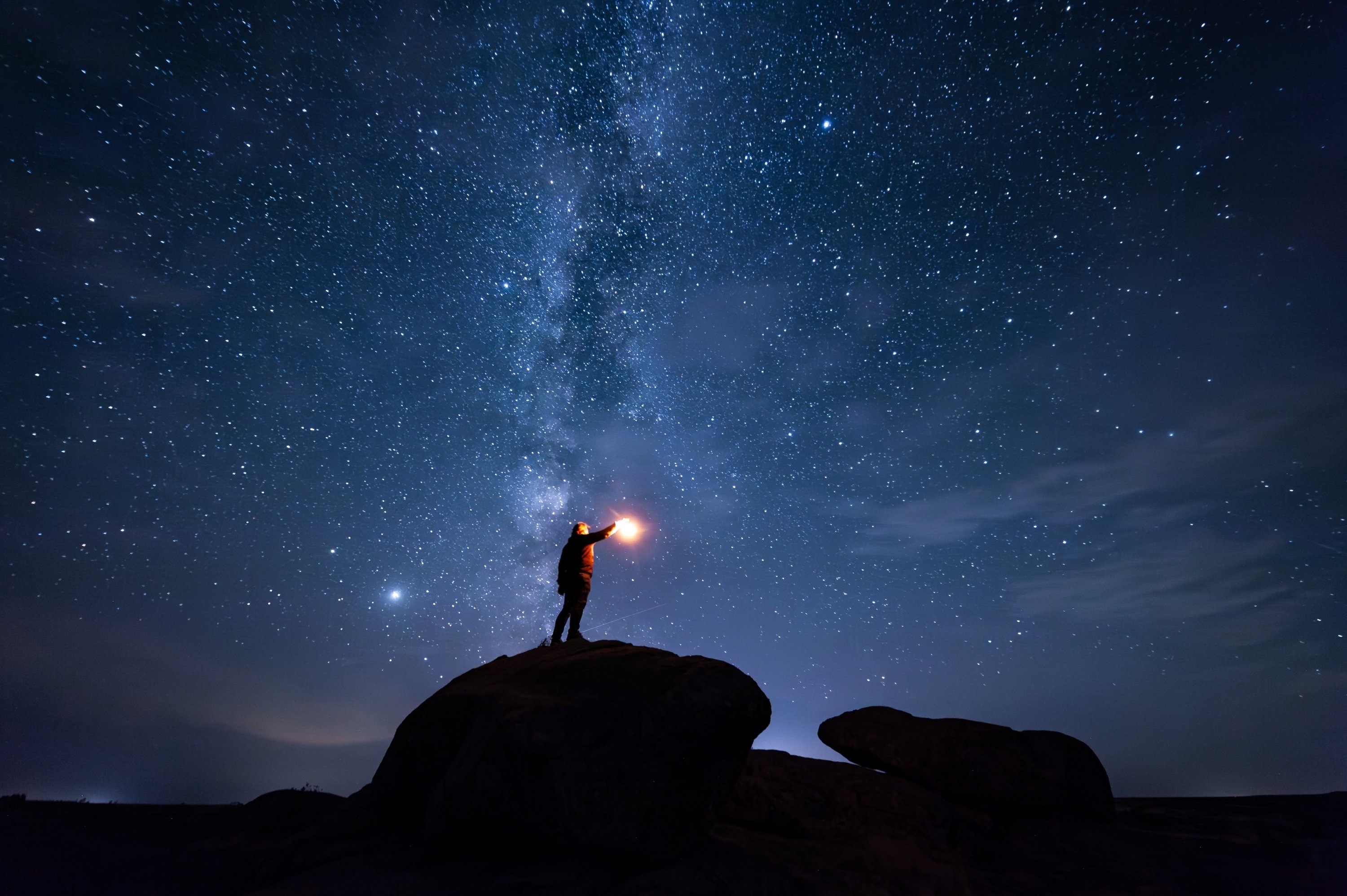
We have multiplied our access to the world while weakening our capacity to receive it. To read the world again, then, is to recover a certain attentiveness. It is to look at a tree and see more than timber; to look at a human being and see more than a profile; to look at the night sky and allow vastness to become a question rather than merely a spectacle.
It is also to understand that signs do not point inward only. They point beyond themselves.
A beautiful thing can be loved for what it is while also awakening gratitude for the source of its beauty. A wise pattern can be studied scientifically while also inviting wonder at the wisdom reflected in it. A life can be examined biologically while remaining an extraordinary gift.
Perhaps this is why one of humanity’s oldest invitations is so simple: read.
Read the book. Read the face. Read the tree. Read the sky. Read the silence. Read yourself.
To read is not merely to recognize words. It is to recognize meaning.
Signature remains
The greatest lesson hidden within the visible world is that its countless forms are not merely objects scattered across existence. They are signs, each carrying something beyond itself: beauty that hints at a deeper beauty, mercy that awakens us to a greater mercy, wisdom that points toward a wisdom beyond our own.
The universe is less a collection of things than a book of signs.
We have spent centuries becoming better at seeing its pages. Perhaps the next step is to learn how to read them again.
Because when the noise falls silent and the eye learns to look beyond the surface, the world begins to resemble something more than a collection of things.
A flower is no longer merely a flower.
A face is no longer merely a face.
A star is no longer merely a distant light.
Each becomes a quiet signature.
And the deeper recognition is this: when countless signs across an immeasurable universe converge toward order, beauty, wisdom and meaning, they do not just enlarge our knowledge of the world. They point toward an unseen source from which their coherence, beauty and very existence proceed.
The many do not remain merely many. Their harmony reveals unity.
Their beauty becomes a window onto the source of beauty; their order raises the question of the source of order. And their very existence returns us to the oldest question of all: not simply how the universe works, but why there is a universe to work at all.
Perhaps this is what we have forgotten how to recognize.
The signature was never meant to make us stare at the ink. It was meant to lead the eye toward the hand.
The world does not merely tell us that it is here. It bears the signature of the One from whom it comes.
DAILYSABAH
هلدینگ کاسپین استانبول | خرید ملک در ترکیه | صرافی معتبر ایرانی در ترکیه | خرید و فروش طلا در ترکیه | مهاجرت به ترکیه | واردات و صادرات در ترکیه | نیازمندیهای ترکیه | اخبار ترکیه | اخبار جهانی | توریست ایران | خدمات توریستی در ایران | تورهای گردشگری ایران | هلدینگ اول | خدمات کاریابی و فریلنسری و شغل | مرجع اطلاعات ایران (همه چیز در ایران) | کیف پول و خدمات مالی و پرداخت یار | اخبار ایران | تابلو زنده قیمت ارز در ترکیه و استانبول | صرافی آنلاین ترکیه | قیمت طلا و نقره در ترکیه | سرمایه گذاری در ترکیه | جواهرات در ترکیه | نرخ لحظه ای ارزها در استانبول | قیمت دلار امروز در ترکیه | قیمت دلار استانبول امروز | قیمت لحظه ای دلار | اخبار روز ترکیه استانبول | اپلیکیشن ISTEX | اپلیکیشن قیمت لحظه ای دلار و یورو و لیر و ارزها در ترکیه
About the Author