Home – CBSNews.com
Add CBS News on Google
The arid hilltops of the West Bank have seen shepherds come and go for thousands of years, and now some of these shepherds are behind settler violence against Palestinians.
The struggle for the West Bank is a biblical story. There are two populations – Jewish and Arab, the descendants of Abraham’s sons, Isaac and Ishmael – fighting over ancestral land. The West Bank, located on the west bank of the Jordan River, is home to more than 3 million Palestinians who hope to make it the heart of their future state. It is also home to over 500,000 Jews who call the area Judea and Samaria, their biblical homeland.
The area has been under Israeli military occupation for nearly six decades. Jewish settlers have built communities in the West Bank in hopes of making the land part of Israel.
With Israeli elections two weeks away, and midterms in the U.S. next month, how settler violence is handled could soon change.
Driving sheep herds into Palestinian communities
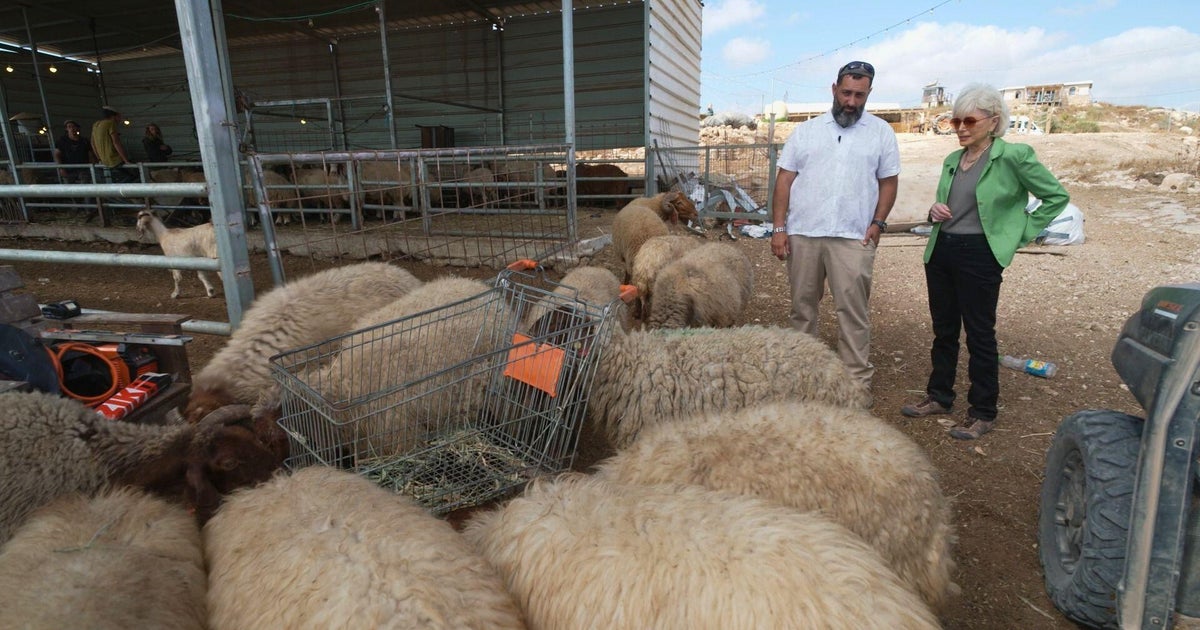
Mordehai Minster, who cofounded a sheep farm in the West Bank, is a new type of Israeli settler. His herd is driven deeper and deeper into surrounding Palestinian communities.
“When you have sheep, everyone understands. Arabs tend to fight over grazing lands among themselves. It’s a language that we understand, and they understand,” Minster said. “And it’s a way to delineate the border. ‘This is where I graze my sheep. You don’t take your sheep here. You don’t plant here. You don’t build here.'”
60 Minutes
Israeli sheep farms have taken over huge swathes of land: an estimated 20% of the West Bank. Some 200 sheep farms have popped up in recent years. Settlers even push sheep into Palestinian homes.
“They enter, they open the gate of the house and take the sheep inside to eat the trees around the house,” Waheed Marsouq, a Palestinian teacher in Al-Mughayyir, said.
For decades, Jewish settlers put up fences to protect themselves from the active threat of Palestinian terrorism. Now it’s the Palestinians who are penning themselves in. More than 100 Palestinian communities have been displaced or erased by the settler violence and the ever-encroaching sheep.
“Whenever you have ethnic religious communities, especially in the Middle East, fighting over land and resources, that conflict sometimes gets ugly,” Minster said. “The fact that violence exists doesn’t change the merit of the right that we have to this land.”
Who are the Israeli settlers?
Young shepherds, known as Hilltop Youth, are often behind the violence. They’ve flocked to the West Bank for a sense of adventure, and are told they’re on a God-given mission to redeem the land. They storm Palestinian fields and villages, cut down olive trees, torch cars and destroy property, and harass farmers and livestock. There have been more than 1,600 incidents so far this year, according to the United Nations Office for the Coordination of Humanitarian Affairs.
There’s a hardcore group of up to 500 settlers, and up to 1,000 more people drift in and out.
“Those are kids that are ranging in age between, I don’t know, 15 and 25,” Minster said. “They don’t do great in school. They don’t get into the army that easily because maybe behavioral problems. So some of them end up in places like this, taking care of sheep, doing construction. Some of these kids may have drug problems. They smoke pot. They grow pot.”
U.S. Ambassador to Israel Mike Huckabee has called the settler violence terrorism, describing it as thuggish and disgusting.
“I wouldn’t classify it as terrorism, but are there some children who overreact and act in thuggish ways and need to be controlled and held in? Yeah, definitely,” Minster said.
Palestinians have been killed by settler violence.
“Yes,” Minster acknowledged. “None of this is great and none of this changes the fact that our right to be here is legal and it’s ancient.”
“This is my land”
That is not how the Palestinians who live directly down the hill from Minster’s farm see it.
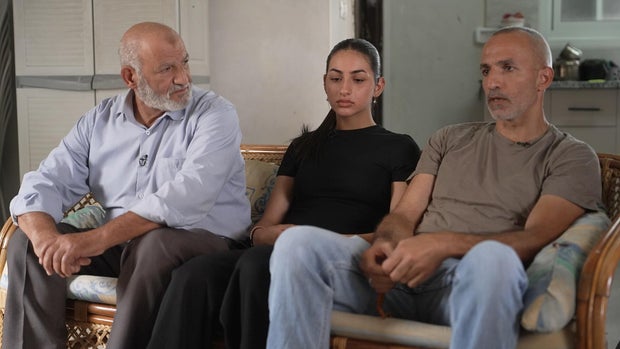
Mahmoud Faraj’s family has had the deed to this land for generations. 60 Minutes talked to him and his cousin Hassan about their village called Janata, which means paradise in Arabic.
The name was accurate until a group of 20 to 25 settlers showed up on March 26, entering the Faraj family’s land and setting up a “tent,” Hassan said.
“And they started to behave that they are the owners of everything,” Hassan said.
The Hilltop Youth outpost, which Hassan described as a “tent,” is in his backyard, cutting off access to one of their family’s houses.
“This is my cousin’s house over there. He’s not allowed to go there at all,” Mahmoud said.
60 Minutes
The Israeli settlers are trying to force the villagers to leave, and they’re succeeding, Hassan said. Many homes have been abandoned.
“They steal electricity from the locals and they also steal water,” Hassan said of the settlers. “This is their strategy, to make the area unlivable.”
Every time the family tries to get near their house, they say teens from the outpost rush down to beat them up. In March, Hassan tried with his uncle and cousin Muhammad.
“They started to attack us in small groups with wood sticks and with stones. And they have tear gas. And three of them, they were armed. So one of the armed guys, he started to shoot. He shot my cousin in his head,” Hassan said. “And it didn’t stop here. They came and they started to beat my uncle and his son, who was dead, with wood, with wood sticks.”
The family is skeptical that anyone will be held responsible as only a tiny number of these cases ever get prosecuted.
On another day, Muhammad’s brother, also named Hassan, tried to take 60 Minutes to the family’s house. But within seconds, the Hilltop Youth in their black hoodies came running down the hill. Soon the teens were blocking Hassan from reaching the house in the distance. The teens shoved Hassan, who kept his hands behind his back so they couldn’t accuse him of hitting them.
“This is my land and you won’t stay. These are my roots,” Hassan shouted back in Hebrew.
He was hit again and his nose was broken. One of the Hilltop Youth headbutted Hassan.
Hassan tried to retreat, but he was blocked.
Israeli activists protecting Palestinians from settlers
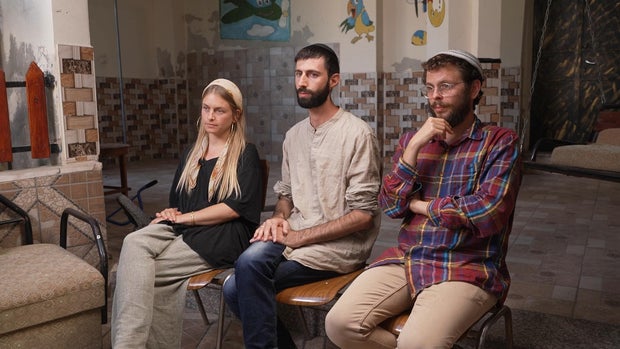
Hassan wasn’t alone that day when he tried to visit his home. He was joined by a group of Jewish activists, called Sons of Abraham, who work to protect Palestinians under siege. They stepped between Hassan and the teenage settlers, acting as human shields. The idea is that the settlers would be more hesitant to attack other Jews.
“They are trying to push us back. They don’t want us to enter with the cameras. So they are pushing and waiting for someone to react with their hands, so they have an excuse for more extreme violence,” Roie, one of the activists, said.
Most of the activists, like the settlers, grew up in right-wing, religious homes. One of them, Amana, used to be a Hilltop Youth herself. But Amana, Dvir and Roie say Judaism calls on them to protect, not expel, their neighbors.
60 Minutes
Some of the Hilltop Youth get angry when they see the Sons of Abraham.
“I think they are angrier because we threaten them ideologically,” Amana said in Hebrew. “And also, I’m not coming from the outside. I also grew up as a settler. I tell them, ‘I changed my ways. I know what you’re doing and I know it’s not the right way.'”
Sometimes the Sons of Abraham and Hilltop Youth recognize each other.
“I think it’s painful for me to see how people I grew up with, and some of them were good friends of mine, behave,” Roie said, acknowledging that they must say the same thing about him.
On the day Roie, Amana and Dvir accompanied Hassan, just as things were getting out of hand, a captain in the Israeli army turned up with soldiers.
In the end, Hassan was kicked off his own property. The Jewish settlers got to stay.
The army’s priority is the settlers, and some soldiers are settlers themselves, and occasionally join the violence.
Though there have also been cases where the soldiers have been attacked by the young settlers.
“People call it ‘settler violence.’ I don’t agree with that,” Roie said. “It is state violence. There is a violence of a government.”
Political landscape in Israel and in the U.S.
Elections in Israel are two weeks away and, so far, the Israeli government has shown an unwillingness to crack down on settler violence in the West Bank.
The Trump administration has called on Israeli Prime Minister Benjamin Netanyahu to deal with the situation. Netanyahu has condemned the violence, but his government has also poured tens of millions of dollars into expanding sheep farms, arming them and giving them American-made off-roaders.
Midterm elections in the U.S. next month could also change the political landscape. If the Democrats win, they’re threatening to limit military aid to Israel in part, they say, because of the West Bank attacks.
Minster said he worries about American public opinion. While he’s concerned about the potential impact if Israel loses America’s support, he doesn’t look at it as an existential threat.
“I am bothered by the fact that America’s turning on us, and we’re turning on America. It’s, like, I see it as losing a friendship,” he said. “And I’m also concerned that, as a military ally, as a political ally, we may lose America as well. It looks like it’s going in that direction. But Israel will find other allies.”
wp:paragraph
هلدینگ کاسپین استانبول | خرید ملک در ترکیه | صرافی معتبر ایرانی در ترکیه | خرید و فروش طلا در ترکیه | مهاجرت به ترکیه | واردات و صادرات در ترکیه | نیازمندیهای ترکیه | اخبار ترکیه | اخبار جهانی | توریست ایران | خدمات توریستی در ایران | تورهای گردشگری ایران | هلدینگ اول | خدمات کاریابی و فریلنسری و شغل | مرجع اطلاعات ایران (همه چیز در ایران) | کیف پول و خدمات مالی و پرداخت یار | اخبار ایران | تابلو زنده قیمت ارز در ترکیه و استانبول | صرافی آنلاین ترکیه | قیمت طلا و نقره در ترکیه | سرمایه گذاری در ترکیه | جواهرات در ترکیه | نرخ لحظه ای ارزها در استانبول | قیمت دلار امروز در ترکیه | قیمت دلار استانبول امروز | قیمت لحظه ای دلار | اخبار روز ترکیه استانبول | اپلیکیشن ISTEX | اپلیکیشن قیمت لحظه ای دلار و یورو و لیر و ارزها در ترکیه
/wp:paragraph wp:paragraph /wp:paragraph
About the Author