When it comes to Europe’s economy or its peace and security, it is obvious that decision-making has to be done largely at the European level to be meaningful. Yet electoral politics is still conducted mostly at the national level. The silver lining of this mismatch is that from country to country in Europe we have governments with different political priorities and leanings. Unlike in the US, where one presidential election can radically change the entire country’s course, as we have seen so vividly under Donald Trump’s leadership, the same drama has not so far unfolded in Europe. This may be about to change.
Pedro Sánchez rolled the dice in Spain last week, calling a snap election for next month after an unholy alliance of the conservative People’s party (PP), the far-right Vox and Catalan pro-independence party Junts blocked his big housing reform package in parliament. If the socialist prime minister, hailed by progressives globally but demonised by Europe’s right and Trump’s US, loses his election gamble, Spain could fall into the hands of a conservative/far-right coalition, which is currently ahead in the polls.
In addition to Spain, France, Italy, Poland, Finland, Greece, Estonia and Slovakia will all head to the polls in the coming year. The four largest of these, France, Italy, Poland and Spain, could see far-right or nationalist populist parties either confirmed in power (Italy), returned to it (Poland) or elected for the first time (France and Spain). This could dramatically change the face of Europe.
Europe has been tilting to the right for some time, with far-right parties entering coalition in different countries at different times. Centre-right and far-right groups are now able to form a majority in the European parliament, coalescing in particular around an anti-climate and anti-migration agenda. But while this tilt has slowed European integration, its policy effects have not been as rapid and radical as those we have seen in the US under Trump.
This is because the rightward shift has so far not been homogeneous. In the Netherlands last year, Geert Wilders’s far-right Freedom party was punished at the polls and the liberals made a comeback. This year, Hungary’s slide into authoritarianism was halted, and is now being reversed, after Viktor Orbán was ousted in a landslide election. Most recently, in Sweden, support for the far right, which had backed the outgoing centre-right government, slipped. The opposition bloc, led by the Social Democrats, scraped a victory. So, while the rise of the far right is a continent-wide trend – Alternative für Deutschland’s recent victory in eastern Germany sent shock waves across Europe – it does not hold everywhere, at all times.
But if the coming round of elections were to bring Marine Le Pen to the French presidency, confirm Giorgia Meloni as Italian prime minister, possibly backed by a coalition even further to the right than the current one, return the Law and Justice party to power in Poland, and produce a conservative/far-right government in Spain including Vox, the face of Europe could change dramatically.
If all these countries, plus several smaller ones, elected far-right or nationalist populist governments, they would not reach a qualified majority able to steer the EU’s policy course. But they would form a blocking minority, putting an end to any ambition of deeper EU integration in such areas as finance, energy, defence and technology.
And it is not just a question of numbers. These far-right leaders would have a galvanising and radicalising effect on each other, propped up by Maga America and Silicon Valley’s algorithms. The common perception outside Italy is that Meloni has mellowed in power. To the extent that this is true, it is in no small measure because she has been surrounded by the likes of Emmanuel Macron, Donald Tusk and Sánchez, among others. If these leaders were replaced by the likes of Le Pen, Jarosław Kaczyński and Alberto Núñez Feijóo, backed by Vox’s Santiago Abascal, Meloni herself would act differently, more in line with her true political instincts. All this could trigger not simply a slow erosion of the European integration project – a muddling through with the unambitious agenda we have seen in recent years – but a hollowing out, if not an outright implosion. The EU as we know it would struggle to retain its purpose, especially if no agreement is reached on its next seven-year budget in the coming months.
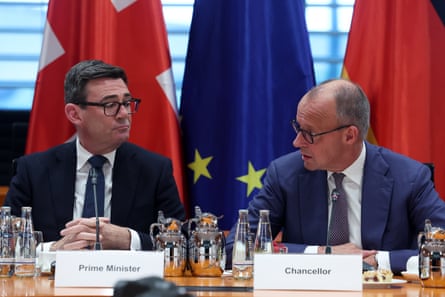
The irony is that European political heterogeneity persists, but outside the EU it is not only Canada that wants more proximity. More importantly, the UK may have begun the slow journey of retracing its steps. It took 10 years for a British prime minister to call a spade a spade, publicly recognise that Brexit has done more harm than good and open the door to rejoining the EU, as Andy Burnham has now done.
It has taken a decade to remember the purpose of European unity and the emptiness of petty nationalism – just as Europe risks losing the memory of its dark past and teeters on the brink of falling apart. Now is perhaps the moment for the UK to remind its European neighbours what it means to be out there, all alone.
-
Nathalie Tocci is a Guardian Europe columnist
The Guardian wp:paragraph
هلدینگ کاسپین استانبول | خرید ملک در ترکیه | صرافی معتبر ایرانی در ترکیه | خرید و فروش طلا در ترکیه | مهاجرت به ترکیه | واردات و صادرات در ترکیه | نیازمندیهای ترکیه | اخبار ترکیه | اخبار جهانی | توریست ایران | خدمات توریستی در ایران | تورهای گردشگری ایران | هلدینگ اول | خدمات کاریابی و فریلنسری و شغل | مرجع اطلاعات ایران (همه چیز در ایران) | کیف پول و خدمات مالی و پرداخت یار | اخبار ایران | تابلو زنده قیمت ارز در ترکیه و استانبول | صرافی آنلاین ترکیه | قیمت طلا و نقره در ترکیه | سرمایه گذاری در ترکیه | جواهرات در ترکیه | نرخ لحظه ای ارزها در استانبول | قیمت دلار امروز در ترکیه | قیمت دلار استانبول امروز | قیمت لحظه ای دلار | اخبار روز ترکیه استانبول | اپلیکیشن ISTEX | اپلیکیشن قیمت لحظه ای دلار و یورو و لیر و ارزها در ترکیه
/wp:paragraph wp:paragraph /wp:paragraph
About the Author