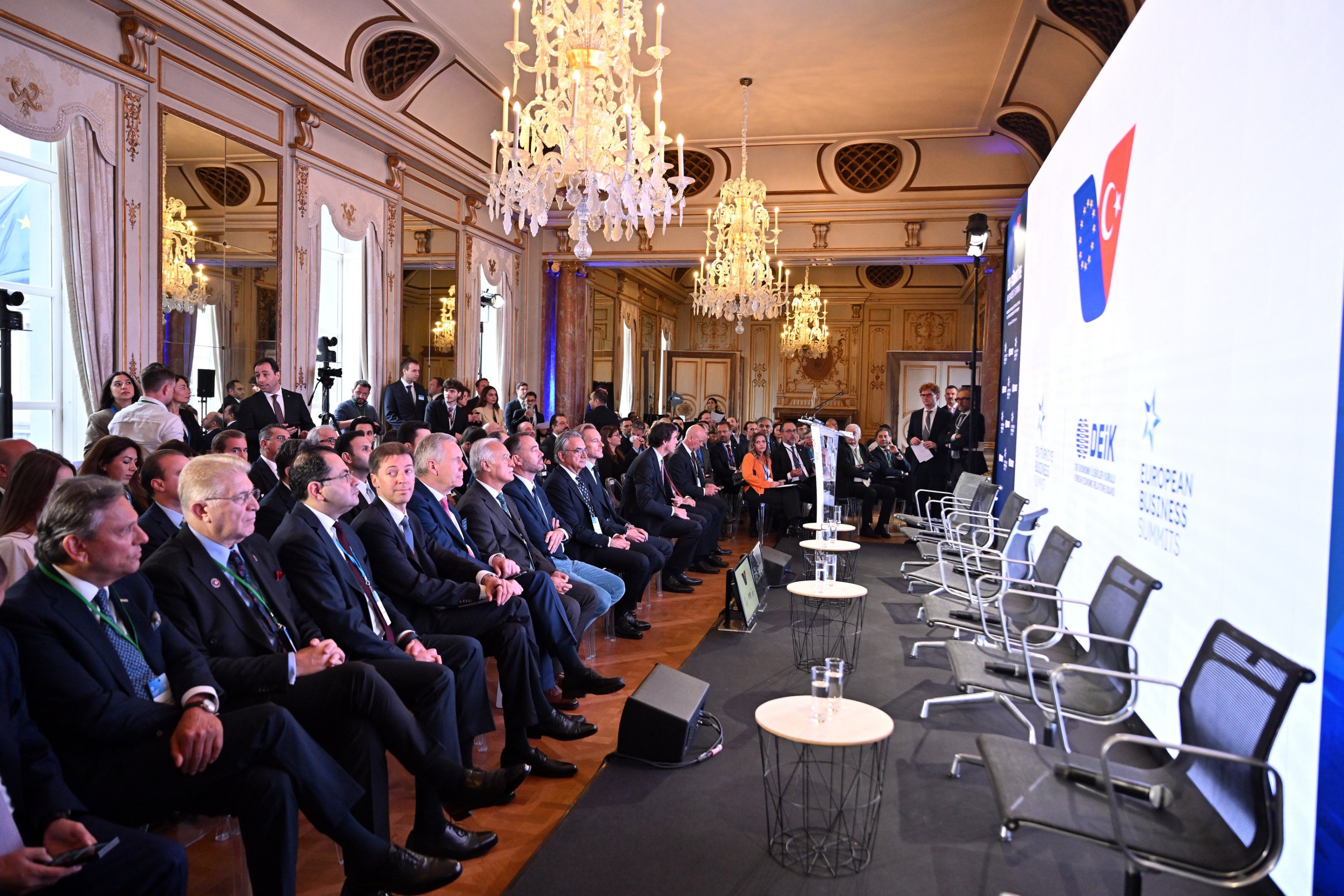
Business leaders and officials used a summit in Brussels on Tuesday to push for closer economic ties between Türkiye and the European Union, again calling for a modernized customs union, a place in the bloc’s industrial supply chains and a clearer accession perspective.
Belgium’s foreign minister also voiced support for updating the three-decade-old customs union.
Speaking at the EU-Türkiye Business Summit, organized by the Foreign Economic Relations Board (DEIK) with the European Business Summit, executives and officials argued that deeply integrated economies need a political and institutional framework that reflects their commercial reality.
DEIK President Nail Olpak quoted Jean Monnet’s line that Europe will be forged in crises and will be the sum of the solutions adopted for those crises. “We are living in such a time. And I believe deeper integration with Türkiye is one of the answers Europe needs today,” Olpak said.
He set out three priorities for the partnership.
The first was modernizing the customs union, which he said has been the backbone of economic ties for more than three decades but no longer meets current needs. “In a world that has changed this fast, we’re missing too many opportunities together,” Olpak said. An update would open up cooperation in services, e-commerce, public procurement and agriculture.
The second was recognizing Türkiye’s place in European industry. Olpak said the EU’s “Made in Europe” approach should become, in his words, “Made with Europe,” noting that Türkiye has been part of the continent’s supply and value chains for over 30 years. Treating Turkish-made products as part of Europe’s industrial ecosystem “without new quotas or barriers,” he argued, is critical to Europe’s own resilience and competitiveness.
The third was connectivity. Geopolitical shocks, from the war in Ukraine to instability in the Middle East, “showed why we need reliable links for transport, energy and data,” he said. The Middle Corridor, which links Europe with Central Asia via Türkiye and the South Caucasus, should remain a shared strategic priority, he added, and emerging north-south links connecting Europe and Türkiye with Iraq and the Gulf could further strengthen regional connectivity.
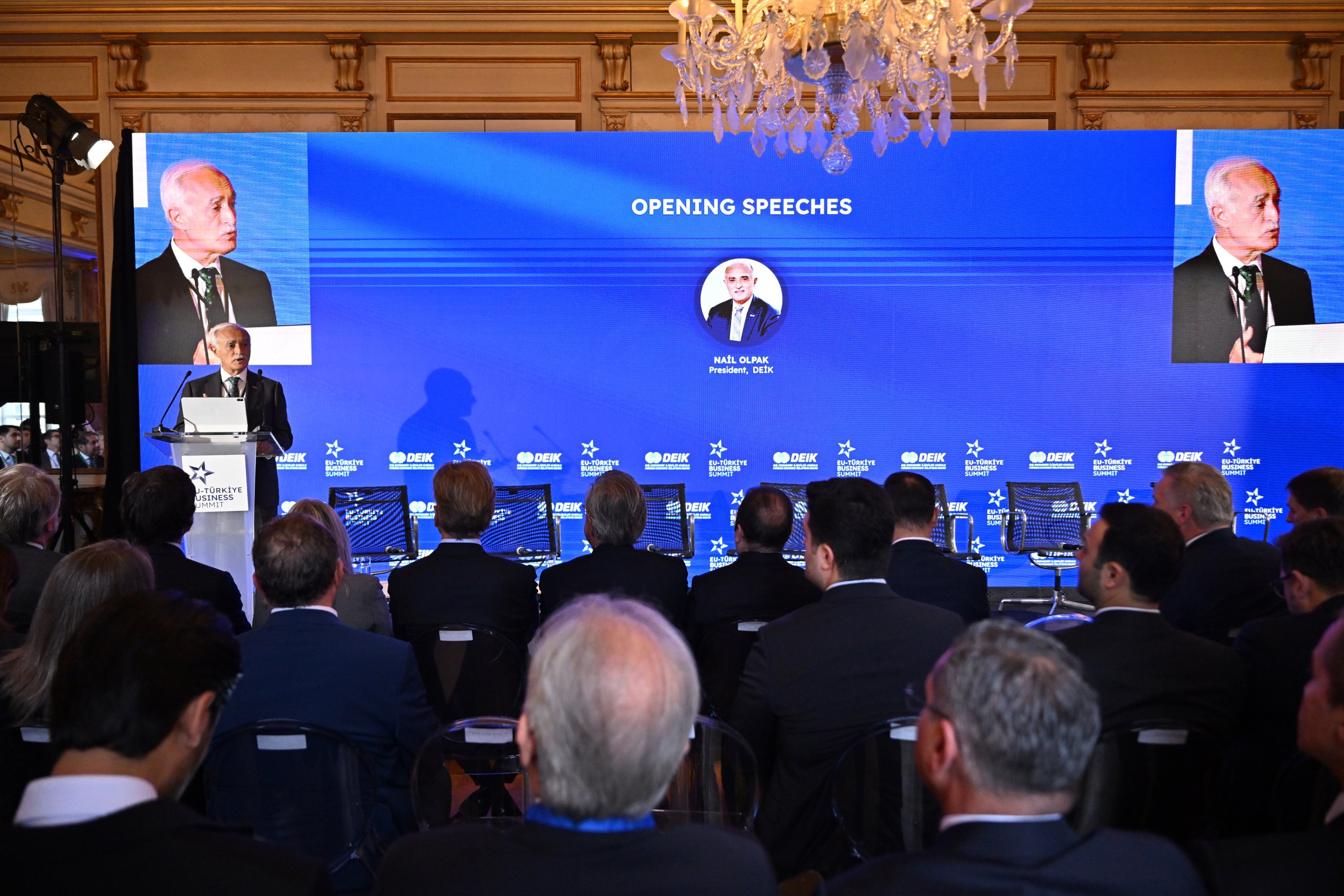
Tying the themes together, Olpak spoke of “competition on trust,” saying trust is built through performance rather than words and that Türkiye has proven itself a dependable partner through every crisis.
Türkiye’s European journey began more than 60 years ago, he noted, and full membership remains its goal. “After so many years, we need fresh momentum,” Olpak said.
Call for clear membership signal
Mehmet Ali Yalçındağ, coordinator chair of the DEIK Türkiye-EU Business Councils, said a “clear and credible reaffirmation” of Türkiye’s membership perspective would give the relationship direction, encourage reform and strengthen confidence in Europe’s ability to act with purpose.
He noted that the heads of DEIK’s 26 business councils with EU member states wrote earlier this year to the leaders of the European institutions, asking for renewed momentum in the accession process. He also welcomed European Commission President Ursula von der Leyen’s recent State of the Union address, which he said put competitiveness, security, affordable energy, AI and democratic resilience at the center.
Europe “will not become more competitive by excluding Türkiye from the economic space where our businesses already work together,” Yalçındağ said, adding that it grows stronger by building on its value chains rather than drawing new boundaries through them.
He urged both sides to move beyond arguments repeated for too long, saying caution has at times replaced initiative, to the benefit of competitors. Political dialogue, credible conditionality and practical cooperation can advance together, he said, without every disagreement being resolved first.
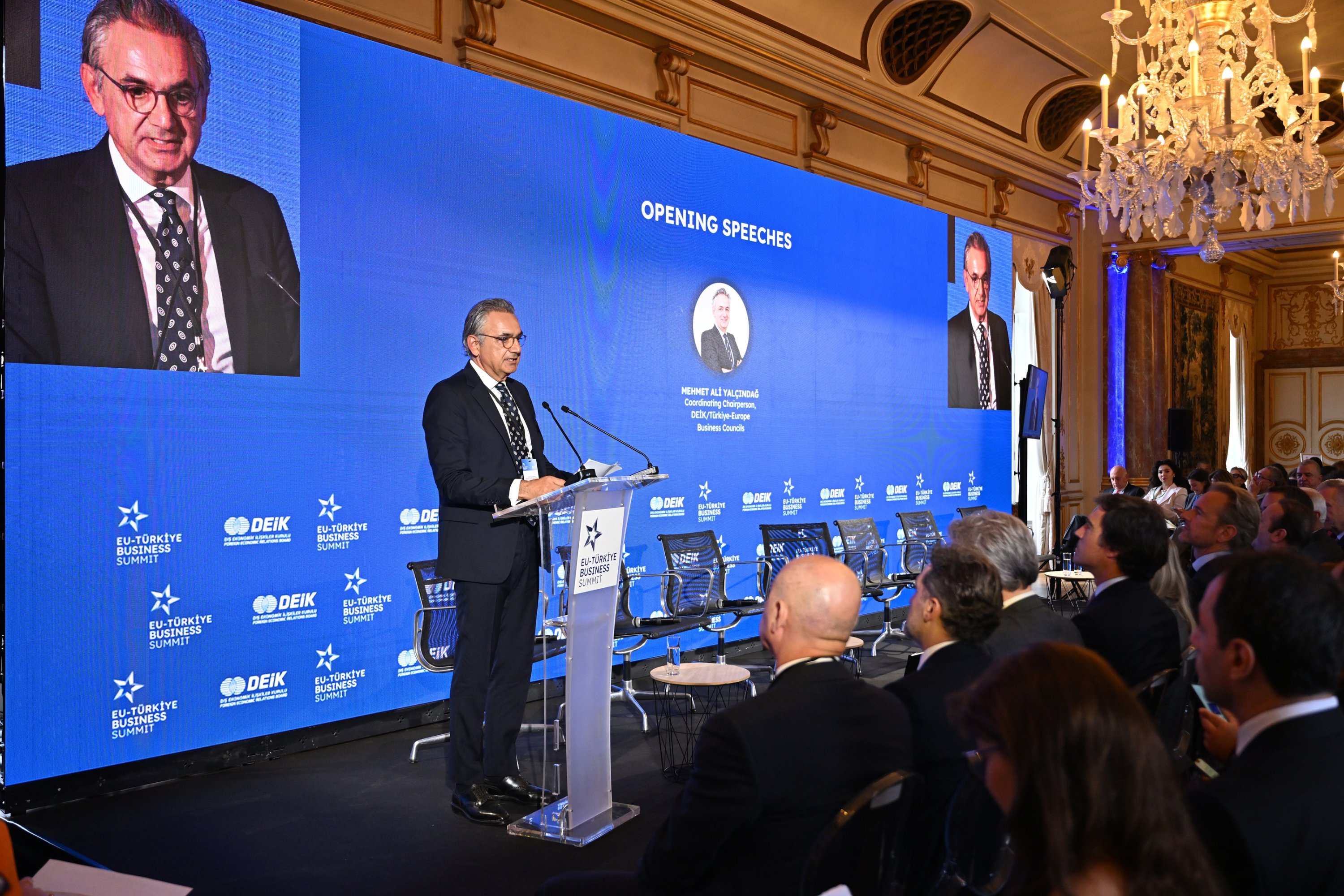
A clear commitment to Türkiye’s European future, he added, could help open the way to a modernized customs union, easier business mobility and visas, and closer cooperation on technology, energy, transport, defense and the green transition. He also urged both sides to act without adding “another ‘yes, but'” to a relationship already burdened by too many.
‘Deeply integrated economic structure’
Trade Minister Ömer Bolat said the global trade order is undergoing a structural realignment in which trade policy is inseparable from industrial strategy and security, and that Türkiye is among the most capable and reliable partners for Europe as it seeks to de-risk its supply chains.
Türkiye and the EU, he said, have built “a deeply integrated economic structure” over many years, and the customs union has linked production chains and encouraged investment on both sides.
The benefits of the customs union must be preserved while it is prepared for new global realities, Bolat said, acknowledging longstanding asymmetries in its current structure. New EU industrial, trade, economic security, and green and digital policies must not create new ones, he said.
Türkiye’s relationship with the bloc differs from that of other third countries, and “this difference should be reflected not only in our words, but also in the way new EU policies are designed and implemented,” he said.
He named mobility as the most fundamental barrier. Turkish business leaders, academics and students “still lack basic travel flexibility,” he said, and bilateral and transit quotas imposed on Turkish transporters by several member states run counter to the goal of deeper integration.
Bolat described the High-Level Trade Dialogue, launched in 2024, as a key mechanism for resolving trade problems and building cooperation. He cited joint work on the green transition as proof that aligned interests and political will deliver results, and urged similar efforts on digital trade, customs cooperation, industrial policy and supply chain resilience.
“Governments can draw the road maps, but it is you, the business leaders in this room, who will build the future,” he said.
Key figures on Türkiye-EU economic ties
- Bilateral trade reached $233 billion in 2025.
- That makes Türkiye the EU’s fifth-largest trading partner and its third-largest among countries with preferential trade agreements, he said.
- The EU accounts for 43% of Türkiye’s exports and 32% of its imports.
- The EU is the source of 70% of the $294.7 billion in foreign direct investment in Türkiye.
- Of the 90,000 foreign companies operating in Türkiye, 60,000 are European. EU-invested firms directly employ around 1.2 million people.
- Turkish companies’ direct investment stock in the EU stands at $36.7 billion.
Industrial Accelerator Act in focus
“Türkiye and the EU need each other more than ever,” said Ambassador Yaprak Balkan, Türkiye’s permanent representative to the EU, speaking at a summit session titled “Made in Europe or Made with Europe? The Industrial Accelerator Act Reimagined.”
She said Türkiye shares the EU’s goals of building more resilient industry and speeding up decarbonization, but that neither side should weaken the value chains that make both more competitive.
Balkan said much of her team’s recent work has centered on the “Made in Europe” approach, which would prioritize European-made products in public procurement and subsidies under the proposed act, and that they have been working day and night to persuade partners with facts and scientific data.
Her central argument was legal. Decision 1/95 of the Association Council, which established the customs union, provides for removing duties and non-tariff barriers on industrial goods. If the act takes shape in the way Ankara fears, she said, it could contradict existing commitments.
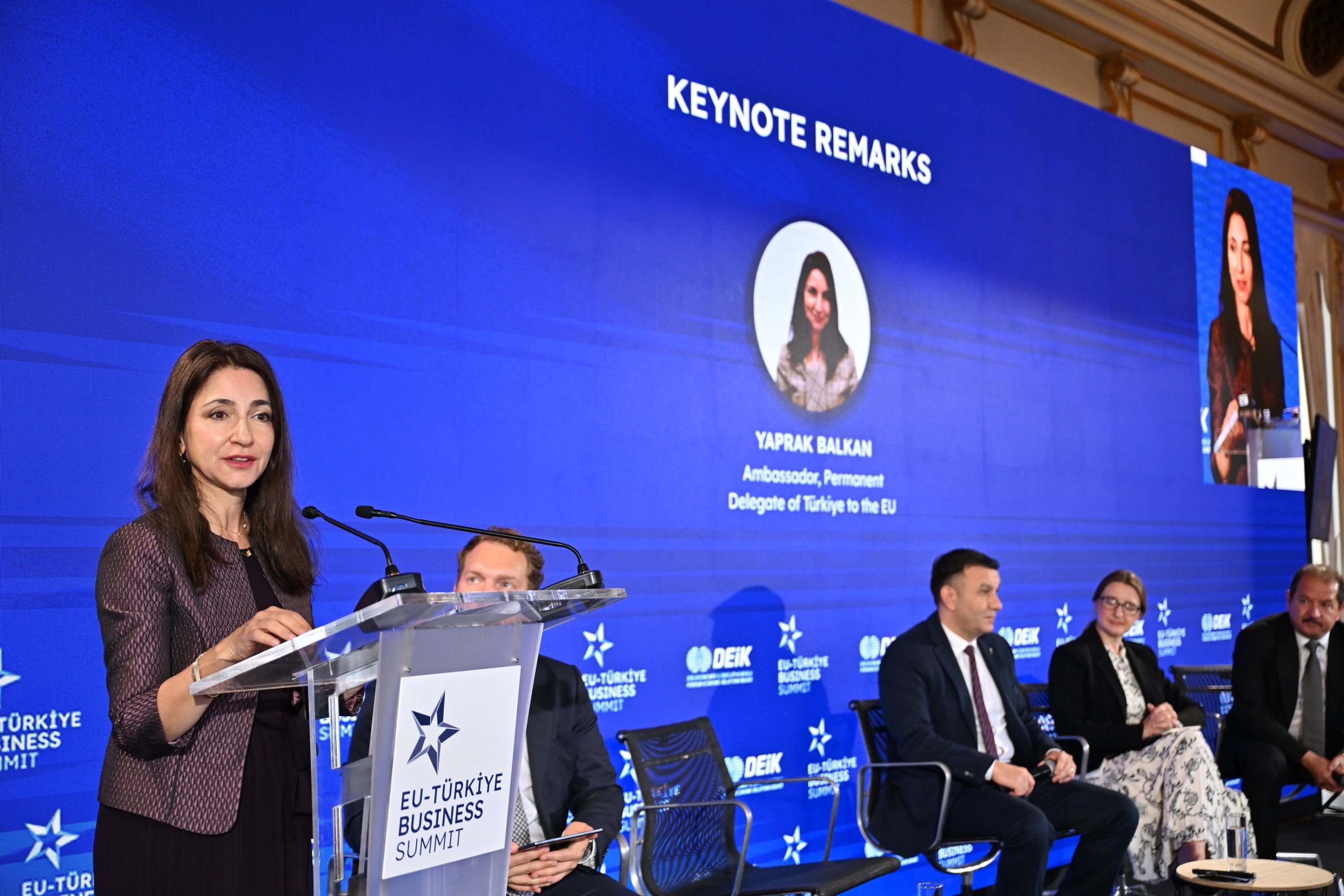
Türkiye’s unique relationship with the EU through the customs union must be fully reflected in the legislation, Balkan said, and if it defines which partners are covered, Türkiye must be included from the outset. Where origin requirements are met, vehicles made in Türkiye should receive equivalent treatment, she noted.
Automotive trade alone accounts for roughly a quarter of bilateral trade, she said, making Türkiye the third-largest export market for the EU automotive industry. About 70% of vehicle production in Türkiye rests on direct or joint investments by major European manufacturers, and more than half of the parts and components in a car made there are imported from the EU.
She dismissed claims that third-country goods would enter the EU through Türkiye as an “urban myth,” saying Türkiye will not become a back door for circumventing the rules and that Turkish industry also suffers from unfair competition and overcapacity.
On public procurement, Balkan said a law passed in Türkiye in July contributes to the process toward an agreement with the EU, that Ankara wants negotiations to start as soon as possible, and that reciprocity will be ensured. She added that senior executives of European carmakers have themselves lobbied for Türkiye’s inclusion.
Future cooperation, she said, should focus on joint research, advanced manufacturing, cleaner materials, batteries, circularity and skills. “Inward-looking attitudes and protectionism cannot be the solution,” she said.
Belgium: Türkiye can help reduce Europe’s dependencies
Belgian Foreign Minister Maxime Prevot also addressed the summit, saying Türkiye has an important role in helping Europe reduce its strategic dependencies, particularly in key industrial sectors.
He said shifting global dynamics, the war in Ukraine and supply chain disruptions had made Europe increasingly aware of its economic vulnerabilities.
“Türkiye has an important role to play, not only as an industrial market but also as a gateway to markets in the wider region,” he said, stressing its manufacturing capacity, industrial expertise and links to neighboring markets.
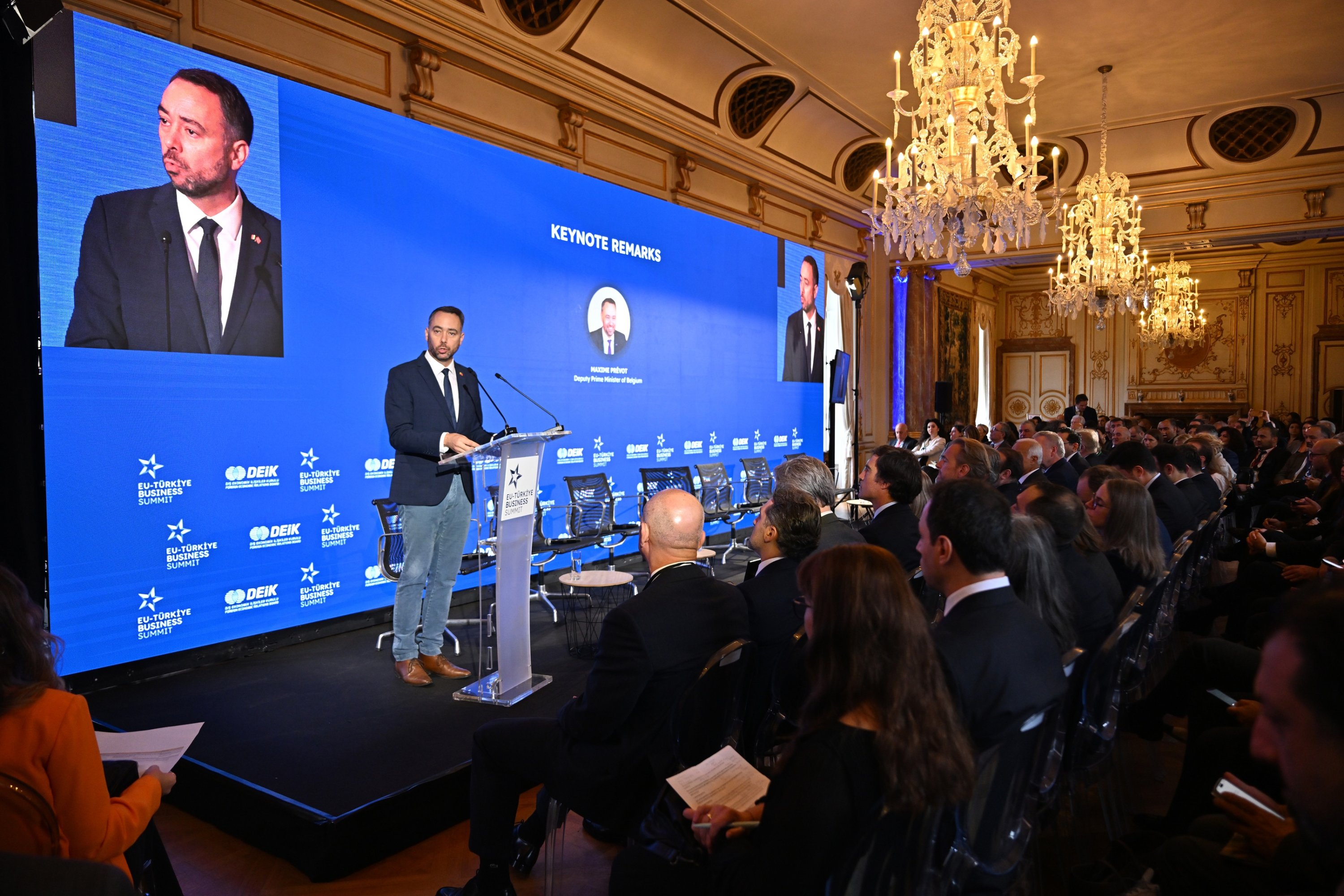
European companies are increasingly seeking reliable partners closer to home as they reconsider where to manufacture and store their goods, Prevot said, and Europe should make the most of Türkiye’s proximity, especially in sectors where it needs to cut strategic dependencies.
He described Türkiye as a NATO ally, an EU candidate country and a major industrial economy connecting Europe, Asia and the Middle East, whose capabilities could make European supply chains more resilient. He called for stronger cooperation between Brussels and Ankara in economic security, defense, innovation, clean energy and digital technologies.
“Our economic relationship should no longer be limited to buying and selling goods. We should also be developing, producing, and investing together,” he said.
Prevot also backed modernizing the customs union, which he said has served both economies for around 30 years but needs to reflect changing global economic conditions.
DAILYSABAH
هلدینگ کاسپین استانبول | خرید ملک در ترکیه | صرافی معتبر ایرانی در ترکیه | خرید و فروش طلا در ترکیه | مهاجرت به ترکیه | واردات و صادرات در ترکیه | نیازمندیهای ترکیه | اخبار ترکیه | اخبار جهانی | توریست ایران | خدمات توریستی در ایران | تورهای گردشگری ایران | هلدینگ اول | خدمات کاریابی و فریلنسری و شغل | مرجع اطلاعات ایران (همه چیز در ایران) | کیف پول و خدمات مالی و پرداخت یار | اخبار ایران | تابلو زنده قیمت ارز در ترکیه و استانبول | صرافی آنلاین ترکیه | قیمت طلا و نقره در ترکیه | سرمایه گذاری در ترکیه | جواهرات در ترکیه | نرخ لحظه ای ارزها در استانبول | قیمت دلار امروز در ترکیه | قیمت دلار استانبول امروز | قیمت لحظه ای دلار | اخبار روز ترکیه استانبول | اپلیکیشن ISTEX | اپلیکیشن قیمت لحظه ای دلار و یورو و لیر و ارزها در ترکیه
About the Author