In May 2025, a 25-year-old man detonated a car bomb outside a Palm Springs fertility clinic, killing himself and injuring four others. For many, it was a wake up call about the threats to reproductive care facilities. For the FBI, though, it was also a sign of what the agency had feared for years: bad actors were using generative AI to plan and execute terror plots.
The suspect used an unnamed generative AI tool that failed to detect his request for bomb-making instructions, law enforcement officers wrote in a previously unreported document reviewed by the Guardian. The privacy of his conversation with the AI chatbot hindered alerting police that someone was looking up how to make a bomb, according to the memo.
FBI officers fear the scenario is set to repeat itself: “Threat actors will likely increase their use of GenAI tools for attack planning,” said the memo, which was distributed by the bureau’s Los Angeles division in May 2026. “Current built-in GenAI safeguards are insufficient to prevent illicit use as malicious actors successfully employ ‘jailbreaking’ techniques to access dangerous information.”
AI executives and staff at leading AI companies have focused their public remarks on potential doomsday scenarios, a long-term, hypothetical harm of the technology they’re developing. Law enforcement officers, by contrast, have been grappling with what they fear are the present-day threats that AI enables, including violent crimes.
A previously unreported cache of law enforcement and intelligence agency documents show that law enforcement agencies have, since 2021, considered AI both a tool and a target of would-be terrorists. Law enforcement has been trying to keep pace with the ways bad actors may be using AI for harm, concerned that the rapidly evolving technology may supercharge new and existing types of crimes.
At the same time, as public sentiment over AI and its impacts on society and the environment has soured, agencies have sought to protect AI infrastructure. The documents show police and intelligence officers are closely monitoring online opposition to datacenters among various groups with what they describe as extremist ideologies.
The Guardian exclusively reviewed more than 80 documents and memos that were distributed among a nationwide network of federal, state and local law enforcement offices – including the Department of Homeland Security (DHS), the FBI and the New York City police department (NYPD) – between 2021 and 2026. They were obtained by government transparency non-profit Property of the People and shared with the Guardian.
In these documents, officers discussed:
-
How extremists could use AI to devise attacks and recruit new members
-
How AI could be used to disseminate and produce everything from deepfakes to election misinformation and child sexual abuse material (CSAM)
-
How people seeking information on how to make weaponry or bombs could use AI to circumvent police detection
-
How to ensure that officers could take advantage of AI tools in policing, for things like social media monitoring, while managing public concern over the use of these tools
-
Monitoring social media for opposition to AI and potential extremist attacks on datacenters
The FBI did not respond to detailed questions on its monitoring of anti-AI sentiment and use of AI, but pointed to a general fact sheet on the agency’s use of the technology.
The NYPD stated that its threat analysis report on artificial intelligence was related to the “AI 2027” project – an influential forecast from several AI researchers that speculated about the technology’s rapid growth and the threats it could present. In one of the project’s possible futures, it predicted bioweapon-armed drones wiping out humanity.
“This NYPD Intelligence Analysis Report contained a summary and assessment of AI 2027,” the NYPD said. “It was distributed to appropriate NYPD members and partners for their awareness, as part of the Intelligence and Counterterrorism Bureau’s mission of analyzing developments and trends that have implications for public safety and national security.”
DHS said it “prioritizes the safety and security of Americans and remains committed to mitigating all forms of ideologically-motivated violence”, and regularly shares intelligence with state and local law enforcement related to threats from violent extremists.
“DHS threat assessments draw on available intelligence, law-enforcement information, and other reporting to inform partners of evolving threats,” DHS said in a statement. “DHS assesses that malicious actors may seek to use artificial intelligence to enhance existing harmful activities, including cyber-enabled activity, fraud schemes, and the production or dissemination of violent extremist propaganda”.
Tech-enabled terrorism and anti-tech extremism
Law enforcement’s concerns over AI and extremism fall into two broad categories, the documents show. One focuses on the burgeoning threat of extremists using new tools such as generative AI to plot attacks or promote their ideology. The other involves extremists targeting the modern technology that underpins society and has a long history within far-right movements.
Before mainstream, widespread opposition to datacenters swept the US, there was a strain of violent extremism that targeted tech facilities and other critical infrastructure, hoping such terrorism could lead to the collapse of society and instigate a race war.
Law enforcement officers expressed concern over the threat these militias posed to datacenters’ security before the 2022 launch of ChatGPT. Several bulletins, such as an October 2021 joint threat analysis from DHS, National Counterterrorism Center and FBI, highlighted a plot by Seth Pendley, a January 6 rioter and far-right militia member, to blow up an Amazon Web Services facility.
“Pendley believed a successful attack on the Amazon facility would disrupt 70 percent of Internet service, expose perceived abuses of power, and lead to revolution,” the bulletin said. Pendley pleaded guilty to a charge of malicious attempt to destroy a building with an explosive and was sentenced in 2021 to 10 years in prison for plotting the attack.
Although law enforcement has long tracked extremist militia threats to infrastructure like Pendley’s, the documents show that in the years since the generative AI boom began, agencies more frequently expressed concern over anti-tech and anti-datacenter sentiment. Multiple fusion centers – law enforcement hubs for collecting information and coordinating between agencies – around the US warned of growing threats from domestic violent extremists – pointing to posts across social media platforms, messaging apps and forums like 4chan in which commenters vowed to destroy datacenters.
“I bring a sort of ‘tannerite and gasoline’ vibe to ai data centers,” an account associated with a white supremacist posted on Facebook last year, according to a 2025 Philadelphia police department intelligence bulletin. Combining gasoline with Tannerite, a brand of well-known explosive compound, produces a large and fiery detonation.
On some far-right forums, users discussed killing CEOs of AI companies and local officials who support datacenters, agents warned, as well as arson and bombing attacks against data facilities.
Law enforcement also monitored real-world anti-datacenter incidents or protests, including a demonstration in Michigan in March where the documents said that three people allegedly associated with a white supremacist group held a banner opposing what they called a “Jewish data center” being built in the state.
As opposition to artificial intelligence and datacenters have become more widespread, however, questions have risen over how law enforcement agencies’ tracking anti-datacenter and anti-tech ideology may bleed over into surveillance of nonviolent protest movements. Distrust of the AI industry and mobilization against datacenters has now become so prevalent that it is a mainstream issue of the midterm elections, far from an extremist position.
The documents show agencies casting a wide net as they track opposition to the tech industry, including broadly monitoring public social media and opposition such as proposed legislation against datacenters. In a Nevada Threat Analysis Center report from April 2026, law enforcement cited a local city council hearing on a datacenter moratorium as part of a trend of increased negative sentiment towards the facilities.
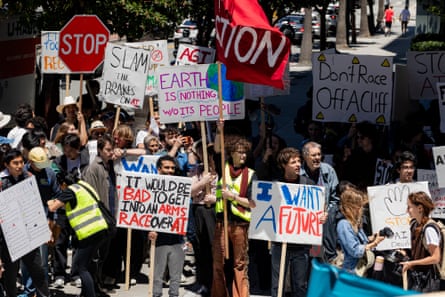
“The Reno City Council heard a strong public opposition to data center development in the area. The concerns focused on water consumption, rising utility costs, pollution, and long-term climate impacts,” the document said.
Some experts and activists have expressed concern that as mobilization against datacenters grows, peaceful anti-AI organizations could face surveillance from authorities.
“There’s nothing extreme about not wanting to lose your livelihood to AI, your drinking water to AI datacenters, your privacy to ubiquitous AI surveillance or your life to runaway rogue AI,” said Ryan Shapiro, executive director of Property of the People. “What’s extreme is the law enforcement treating these legitimate objections as threats to be neutralized.”
The ‘rising threat’ of AI
In the months after OpenAI introduced ChatGPT in 2022, law enforcement across the US began to pay attention to the way the novel technology was being used. Even in its infancy, the tool could produce images that were indistinguishable from “authentic images”, according to one May 2023 law enforcement document. Police in Minnesota and in California worried that function could exacerbate problems with child sexual abuse material (CSAM), deepfakes and “terrorist propaganda materials”.
At the time, many of these risks were largely theoretical in the eyes of law enforcement, the documents show. In one memo distributed by two California intelligence centers, officials warned that officers should remain vigilant because they predicted AI may one day make it easier to circumvent CSAM detection methods, that it may be used to produce and disseminate deepfakes and that it may increase the volume of propaganda.
But as generative AI expanded in both its capabilities and reach, so too did law enforcement concerns about the types of crimes it could enable. By April 2024, the DHS’s intelligence department sent out a memo suggesting, without citations or evidence, that foreign terrorist organizations and domestic violent extremists who were “presumably US based persons” had “successfully bypassed generative Al guardrails” in order to generate bomb-making instructions and “general tactics for conducting attacks against the United States”.
Warnings about the ways violent extremists exploit AI grew in their intensity in 2025. Individuals and malicious groups across the US were weaponizing AI tools “to spread hate speech, recruit new members, and radicalize online supports more efficiently”, according to a memo from the Orange County Intelligence Assessment Center. In one example the memo cited, users of rightwing social media platform Gab created an Adolf Hitler chatbot that was programmed to say that the Holocaust was exaggerated, climate change was a scam and the 2020 election was rigged. Other examples had less evidence. The intelligence center wrote that a 17-year-old student who opened fire in Antioch, Tennessee, in January 2025 was “likely influenced by the vast amounts of extremist content readily available through the AI-enhanced web”. The source the center cited in this example included no mentions of AI.
A few months later, in April 2025, the Joint Regional Intelligence Center (JRIC), a Los Angeles-based DHS fusion center and the largest such facility in the country, published a five-part series issuing a stern warning: the misuse of generative AI for nefarious purposes was on the rise. Among the concerns was the surge in AI-created CSAM. The National Center for Missing and Exploited Children (NCMEC), a child protection non-profit, received more than 7,000 child exploitation reports involving GenAI between 2023 and 2025, the memo said.
By 2026, the documents showed that law enforcement agencies were paying more attention to how AI could make their jobs harder. In April, New York state’s intelligence center warned that AI-generated images were being used to prank people, including officers. In March, a man was arrested in Florida for showing an officer an AI-generated video of his patrol car being broken into. That same month, a man in New York was arrested for using AI to create false evidence that his car was damaged by police.
“This activity involving a patrol car represents a form of law enforcement harassment,” the memo said. “While often intended as humorous and not intentionally seeking to create dangerous situations, the prank can elicit an armed law enforcement response.”
AI’s proliferation could also make it harder for police to be tipped off to planned violent attacks, officers’ memos warned. In an FBI public safety awareness report, the agency cautioned that the private nature of AI models make it easier for bad actors to evade any “tripwires” or anything that would trigger an alert – like posting in an open forum with bystanders who might report them to the authorities. In the memo, the FBI encouraged agencies to develop relationships with AI companies to streamline “reporting avenues”.
Law enforcement have grown wary of the ways AI could be used against them – even if they also use those very same tools for their police and investigative work. As the Guardian previously reported, police have warned that Meta’s AI-enabled smart glasses could be used to surreptitiously record their activities. In an August 2025 NYPD memo, police warned that law enforcement needed to keep pace with AI advancements so they were prepared to respond “to increasingly sophisticated cyberattacks, other Al-enabled crime, and advanced malign influence campaigns”. But they also worried about the public questioning police use of AI including for social media monitoring.
“Law enforcement organizations may also face the challenge of calming public fears over the extent of the use of Al in policing, including rumors surrounding surveillance, the loss of privacy, and even the future integration of humanoid robots into the police force,” the memo said.
In January, an officer from a Maine intelligence center warned that a new AI-enabled software in Amazon Ring and other video doorbells could be used to monitor and alert residents of police activity. Several companies have implemented a feature that sends alerts about activity that the doorbell cameras detect, describing what’s happening outside using AI. Police and law enforcement have a long history of obtaining and accessing Amazon Ring footage as part of their investigations.
“This notification feature can compromise officer safety, as it could provide advanced warning of an officer’s presence, tactics, formations, equipment, and could expose officers to increased risks,” the memo said.
The Guardian wp:paragraph
هلدینگ کاسپین استانبول | خرید ملک در ترکیه | صرافی معتبر ایرانی در ترکیه | خرید و فروش طلا در ترکیه | مهاجرت به ترکیه | واردات و صادرات در ترکیه | نیازمندیهای ترکیه | اخبار ترکیه | اخبار جهانی | توریست ایران | خدمات توریستی در ایران | تورهای گردشگری ایران | هلدینگ اول | خدمات کاریابی و فریلنسری و شغل | مرجع اطلاعات ایران (همه چیز در ایران) | کیف پول و خدمات مالی و پرداخت یار | اخبار ایران | تابلو زنده قیمت ارز در ترکیه و استانبول | صرافی آنلاین ترکیه | قیمت طلا و نقره در ترکیه | سرمایه گذاری در ترکیه | جواهرات در ترکیه | نرخ لحظه ای ارزها در استانبول | قیمت دلار امروز در ترکیه | قیمت دلار استانبول امروز | قیمت لحظه ای دلار | اخبار روز ترکیه استانبول | اپلیکیشن ISTEX | اپلیکیشن قیمت لحظه ای دلار و یورو و لیر و ارزها در ترکیه
/wp:paragraph wp:paragraph /wp:paragraph
About the Author