The civil war that began in Libya in 2014, dividing the country between the Tripoli-based Government of National Accord (GNA) and the House of Representatives in the east, has, after a decade, evolved from a mere power struggle into a fundamental axis determining the geopolitical fate of the Eastern Mediterranean. The ratification by the Libyan House of Representatives, as of October 2026, of the memorandum of understanding on the delimitation of maritime jurisdiction areas signed between Türkiye and Libya on Nov. 27, 2019, signals the beginning of a new and lasting era in regional balances. This development is the most concrete indication of how the process Türkiye initiated in Libya through military intervention has evolved into a multidimensional strategy based on inclusive diplomacy and rational energy interests.
Shifting balance on ground
The foundation of today’s diplomatic framework is shaped by the outcomes of the intense proxy war that unfolded on the ground. In 2019, an offensive launched against Tripoli by forces led by Gen. Khalifa Haftar, backed by global and regional actors, was halted when Türkiye supported the internationally legitimate government.
During this process, the Turkish Armed Forces’ training support and the effective use of Turkish defense industry equipment on the ground, particularly the Bayraktar TB2, air defense systems, and electronic warfare assets, altered the course of the conflict. Rather than resulting in an absolute military victory, Türkiye’s intervention froze the conflict by forcing the parties into a permanent cease-fire on Oct. 23, 2020, and paved the way for a political solution.
As the dynamics of the conflict in Libya gradually shifted from an east-west axis to power struggles between factions, Türkiye focused on translating the stability brought about by the military balance into a diplomatic framework.
‘One Libya’ diplomacy
The most distinctive feature of Türkiye’s post-2020 Libya policy is that it does not limit its approach solely to its Western allies but extends it to the entire country within the framework of the “One Libya” vision. Ankara has taken significant diplomatic steps to resolve Libya’s division and establish dialogue with all segments of society.
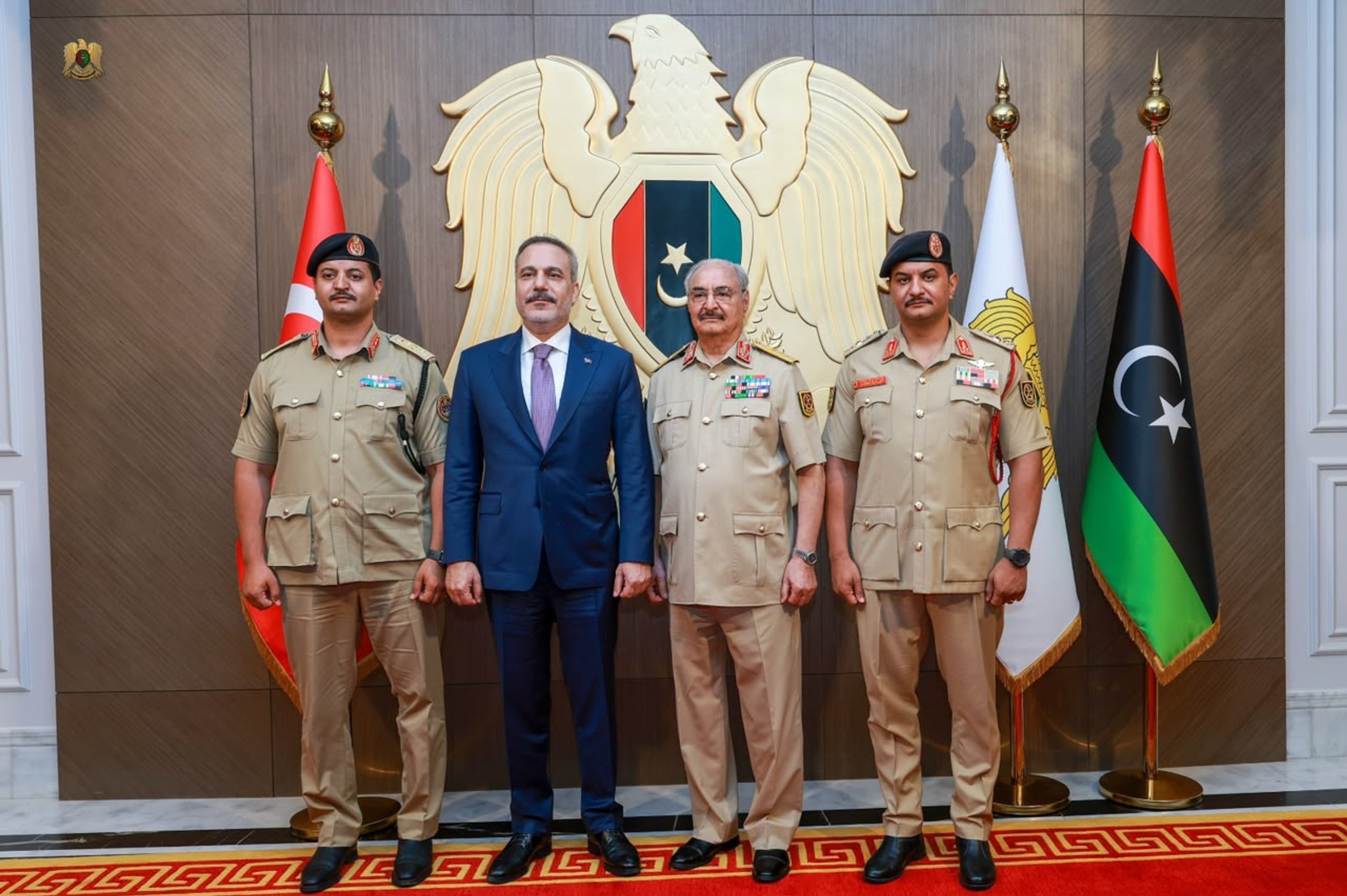
One of the most striking examples of this is the establishment of contacts with the Haftar faction, which had previously adopted a hardline stance against Türkiye. The visits to Ankara by Haftar’s son and deputy commander-in-chief of the Libyan National Army (LNA), Saddam Haftar; the hosting of the 5 5 Joint Military Committee meetings in Türkiye; and the intensive shuttle diplomacy conducted by Türkiye’s Ministry of Foreign Affairs and National Intelligence Organization have demonstrated that Ankara is a unifying rather than an exclusionary actor. The visits of the TCG Kınalıada corvette to both the ports of Tripoli and Benghazi, along with the intelligence-sharing agreements signed with the eastern administration, underscore Türkiye’s determination to serve as a security partner for all of Libya.
In an environment where global actors, such as Russia, are shifting their forces from Syria to Libya (via Tobruk and Maaten Al Sarra) to establish military logistics routes deep into Africa, Türkiye’s efforts to ensure Libya’s political unity have become even more critical.
Ratification of 2019 agreement
As a result of this multifaceted strategy, the ratification of the maritime jurisdiction agreement by the Libyan House of Representatives, and by Saddam Haftar himself, who described it as “a tool to protect the country’s rights and economic interests,” has anchored the arrangement on a legal foundation.
This agreement is not merely a matter of drawing a boundary. This 29.9-kilometer (18.6-mile) maritime boundary line drawn between the two states serves as a strategic shield against plans to confine Türkiye to the Gulf of Antalya. Article 4 of the agreement establishes a partnership mechanism extending beyond the borders by stipulating that if one party engages in negotiations with a third country regarding its exclusive economic zone, it must inform the other party and cooperate on the joint exploitation of resources. This situation has created a new and more complex geopolitical reality in the Eastern Mediterranean, where the Türkiye-Libya line intersects with the maritime boundaries established between Greece and Egypt in 2020.
International unease
This approval by the Libyan House of Representatives has caused serious unease among actors seeking to shape the status quo in the Eastern Mediterranean in their favor. Türkiye, which had been excluded from the EastMed (Eastern Mediterranean Gas Forum) mechanism formed over the past decade by Greece, the Greek Cypriot administration, Egypt and Israel, has limited the sphere of influence of this bloc through this agreement.
Regional reactions were swift; the Egyptian Ministry of Foreign Affairs declared the agreement “invalid and null and void,” arguing that it would have no legal binding force on Cairo. Israel strongly condemned the approval, accusing Türkiye of “destabilizing the region.” The Greek government, meanwhile, urgently brought the matter before the United Nations Security Council, issuing a warning about a threat to regional security. From the EU side, High Representative Kaja Kallas called on the parties to respect international law and the sovereign rights of member states. These strong reactions demonstrate just how profoundly Türkiye’s alliance with Libya has shaken the Eastern Mediterranean energy equation.
Energy, economic interests
At the heart of the international objections lies the reality that this issue is not merely a border dispute, but rather a matter of who owns the hydrocarbon resources and how they will be transported to global markets. At the heart of Türkiye’s Libya strategy lie not only security policies but also rational energy interests and goals of economic cooperation.
The delimitation agreement has opened the door to new economic opportunities for both countries. As a reflection of this climate of trust, the Turkish Petroleum Corporation (TPAO) is playing an active role in energy tenders in Libya. Following the seismic research agreements signed in 2025, TPAO’s acquisition of licenses, with a 40% stake, in both Libya’s offshore and onshore blocks, in partnership with international companies such as Spain’s Repsol and Hungary’s MOL, as of 2026, highlights the technical and commercial dimensions of these relations. Through these moves, Türkiye is not only safeguarding its regional rights but also taking steps within legitimate and legal frameworks to meet its growing energy needs and assert its influence in the international energy market.
Türkiye’s policy toward Libya has evolved amid the series of crises since 2019, transforming into a three-pronged strategy built on military deterrence, diplomatic inclusivity, and economic realities. The formal adoption of the maritime jurisdiction agreement by all parties in Libya has solidified Türkiye’s position in the Eastern Mediterranean based on international law and geographical realities. The current situation demonstrates that Ankara has succeeded in establishing a lasting balance, one that promises prosperity and stability to both countries through shared interests, rather than merely projecting power. Although this same picture has been presented to other littoral states, it appears that countries such as Egypt continue to remain hesitant due to political pressures from the EU and Israel. However, if the shifting global balance of power continues in the coming period, the EU will not be able to sustain this pressure for very many years.
The views and opinions expressed in this article are solely those of the author. They do not necessarily reflect the editorial stance, values or position of Daily Sabah. The newspaper provides space for diverse perspectives as part of its commitment to open and informed public discussion.
DAILYSABAH
هلدینگ کاسپین استانبول | خرید ملک در ترکیه | صرافی معتبر ایرانی در ترکیه | خرید و فروش طلا در ترکیه | مهاجرت به ترکیه | واردات و صادرات در ترکیه | نیازمندیهای ترکیه | اخبار ترکیه | اخبار جهانی | توریست ایران | خدمات توریستی در ایران | تورهای گردشگری ایران | هلدینگ اول | خدمات کاریابی و فریلنسری و شغل | مرجع اطلاعات ایران (همه چیز در ایران) | کیف پول و خدمات مالی و پرداخت یار | اخبار ایران | تابلو زنده قیمت ارز در ترکیه و استانبول | صرافی آنلاین ترکیه | قیمت طلا و نقره در ترکیه | سرمایه گذاری در ترکیه | جواهرات در ترکیه | نرخ لحظه ای ارزها در استانبول | قیمت دلار امروز در ترکیه | قیمت دلار استانبول امروز | قیمت لحظه ای دلار | اخبار روز ترکیه استانبول | اپلیکیشن ISTEX | اپلیکیشن قیمت لحظه ای دلار و یورو و لیر و ارزها در ترکیه
About the Author