
Two Israeli TV networks have now updated their exit polls and are predicting that Netanyahu’s bloc will be tied with Eisenkot’s opposition grouping.
Kan 11 and Channel 13, two of the country’s leading broadcasters, have revised their exit poll to put the Netanyahu and Eisenkot blocs tied on 51 seats each. Channel 12, the other main broadcaster, has Netanyahu’s bloc on 50 seats and the opposition on 52 seats – narrowing their projections from earlier in the night.
A candidate needs 61 parliamentary seats to form a majority coalition government.
Exit polls released earlier on Tuesday evening had Eisenkot winning most seats in the Knesset by a slight margin. Israeli exit polls are often revised after publication and are notoriously imprecise, with the final count often swinging by several seats.
Earlier in the evening, Avigdor Lieberman, head of the Yisrael Beitenu party, warned supporters that the final results could still change after hundreds of thousands of absentee ballots cast by on-duty soldiers are counted in the coming days.
It has just ticked past 5am in Tel Aviv, and local media report that 28% of votes in Israel’s 2026 election have been counted. The vote drew 77.7% turnout, the highest since 1999.
As to how things are tracking, exit polls published by Israel’s major TV networks have revised their projections to show Benjamin Netanyahu’s governing bloc tied with the opposition grouping of Gadi Eisenkot. Exit polls released earlier on Tuesday evening had Eisenkot winning most seats in the Knesset by a slight margin. Israeli exit polls are often revised after publication and are notoriously imprecise, with the final count often swinging by several seats.
Here are some of the latest pictures capturing the mood in Israel tonight.
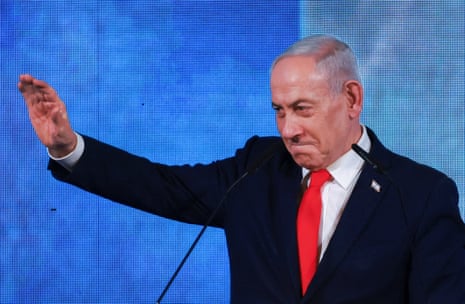
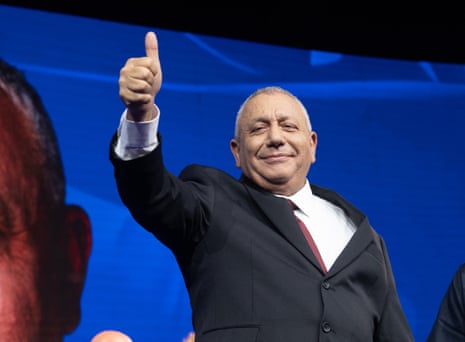

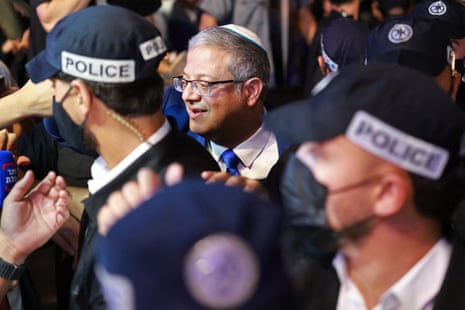


No single party has ever won a 61-seat majority in the 120-member Knesset, the country’s parliament. This means Israeli governments are built on coalitions.
If the official results match last night’s exit polls, it could lead to weeks of political negotiations to form a coalition. During that time, Netanyahu will remain as a caretaker prime minister.
That situation has happened multiple times in the past and allowed him to eventually form a coalition or, if that failed, trigger a new round of elections.
Coalition building in Israel has always been difficult because mainstream parties usually refuse to collaborate with parties run by Palestinian citizens of Israel.
This has led to what Israelis see as a farcical number of repeat snap elections. Between 2019 and 2022, Israel held five elections.
In his speech to supporters, Benjamin Netanyahu also spoke about the Iran war, saying that Israel had a “unique opportunity” to work with Donald Trump to end the “existential threat”.
His comments come after days of brandishing threats of a new bombing campaign against Iran.
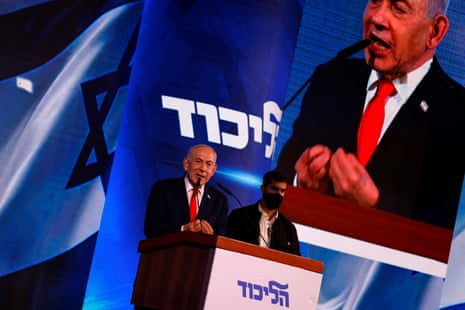
He celebrated the death of Iran’s supreme leader, Ayatollah Ali Khamenei, saying of “Iran is weaker than ever, Israel is stronger than ever.”
He continued to claim that working with Trump he could remove the threat from Iran once and for all.
Israel’s defence minister and Likud member, Israel Katz, has warned the opposition bloc to “wait for the true results” before they declare their “willingness to form a minority government with the support of the Arab parties”.
Palestinian parties are projected to dramatically increase their representation in the Knesset, with predictions they could win as many as 18 seats, up from 10.
Experts have said that if Eisenkot has fallen short of a majority, as the exit polls suggest, he would be obliged to sit down to talk with the Palestinian groupings, the Joint List and Ra’am, to try to form a government – which could take weeks.
Katz appears to be laying the groundwork to rally support among conservative Israeli Jews, to claim Netanyahu’s campaign slogan, “the Right or Palestine”, has been vindicated.
Benjamin Netanyahu has finally taken the stage at the Likud election night party in Jerusalem, just after 3am local time, telling his supporters official results will show that “Likud is the largest party in Israel”.
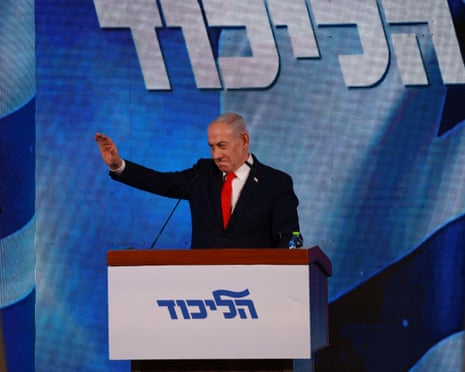
He has claimed that the right-wing bloc has a clear majority among the Jewish public, despite exit polls showing his grouping tied with the opposition bloc led by Gadi Eiesnkot.
He has told supporters that the country must “establish a strong, right-wing national government” – adding that a government that relies on the support of Palestinian parties must not be formed.
While Netanyahu’s Likud could emerge as the largest party, voters appear to have shrunk his bloc’s majority in parliament, jeopordising his return to power and pointing to potential weeks of political wrangling to form a government from either side.
A record number of Israeli’s are expected to have voted at “special polling stations” in 2026, casting more confusion into the mix as the results as these ballots are not expected to be announced before Thursday.
Under Israeli electoral law, each voter is assigned to a specific polling station and can only vote at that station. However in exceptional circumstances, some voters are allowed to cast their ballot at special polling stations they are not registered at. Among those afforded this exception are soldiers stationed at IDF bases, diplomats working abroad, prisoners and prison guards and people in hospital.
Ballot boxes from these special polling stations are transported directly to the Knesset where they undergo a series of checks before they are counted.
According to some reports, Israel’s Central Elections Committee expects between 600,000 and 650,000 people to vote in such a way, almost 10% of elegible voters and an unprecedented number in Israeli electoral history.
More than four hours after polls closed, party faithful are waiting for Netanyahu to address his Likud party’s headquarters in Jerusalem.
Israeli media is reporting that the Israeli prime minister is set to speak soon, and live images on local TV show crowds of supporters and journalists gathering to hear from Likud’s leader.

On a giant screen at the event a video montage has been playing showing the prime minister hugging Donald Trump alongside footage of military strikes from the assorted wars he has led since the Hamas attack.
Elie Pieprz told Agence France-Presse he was feeling optimistic about Netanyahu’s chances.
Usually things move more in our favour as the night goes on and as the morning approaches … I’m very optimistic. I feel the prime minister has performed better than some of the pre-campaign polls suggested.”
Nadav Eyal, a columnist in the daily newspaper Yedioth Ahronoth, has said that the revised exit polls show its going to be a long night for election watchers.
Historically, Israeli exit polls have tended to underestimate Likud, but shifts between blocs are usually limited to 2–3 seats at most.
Meanwhile a minister from Netanyahu’s party has told the Associated Press he’s cautiously optimistic about the results.
Amichai Chikli, minister for diaspora affairs for Israel’s government, said it was too early to celebrate the initial poll results but that the party was optimistic and had to be patient.
“One thing we know for sure, those who said Netanyahu is over, the Likud is over, celebrated too early,” he said.
Yair Golan, the leader of the Democrats, has hinted that the opposition bloc could include Palestinian parties in its coalition, according to Haaretz.
Golan, who represents the last remnants of Israel’s once dominant Labour party, has policies on Gaza and a two state solution, that track towards a more centrist position in Israeli terms.

Speaking to supporters, Golan said “every Knesset member elected in the democratic, legal process is a legitimate part of our political system. If there is a democratic majority to replace the government of destruction – we must actualise it.”
“We are ready to work with all our partners, bridge the gaps and take responsibility,” Golan added in a statement. “The public has spoken. Now it’s our turn to do the work.”
Two Israeli TV networks have now updated their exit polls and are predicting that Netanyahu’s bloc will be tied with Eisenkot’s opposition grouping.
Kan 11 and Channel 13, two of the country’s leading broadcasters, have revised their exit poll to put the Netanyahu and Eisenkot blocs tied on 51 seats each. Channel 12, the other main broadcaster, has Netanyahu’s bloc on 50 seats and the opposition on 52 seats – narrowing their projections from earlier in the night.
A candidate needs 61 parliamentary seats to form a majority coalition government.
Exit polls released earlier on Tuesday evening had Eisenkot winning most seats in the Knesset by a slight margin. Israeli exit polls are often revised after publication and are notoriously imprecise, with the final count often swinging by several seats.
Earlier in the evening, Avigdor Lieberman, head of the Yisrael Beitenu party, warned supporters that the final results could still change after hundreds of thousands of absentee ballots cast by on-duty soldiers are counted in the coming days.
The Israeli election commission has began to release official results.
The commission has published the first batch of results. It says it has tallied just 2,670 of the more than 7.3 million ballots cast.
Ballots will be counted throughout the night, with clearer results expected in the coming hours.
Gadi Eisenkot, the leader of the main opposition bloc, has said the Israeli public has voted for change and against Benjamin Netanyahu.
Speaking to supporters at his election headquarters, he said another election would be a mistake – and he would do everything to “fulfil the will of the people.”
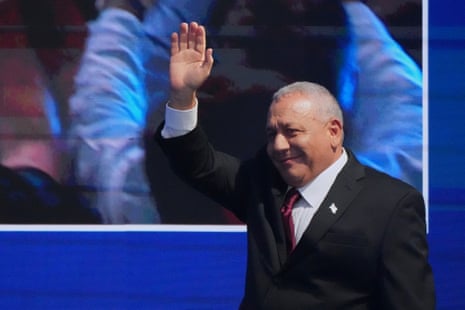
Exit polls suggest that Eisenkot’s bloc has secured the largest number of seats, but has fallen short of the majority needed to form a government.
Today, Israel went out to a referendum over the leadership that will lead Israel in the coming years … The people decided in favour of change.”
In his speech, he also warned Netanyahu not to “use Israel’s security” for political ends, playing on fears that the prime minister could use this period of uncertainty to launch a new attack on Iran.
The big gains made by Palestinian parties in Israel’s general election pose an urgent and fundamental challenge to the country’s mainstream opposition: either cooperate with Arab Israelis or hand Benjamin Netanyahu a roadmap to political survival.
In the wake of Tuesday’s exit polls, the leader of the opposition bloc, Gadi Eisenkot, declared them a victory for “Israel’s Zionist national majority” but the real outcome looks as if it will be far more complex than that.
The greatest change between the new Knesset and the old will be the dramatically increased representation of Palestinian parties, currently projected to win 17 to 18 seats, up from 10. That redraws the battle lines on Israel’s political landscape. Arab Israelis will not so easily be sidelined and ignored.
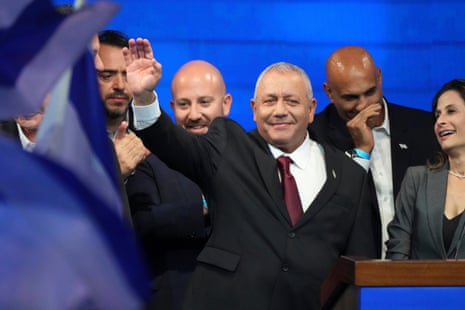
Eisenkot will argue that he commands the bigger overall bloc and has the better chance of negotiating his way to a Knesset majority. To do so, however, he and his partners in the “change” bloc would be obliged to sit down to talk with the Palestinian groupings, the Joint List and Ra’am (an acronym for the United Arab List).
They would probably find Ra’am and its leader, Mansour Abbas, easier to talk to. Abbas has already participated in a right-leaning government of Naftali Bennett, now a junior partner in the Eisenkot bloc. Abbas has shown willingness to make political compromises and stated emphatically on Tuesday that his priority is to “bring down Benjamin Netanyahu, Smotrich, and Ben Gvir in this election”.
However, most estimates based on the exit polls show Ra’am as the smaller of the two Palestinian groupings, with seven projected seats in the new Knesset and it is not clear that would be enough, even if a pact was made with the consent of the other members of Eisenkot’s bloc, to produce a majority government.

Negotiations with the Joint List, with 10 or more projected seats, would be tougher. Eisenkot has laid down four conditions: recognise Israel as a Jewish and democratic state, accept the values expressed in Israel’s declaration of independence, accept conscription for Palestinians Israeli citizens, who are currently exempt, and denounce Hamas as a terrorist organisation.
Speaking on Tuesday as the votes were being counted, Amjad Shbita, the general secretary of Hadash, the socialist party that is the biggest faction in the Joint List, said Eisenkot would be in no position to impose terms for coalition talks.
Among the more surprising outcomes of the exit poll has been the forecast for the far-right Otzma Yehudit (Jewish Power) led by public security minister Itamar Ben-Gvir,
Ben-Gvir’s extremist, ultranationalist party was expected to better their result of six seats from the 2022 elections.

But there was stunned silence at the group’s watch party in central Israel as results from the exit polls flashed across the screen, with most channels suggesting the party would captur just six or seven seats.
Ben-Gvir attempted to revive his supporter’s spirits by reminding them of all he had achieved in the past four years to further their agenda, including passing a law approving the death penalty for Palestinians convicted of murdering Israelis and worsening conditions for Palestinian prisoners.

Ben-Gvir denounced other members of Netanyahu’s coalition for who had suggested a unity government with his main rival, Gadi Eisenkot, which the audience booed loudly.
This is precisely the scenario we warned against – it is a terrible mistake.”
-
This is Jonathan Yerushalmy, picking up our live coverage from Lucy Campbell.
The Guardian wp:paragraph
هلدینگ کاسپین استانبول | خرید ملک در ترکیه | صرافی معتبر ایرانی در ترکیه | خرید و فروش طلا در ترکیه | مهاجرت به ترکیه | واردات و صادرات در ترکیه | نیازمندیهای ترکیه | اخبار ترکیه | اخبار جهانی | توریست ایران | خدمات توریستی در ایران | تورهای گردشگری ایران | هلدینگ اول | خدمات کاریابی و فریلنسری و شغل | مرجع اطلاعات ایران (همه چیز در ایران) | کیف پول و خدمات مالی و پرداخت یار | اخبار ایران | تابلو زنده قیمت ارز در ترکیه و استانبول | صرافی آنلاین ترکیه | قیمت طلا و نقره در ترکیه | سرمایه گذاری در ترکیه | جواهرات در ترکیه | نرخ لحظه ای ارزها در استانبول | قیمت دلار امروز در ترکیه | قیمت دلار استانبول امروز | قیمت لحظه ای دلار | اخبار روز ترکیه استانبول | اپلیکیشن ISTEX | اپلیکیشن قیمت لحظه ای دلار و یورو و لیر و ارزها در ترکیه
/wp:paragraph wp:paragraph /wp:paragraph
About the Author