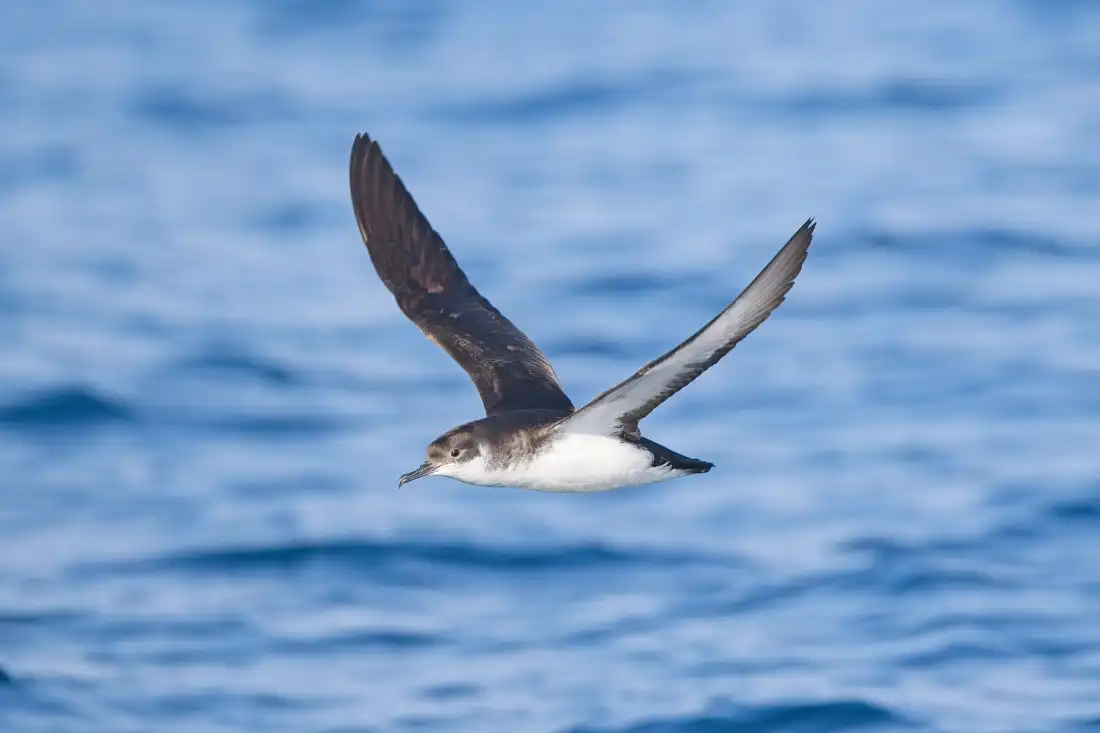
Manx shearwaters race back to their nests after spending weeks hunting at sea. New research suggests they get jet lagged on their journey home.
birdsonline/Getty images
birdsonline/Getty images
New research shows that humans are not the only species to get jet lag: Some birds appear to experience it too.
A study published in the journal Science found that a type of seabird known as the Manx shearwater appears to become slightly disoriented during long flights across the Atlantic Ocean. That disorientation, the authors say, is due to the bird’s internal clock falling out of sync with the sun’s position in the sky.
Manx shearwaters are a common bird in the British Isles. They look a little like seagulls, but “they’re actually very closely related to an albatross,” said Patrick Lewin, a behavioral ecologist at the University of Oxford.
Shearwaters mate for life, and when they breed, a couple lays just one egg.
Then they take turns incubating it: “One partner will sit on the egg nonstop while the other one goes out to sea,” Lewin said.
For up to two weeks the hunting partners scour the North Atlantic for fish and squid, often travelling hundreds of miles from their nests.
Once these birds’ bellies are full “they absolutely bomb it back to their colony,” Lewin said. Often they make the long journey home in just a day or so.
Which raised an interesting question: Do Manx shearwaters feel jet lag (or perhaps more aptly, flap lag)?
To see if these little birds really did feel the effects of flying through time zones like humans do, Lewin used a remarkable tool – for 20 years, his colleagues had been tagging birds with GPS trackers and collecting data on their flights out to the Atlantic and back.
He figured he could see the jet lag in their flights. That’s because the Manx shearwaters are believed to use the sun to navigate.
“To use the sun as a compass you have to know what time of day it is,” Lewin said.
In the morning, the sun is in the east, at midday it’s slightly to the south (if you’re in the northern hemisphere) and then in the evening it’s in the west. If the shearwaters had the wrong time of day, they would fly the wrong way.
That’s exactly what Lewin and his colleagues saw. As the birds rushed back to their partners and eggs, they veered ever-so-slightly off course. It wasn’t much: A seven-degree error, the maximum deviation observed, only took a bird out of its way by about three miles on a 600-mile journey. “It’s a really small addition,” he said.
“This paper is so cool,” said Alice Boyle, a biologist at the Centre for Animals on the Move at Western University in Ontario, Canada who was not part of the study.
Boyle said pretty much every creature on the planet, from corals to chipmunks, has to navigate its environment, yet it’s rare to see a study showing navigation decisions in action. That’s what makes this type of GPS work so valuable.
“It’s using these wild birds that travel to completely remote places and we’re able to learn so much about how they do that,” she said.
NPR Topics: News wp:paragraph
هلدینگ کاسپین استانبول | خرید ملک در ترکیه | صرافی معتبر ایرانی در ترکیه | خرید و فروش طلا در ترکیه | مهاجرت به ترکیه | واردات و صادرات در ترکیه | نیازمندیهای ترکیه | اخبار ترکیه | اخبار جهانی | توریست ایران | خدمات توریستی در ایران | تورهای گردشگری ایران | هلدینگ اول | خدمات کاریابی و فریلنسری و شغل | مرجع اطلاعات ایران (همه چیز در ایران) | کیف پول و خدمات مالی و پرداخت یار | اخبار ایران | تابلو زنده قیمت ارز در ترکیه و استانبول | صرافی آنلاین ترکیه | قیمت طلا و نقره در ترکیه | سرمایه گذاری در ترکیه | جواهرات در ترکیه | نرخ لحظه ای ارزها در استانبول | قیمت دلار امروز در ترکیه | قیمت دلار استانبول امروز | قیمت لحظه ای دلار | اخبار روز ترکیه استانبول | اپلیکیشن ISTEX | اپلیکیشن قیمت لحظه ای دلار و یورو و لیر و ارزها در ترکیه
About the Author