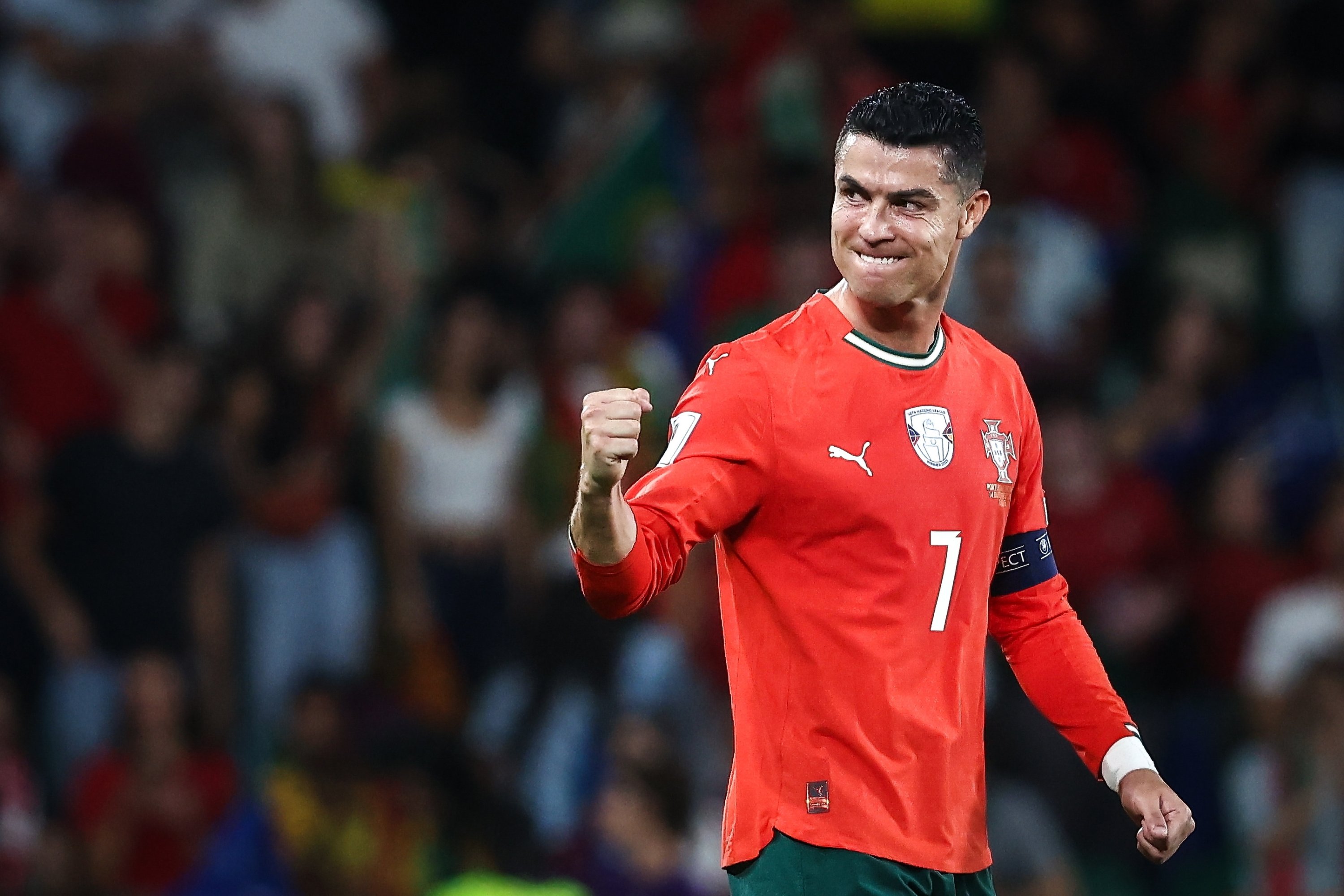
Cristiano Ronaldo’s international career began with a teenage debut in 2003 and ended with a record-breaking farewell 23 years later, leaving Portugal’s No. 7 shirt behind as one of the most decorated players in football history.
The 41-year-old announced his retirement from international football Thursday, saying the time had come to return the iconic shirt to the national team and “pass it on to the future.”
Ronaldo leaves Portugal with 146 goals in 234 appearances, both men’s international records. His career brought three major international trophies, five Ballon d’Or awards and a collection of individual achievements that transformed him into one of the defining footballers of his generation.
In a farewell video, the Portuguese captain reflected on more than the matches, goals, trophies and records, thanking the teammates, coaches, supporters and Portuguese communities around the world who had accompanied him throughout his journey.
“Football is about people,” he said, ending his message with a declaration that captured his enduring connection to his country: “Portugal will always be in me.”
His departure closes an extraordinary international chapter, although he intends to continue playing club football for Saudi Arabian side Al Nassr.
From Madeira to Manchester
Born Cristiano Ronaldo dos Santos Aveiro in Funchal, on the Portuguese island of Madeira, on Feb. 5, 1985, Ronaldo left his family at 12 to join Sporting CP’s academy in Lisbon.
His determination quickly became apparent. Former academy teammates have recalled a youngster who regularly stayed behind after scheduled training sessions, working on his speed, technique and physical conditioning. His commitment to improving himself became a defining characteristic of a career that would span more than two decades.
Ronaldo made his senior debut for Sporting in August 2002, aged 17, against Inter Milan in a Champions League qualifier. His breakthrough in Portuguese football was brief, however, as an impressive performance against Manchester United in a friendly the following year changed the direction of his career.
His pace, close control, stepovers and attacking movement caught the attention of United’s players, who urged manager Alex Ferguson to sign him.
Manchester United secured his services in 2003, bringing an exceptionally gifted but physically slender 18-year-old to Old Trafford. Ronaldo initially preferred the No. 28 shirt, but Ferguson handed him the No. 7, previously worn by club icons George Best, Eric Cantona and David Beckham.
The decision proved significant. Ronaldo developed from an unpredictable young winger into one of Europe’s most dangerous attacking players, combining his natural flair with greater physical strength, tactical discipline and a growing instinct for goals.
He won three consecutive Premier League titles, the 2008 Champions League and his first Ballon d’Or during his initial spell at United. By the time he left for Real Madrid in 2009, he had established himself among the world’s leading footballers.
A record-breaking era at Real Madrid
Ronaldo’s move to Spain marked the beginning of the most prolific period of his club career.
Across nine seasons at Real Madrid, he scored 451 goals in 438 competitive appearances, becoming the club’s all-time leading scorer. His extraordinary scoring rate helped establish him as one of the most productive forwards the game has seen.
He won four Champions League titles, two La Liga championships and three Club World Cups with the Spanish giants. His 17 goals during the 2013-14 Champions League campaign remain a competition record for a single season.
His playing style also continued to evolve. The explosive winger who had once relied heavily on pace, elaborate dribbling and one-on-one battles increasingly became a ruthless penalty-area forward.
Ronaldo refined his movement, positioning and timing, developing an exceptional ability to find space, attack crosses and finish with either foot. His aerial strength became another major weapon, allowing him to remain decisive even as his acceleration gradually declined.
The transformation helped him sustain his dominance at the highest level. He finished his Real Madrid career with 140 Champions League goals, 183 appearances in the competition and goals in three separate finals.
His individual achievements included five Ballon d’Or awards, while his rivalry with Lionel Messi became one of the defining storylines of modern football. Their prolonged competition for individual honors, records and major trophies raised standards across an entire generation.
Juventus, Manchester United return and Saudi Arabia
In 2018, Ronaldo left Real Madrid for Juventus, taking his goalscoring ability to Italian football.
He scored 101 goals in 134 appearances across three seasons, winning two Serie A titles, a Coppa Italia and two Italian Super Cups, among other honors.
His return to Manchester United in 2021 initially generated enormous excitement among supporters. However, the second spell became increasingly difficult as disagreements over his role and the club’s direction overshadowed his performances.
Ronaldo scored 145 goals in 346 appearances across his two periods at Old Trafford. His departure in November 2022 followed a controversial televised interview with broadcaster Piers Morgan, during which he criticized the club’s management and manager Erik ten Hag.
United subsequently terminated his contract by mutual agreement.
He then joined Al Nassr, becoming the most high-profile international star to move to the Saudi Pro League. His arrival helped raise the competition’s global profile and was followed by a series of other prominent players making the move to Saudi Arabia.
Controversies away from football
Ronaldo’s career has not been without controversy, with several legal disputes and public disagreements attracting considerable attention.
In Spain, he reached a settlement in a tax fraud case involving undeclared income from image rights. In 2019, he agreed to pay an 18.8 million euro ($21 million) fine and accept a 23-month suspended prison sentence.
In 2018, a woman accused him of sexually assaulting her in Las Vegas in 2009. Ronaldo denied the allegation. U.S. prosecutors declined to pursue criminal charges, and a civil lawsuit was dismissed in 2022 after a judge ruled that the plaintiff’s lawyer had engaged in misconduct.
His departure from Manchester United also exposed the increasingly strained relationship between the forward and the club, with his public criticism of its leadership contributing to the termination of his contract.
Portugal’s defining footballer
For all his individual success at club level, Ronaldo’s greatest emotional connection remained Portugal, where his international career brought both painful disappointments and historic celebrations.
He made his senior debut against Kazakhstan in August 2003, aged 18, and represented his country at Euro 2004 on home soil.
Portugal reached the final but suffered a shock 1-0 defeat to Greece. The young Ronaldo, who had scored twice during the tournament, was left in tears as the hosts missed an opportunity to win their first major international trophy.
The disappointment remained part of his journey for another 12 years.
At Euro 2016 in France, Ronaldo captained Portugal to their first European Championship title. He scored three goals during the tournament and played a decisive role in the semifinal victory over Wales, scoring once and setting up another goal.
His contribution to the final against France was cut short after just 25 minutes when a knee injury forced him off. Rather than retreating from the occasion, he remained alongside the technical area, encouraging and directing his teammates as they fought to secure the trophy.
Portugal eventually prevailed 1-0 after extra time, with substitute Eder scoring the winning goal.
It was a defining moment for Ronaldo and Portuguese football. After the heartbreak of 2004, he had finally helped deliver the country’s first major international title.
He subsequently captained Portugal to the inaugural UEFA Nations League trophy in 2019 and another triumph in 2025.
During the 2025 campaign, he scored in the semifinal victory over Germany and found the net again in the final against Spain, becoming the first player aged over 40 to score in a Nations League final.
Six World Cups and a collection of records
Ronaldo’s remarkable longevity became as impressive as his goalscoring ability.
He appeared at six European Championships and six World Cups, maintaining his place in Portugal’s squad across an era that saw several generations of players come and go.
At the 2026 World Cup in North America, he became the first player to score at six different editions of the men’s tournament. He achieved the milestone with two goals in Portugal’s 5-0 group-stage victory over Uzbekistan before adding another goal against Croatia.
He finished his World Cup career with 11 goals in 27 appearances, placing him second on the tournament’s all-time appearance list behind Argentina’s Lionel Messi, who has played 34 matches.
Ronaldo’s international records extend well beyond the World Cup.
His 146 goals and 234 appearances for Portugal make him the leading men’s international scorer and appearance-holder. He is also the leading scorer in European Championship history, with 14 goals, and holds the record for most goals in World Cup qualifying, with 41.
His achievements across six tournaments also underlined a level of consistency rarely sustained in international football, particularly for an attacking player whose career began in an era when he was still establishing himself at Sporting.
A turbulent end to his Portugal career
Despite the extraordinary achievements, Ronaldo’s final weeks with Portugal were overshadowed by a dispute with national team coach Jorge Jesus.
Tensions emerged during the September international window after Ronaldo was left on the bench for Portugal’s Nations League match against Norway. He subsequently left the national team camp in Copenhagen, prompting questions about his relationship with the coach and his future role in the squad.
Ronaldo accused Jesus of breaking promises regarding his playing time. His departure without permission also drew criticism, particularly given his position as the team’s captain and most experienced player.
He later apologized to supporters and teammates for leaving the camp and said he remained available for international selection. He also indicated that the Portuguese Football Federation should determine whether disciplinary action was necessary.
On Oct. 19, the federation handed him a 30-day suspension and a 255-euro fine. Ronaldo had already served part of the suspension under a provisional disciplinary measure.
The dispute added an uncomfortable ending to an otherwise historic international career, raising questions about how one of football’s greatest players would leave the national team.
His retirement announcement less than a month later brought that chapter to a close.
Ronaldo departs having helped Portugal win its first European Championship and two Nations League titles, while setting records that may stand for generations.
DAILYSABAH wp:paragraph
About the Author