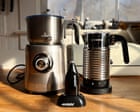
At your local cafe, your barista probably whips up your morning brew using a double boiler espresso machine that includes a very capable steam wand for those perfect cappuccinos, cortados and lattes. But not every coffee enthusiast is an espresso enthusiast or wants to devote the counter space to a contraption to make it, and all of the myriad other ways of preparation have one thing in common – they don’t include a device capable of steaming milk.
If you’re using a moka pot, Aeropress or even instant coffee, a stand-alone milk frother can get barista-quality microfoam, and then some. Unlike a steam wand, the right stand-alone frother can churn out hot foam for tea and cold foam for iced drinks, and it can even whip egg whites, emulsify dressings, mix protein powders into shakes and whip cream, and up your hot chocolate game. It’s a tool you might want to add to your kitchen, even if you already have an espresso machine.
Why you should trust me
Like many people who type and make phone calls all day for a living, I have, let’s say, a bit of a coffee problem. And in pursuit of the perfect cup, I’ve swapped drip for Aeropress, a basic single-boiler espresso machine for something more elaborate, that for a classic manual and that for a double-boiler model with fine-grained control of every parameter.
Outside of my caffeine habit, I’ve headed up product testing programs for some well-known product review and recommendation publications, helping to develop many of the testing approaches that readers of publications like this one are familiar with today. I’ve tested everything from bicycles to pizza ovens to eyeglasses to guitar amplifiers, and edited reviews of almost everything else, including coffeemakers and accessories of every stripe.
And, of course, I’ve made and consumed a lot of coffee along the way.
How I tested
I obtained representative samples of each type of stand-alone milk frother available: carafe-style devices, handheld frothing wands, stand-alone steamers and even fully manual, French-press-style frothers. Over the course of several weeks, I put them through their paces, assessing their performance as I prepared hot and cold froth using whole, oat, almond and soy milks, as well as hot chocolate. For the handheld devices, I also used them in other kitchen tasks, though this was a secondary focus.
During testing, I assessed each device’s ease of use and the usefulness of its feature set, the density and quality of the foam it was able to produce, its temperature consistency (measured with an instant-read thermometer and an infrared surface thermometer), its versatility and considered what kind of user it would likely appeal to as a kitchen tool for daily use.
At a glance
Best milk frother overall:
Nespresso Aeroccino 4
$119 at Amazon
Best budget frother:
Aerolatte
$19.99 at Amazon
Best frother for hot chocolate:
Breville Milk Café
$199.95 at Breville
Best milk frother overall:Nespresso Aeroccino 4
$119 at Amazon
$119.95 at Crate & Barrel
The Aeroccino 4 is dead simple to use, among the most compact of its type, the quietest and fastest unit we tested – and it turns out quality foam on every setting, with both dairy and oat milk.
Why we love the Nespresso Aeroccino 4
Nespresso’s Aeroccino devices are probably what most people think of when they imagine an electric milk frother. The latest iteration, the Aeroccino 4, is a compact, cylindrical stainless pitcher, hefty and substantial in construction. A single magnetic whisk is used for all settings: you can do dense foam, a lighter, more aerated foam, cold foam or heated milk with no froth.
We got silky, convincing foam from the Aeroccino; it’s capable of producing a very stiff foam on the maximum setting if that’s your preference, or an airier, more pourable foam.
The Aeroccino 4 is an especially practical choice if you often make coffee for one – you only need enough milk to cover the whisk to get a satisfying froth. Other devices we tested didn’t work as effectively with so little milk. On the other hand, if you’re looking to regularly make hot chocolates for the whole family, the Aeroccino XL or Breville Milk Cafe are better choices.
If you do scald your milk, no worries – you can toss everything but the base in the dishwasher, unlike most similar units.
It’s a shame that …
There’s not much to complain about with this set-and-forget marvel, but if you want fine-grained control over your foam, you’ll want to look elsewhere. The Subminimal NanoFoamer Pro, for instance, lets you tinker with all the variables of flow.
Like a majority of the carafe-style electric frothers out there, the milk chamber is nonstick. While scientists suggest the risk of Pfas exposure from household products is low, you may want to choose an uncoated alternative, if that’s a concern for you.
Nespresso
Aeroccino 4
from $119
$119 at Amazon$119.95 at Crate & Barrel
Best budget frother:Aerolatte
$19.99 at Amazon
$20.24 at Bed Bath & Beyond
The wands we tested ranged from the incredibly basic to the seriously full featured, but we thought the simple, versatile and highly effective Aerolatte struck the best balance between affordability and performance.
Why we love the Aerolatte
The Aerolatte follows the same basic design as most wands: a motor housed in a compact plastic grip spins a whisk at the end of a stiff steel rod. But it is better built than ultra-cheap options like the Ikea Produkt, and it comes with a pair of AA batteries and a convenient stand.
As with using a traditional steam wand, you’ll need to practice with any frother wand to get the best results. You start with the whisk centered in your jug, get a vortex going, then move outward into the vortex itself as you continue folding air into the milk with the vibrating whisk to fine-tune your froth. Once you get the hang of it, you can create convincing microfoam with hot or cold milk.
Since the Aerolatte is basically just a tiny electric whisk, it’s very versatile. We put it to work at other kitchen tasks and found it especially nice for emulsifying dressings. You’ll need to wash it by hand, but the simple design makes it easy to clean.
It’s a shame that …
At $20, there’s not that much to complain about with the Aerolatte. Its output is not quite on par with a steamer wand or electric carafe-style frother, or the more elaborate Subminimal NanoFoamer, but you can get very close with some practice, and the versatility is nice to have.
As with any wand, if you want heated milk you’ll need to do that on the stove or in the microwave – but if you’re looking for maximum convenience, a wand-style device may not be your go-to choice.
Aerolatte
Milk Frother with Storage Case
from $19.99
$19.99 at Amazon$20.24 at Bed Bath & Beyond
Best frother for hot chocolate:
Breville Milk Café
$199.95 at Breville
$199.95 at Sur La Table
It’s bigger and more adjustable (without being too complex).
Want to whip up some hot cocoa for the family? Breville’s Milk Café can handle up to 25oz of milk – enough for 3 mugs of hot chocolate, with a little left over (you know how that is).
Why we love the Breville Milk Café
Besides its superior capacity, Breville’s thoughtfully designed lid includes a built-in measuring cup to add cocoa powder splash-free after the milk has warmed. Further underscoring its chocolate friendliness, Breville got hotter than the other models we tested – you can hit the mid-160s fahrenheit (unlike all of the other units, Breville doesn’t have set temperature presets; you get continuous control of the temperature or its induction element).
To control foam density, you swap out frothing discs, which live in a convenient magnetized storage nubbin on the back of the base. As long as we filled it enough to start, the Milk Café turned out acceptably smooth or stiff foam across its temperature range, and performed well with alternative milks. When we tried below the minimum fill line (under 6oz), we got over bubbly froth rather than foam, even with dairy milk.
Like the Nespresso, Breville’s carafe is dishwasher-safe, and its bare stainless steel surface makes it a good choice if you’re worried about nonstick surfaces.
It’s a shame that …
If you want good froth, you’ll have to use at least 6oz of milk, which is likely more than you need if you’re making a single drink. That means you’ll likely find yourself with leftover milk if you’re routinely making solo drinks. More milk to froth and heat also means a longer run time: even at minimum fill, it takes nearly a minute longer than the Nespresso to complete a frothing cycle, and up to seven minutes to heat a full pitcher.
Naturally, the Milk Café also consumes more counter space, and it’s quite loud compared with the near silent Aeroccino 4.
Breville
The Milk Café
from $199.95
$199.95 at Breville$199.95 at Sur La Table
The best of the rest
Best for tinkerers: Subminimal NanoFoamer Pro
Subminimal
NanoFoamer PRO
from $159
$159 at Subminimal$159 at Amazon
$159 at Subminimal
$159 at Amazon
If you’ve ever used a scale and a timer to perfect your Aeropress shots and you need silky microfoam to match, the Subminimal NanoFoamer Pro is for you.
It’s the only carafe-style electric milk frother we tested that offers the kind of adjustability you’d get from a steam wand. Not only do you get six aeration modes, you can adjust the height of the impeller and fine tune the flow within the pitcher using three magnetic “flow controllers” to compensate for different types of milk. If you’re a real stickler for temperature control, the Subminimal NanoFoamer Pro consistently hit advertised temperatures for both the liquid (measured with an instant-read thermometer) and foam (measured with an infrared surface thermometer) in every run.
You can easily spend an hour tweaking to find the right setting, and we imagine that’s exactly what the target user for the NanoFoamer Pro will enjoy. Once you do, you can get very convincing microfoam from the device, as silky or stiff as you like, with dairy or plant milks.
We think it’s likely too finicky for most users, who’ll find the complexity and array of extra parts more than they want to deal with. Plus, the impeller is connected to the lid makes it messy to use: you’ll want a plate handy so you can put it down while you’re pouring.
Subminimal
NanoFoamer PRO
from $159
$159 at Subminimal$159 at Amazon
Best for one-button operation on a budget: Cuisinart Hot/Cold Foam Milk Frother
Cuisinart
Hot/Cold Foam Milk Frother
from $83.49
$83.49 at Amazon$89.95 at Cuisinart
$83.49 at Amazon
$89.95 at Cuisinart
This cheaper alternative to the Nespresso Aeroccino 4 is the simplest of the carafe-style models we tested, with a single-button interface and a dual-purpose whisk-and-impeller. You get just two operating modes (hot or cold), and you can remove the spring-style whisk if you don’t want froth. Switching modes takes a long press on the stop-and-start button, and we found it a bit too easy to inadvertently start the wrong cycle as we were trying to switch from hot to cold.
That said, it did a good job on dairy milks, oat and soy, but struggled with almond (admittedly the most difficult milk to froth), either hot or cold. While it costs less than the Nespresso Aeroccino 4, we’d suggest stretching your budget a bit for the Nespresso’s better overall performance and improved ease of use.
Cuisinart
Hot/Cold Foam Milk Frother
from $83.49
$83.49 at Amazon$89.95 at Cuisinart
Best high-end wand: Subminimal NanoFoamer V2 Lithium
Subminimal
NanoFoamer V2 Lithium
$49.95
$49.95 at Subminimal
$49.95 at Subminimal
Like its bigger sibling, Subminimal’s frother wand aims to give you more fine-grained control than the competition. You can swap interchangeable whisks for thinner or denser foams, and the motor runs at two speeds. The travel- and drawer-friendly case is a nice touch, and we didn’t manage to exhaust the USB-C rechargeable battery.
There’s no question that the NanoFoamer surpasses the Aerolatte in raw performance, but it’s twice as expensive, harder to clean and the difference in results will mostly be of interest to very serious enthusiasts.
Subminimal
NanoFoamer V2 Lithium
$49.95
$49.95 at Subminimal
Best for power and speed: Golde Superwhisk
Golde
Superwhisk
$45
$45 at Golde
$45 at Golde
The Superwhisk is a rechargeable, overbuilt wand whisker with a heavy-duty, double-thickness whisk made up of two springs (the assembly is removable for cleaning). It has two speeds, and on the top setting it’s far more powerful than even the NanoFoamer. This allows you to froth milk very quickly, though you’ll want to be careful not to fill your jug too much to avoid overflowing. It feels a lot more capable tackling other kitchen tasks, if you’re looking for versatility. It’s similarly priced to the NanoFoamer, so whether you choose one or the other depends on whether you prefer the Superwhisk’s more traditional steel spring-style whisk over the NanoFoamer’s interchangeable screens.
Golde
Superwhisk
$45
$45 at Golde
Best for infrequent use: Ikea Produkt
Ikea
Produkt
$3.99
$3.99 at Ikea
$3.99 at Ikea
At less than $4, Ikea’s Produkt frother wand is by far the cheapest model we tested, and it feels like it. The build is so flimsy you can easily bend the rod out of shape, which throws off the operation. It ships without batteries, and the battery compartment is annoyingly difficult to access. But it does the job, and if you’re not a regular milk drink enthusiast but want to keep something around for occasional use, it’s a no-brainer. For anyone else, we’d suggest springing for the Aerolatte.
Ikea
Produkt
$3.99
$3.99 at Ikea
Best manual option: Ninja Coffee Bar Milk Frother
Ninja
Coffee Bar Milk Frother
from $19.99
$19.99 at Home Depot$19.99 at Bloomingdale’s
$19.99 at Home Depot
$19.99 at Bloomingdale’s
“Why not just use a French press?” you might ask, and it’s a valid question. If you have one sitting idle, you can put it into service, or pick up something like the Ninja Coffee Bar Milk frother, which works on similar principles, but is more appropriately sized and has a purpose-built plunger with an extra aerator.
Fill to the indicated line, and plunge (to another clearly indicated marker) for a minute, and you’ll find the Coffee Bar does a very good job. Results are better with warm than cold milk (since it’s basically a glass pitcher, you can just stick it in the microwave), but very passable cold. It did a good job with dairy and alternative milks, but we weren’t able to get consistently uniform microfoam without a few big bubbles. It’s also hard to keep an eye on what you’re doing, since the plunger obstructs the view. If you’re looking for an inexpensive option that doesn’t require power at all, it’s certainly worth considering.
Ninja
Coffee Bar Milk Frother
from $19.99
$19.99 at Home Depot$19.99 at Bloomingdale’s
Best for serious baristas: Flair Wizard Steamer
Flair Espresso
Wizard Steamer
$189
$189 at Flair Espresso
$189 at Flair Espresso
The Flair is essentially the steamer wand element from an espresso machine, but in a stand-alone stovetop version. You build up pressure in the miniature boiler, then use the heated steam to aerate your milk. It’s a beautiful design, with a securely locking lid, a cool-touch wooden handle, a comfortable insulated wand, easy-to-use steam valve and two tips (a single-hole model and a three-hole version if you want more forceful steam). With steel construction, it works just fine on an induction cooktop.
It works just like the steam wand on an espresso machine, producing not just a convincing microfoam analogue, but the real thing. You’ll need some practice to get good results with steam (the most flexible way to make milk foam), but once you’ve mastered it, you’ll be able to produce the airy, silky or stiff foam to taste.
The price and learning curve will be off-putting to some, but it will appeal to the sort of enthusiast who is entranced by Flair’s line of minimalist, manual espresso machines, which require you to boil water on the stove anyway.
Flair Espresso
Wizard Steamer
$189
$189 at Flair Espresso
What you need to know about milk frothers
If you’re looking for satisfying dairy milk froth, hot or cold, all of these devices work as advertised. If you’re a serious steamed milk aficionado, you will have to adjust your expectations accordingly. It’s difficult to get perfect microfoam out of these devices – milk varies too much for a set-and-forget device to get perfect results every time, and to really get perfection, you’ll want the control over temperature, pressure and speed that a steam wand gives you. But the best devices get you very, very close.
What types of milk frothers are there?
Carafe-style electric milk frothers
These units resemble small pitchers, with integrated heating elements and a small motor-driven whisk inside to froth your milk. By varying temperature, time and whisk style, you can produce anything from smooth, airy froth to dense, stiff foam. These are the simplest devices to use, offering single-touch access to multiple styles of foam. Some units let you add other ingredients to make drinks like hot chocolate in a single pass.
Frother wands
These handheld devices are miniature electric whisks, capable of producing convincing froth or foam from any variety of milk with a bit of practice. You’ll need to heat your milk on the stove or in the microwave if you want warm foam. You can also use them for other whisking tasks like emulsifying dressings, beating egg whites or whipping cream.
Manual frothers
These resemble French presses and operate similarly, though their plungers are designed specifically for foaming, and they require you to plunge repeatedly for a minute or more to produce microfoam. Since these are made of glass or metal, you can heat milk within the frother itself, or do it in a separate vessel, they perform well with cold milk as well.
Milk steamers
Stand-alone milk steamers offer a design similar to an espresso machine’s steam wand, in a stovetop version. You fill a chamber with water, heat it to build pressure and temperature and then release steam using a valve to froth your milk. You can get the same results you’d get from an espresso machine, because you’re employing the same technique.
What type of milk should I use?
Dairy milk performs the most predictably and gets you the best froth, whether you’re looking for stiff peaks that persist for many minutes, or an airy froth with a lot of liquid for your latte.
Plant milks vary significantly. Soy and oat perform more like dairy (oat has a slight edge on flavor), while almond is more challenging. You’ll get much better results with special “barista” formulations of any plant milk, which include a bit of fat (generally oil) and an emulsifier like lecithin to get closer to the feel and performance of dairy milk.
How can I make the best milk froth?
While our top picks are largely set-and-forget devices, some barista tricks can still help perfect your foams. Knock the carafe on the counter gently to break up the occasional large bubble, or swirl it before pouring to “polish” the foam.
Want to perfect your frothing skills without wasting milk? There’s an old trick you can use: fill your frothing jug or glass with a couple of fingers of water and add a drop of dish soap – it performs much like milk – and clean your device as you experiment.
Michael Berk is a writer and editor with decades of experience in consumer journalism. As a former editor at several leading product review sites, he has conducted or overseen product testing and reviews in nearly every imaginable category, with an eye to providing readers with the best, most practical advice on choosing the things they need
The Guardian
About the Author