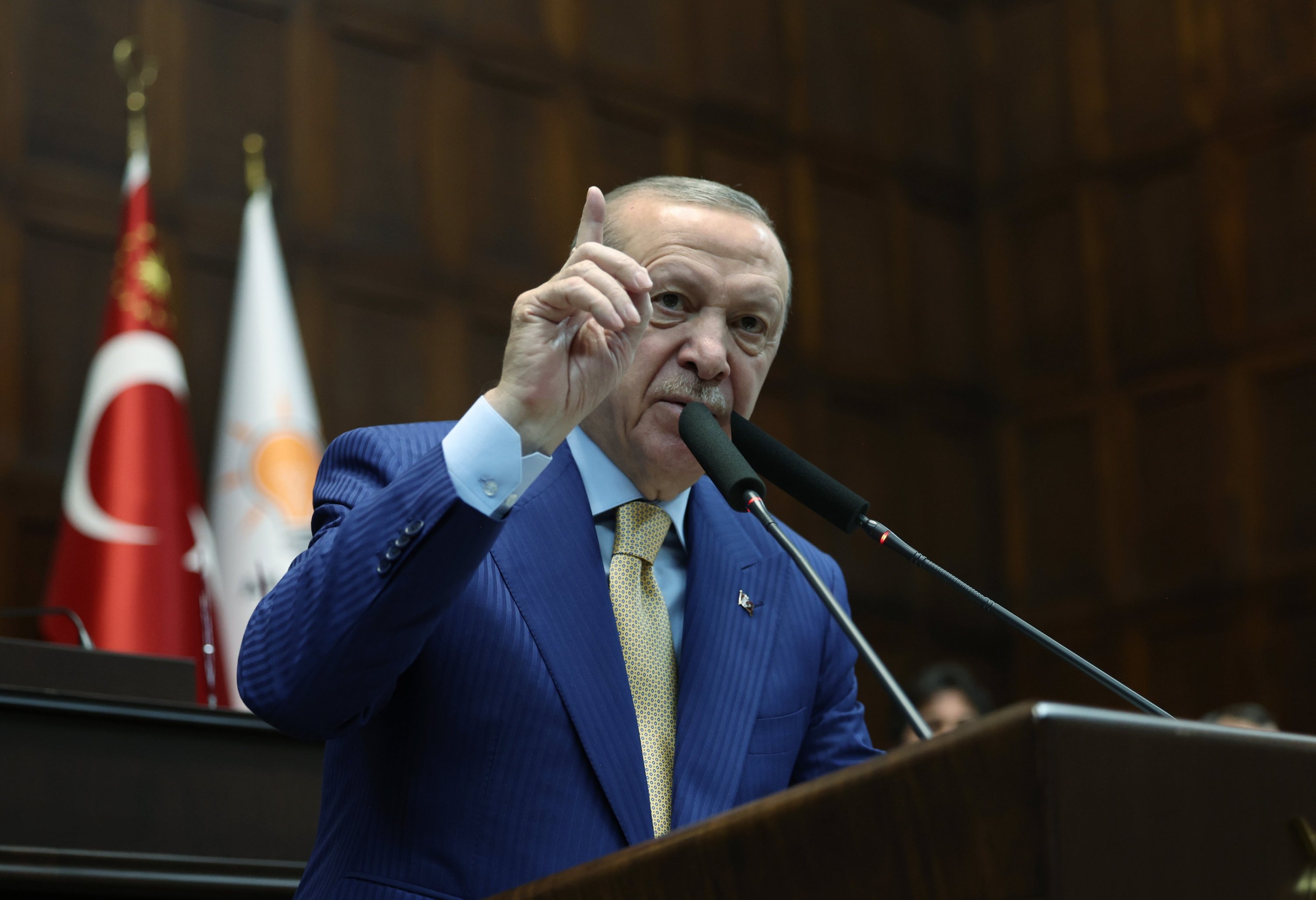
President Recep Tayyip Erdoğan on Wednesday slammed opposition to Ramadan-themed school activities, accusing critics of hiding hostility toward Türkiye’s religious values behind the notion of “secularism.”
Speaking to lawmakers from his ruling Justice and Development Party (AK Party) group meeting at Parliament, Erdoğan defended a recent directive by the Education Ministry encouraging schools nationwide to organize voluntary events during the holy month.
“Ramadan activities in schools are lawful. Regardless of their views, our nation has welcomed the circular positively,” Erdoğan said.
He accused a small group of opponents of spreading alarmist claims that secularism was under threat. “Their problem is not secularism; their problem is this nation itself,” he said, arguing that the criticism reflected discomfort with Türkiye’s growing social and cultural confidence.
On Feb. 12, the Education Ministry instructed provincial authorities in all 81 provinces to organize events under the theme “Ramadan at the Heart of Education.” The ministry said the program aims to promote values such as justice, compassion and patriotism through classroom activities, charity efforts and social responsibility projects, with participation based on volunteerism.
The initiative drew a public declaration titled “We defend secularism together,” signed by 168 academics, writers, journalists and public figures, many aligned with leftist groups and the main opposition Republican People’s Party (CHP). The signatories claimed the program threatened secular principles and warned of what they described as a drift toward religious rule.
Erdoğan said critics were selectively tolerant, arguing they did not object to Western-themed celebrations such as Christmas or Halloween decorations. He accused them of using secularism as a shield while attempting to distance younger generations from their cultural roots.
“Stop hiding behind secularism,” he said. “The real reason for their discomfort is the loss of their privileges. Türkiye’s liberalization and its natural course disturb them.”
Since the collapse of the Ottoman Empire and the abolition of the Caliphate, Türkiye has prided itself as a secular state, separating religion from state affairs, but the concept has been muddled and exploited by anti-Muslim circles to disenfranchise Muslims from the political scene. Invariably, AK Party governments, which rose to the occasion to represent disenfranchised Muslims along with other disadvantaged communities, are being accused of pushing an “Islamic agenda.”
The Muslim identity of the country becomes more prominent every Ramadan and days before, as evidenced in the skyrocketing popularity of a modern-day Islamic hymn or ilahi praising Hajj, a pillar of Islam in recent days.
Erdoğan also thanked everyone who popularized the hymn, saying no one should be offended by its popularity and praising it as ”a dearly-missed, true picture of Türkiye.”
Legacy of past restrictions
Erdoğan’s remarks come days before the anniversary of the Feb. 28, 1997 intervention, widely described as a “postmodern coup,” during which powerful military brass issued a veiled ultimatum to the government that ended with the latter’s fall. It is considered “postmodern” as it did not involve the army openly taking power as it had in the past coups. The coup was no different than others otherwise.
The coup’s primary target was the “Islamists” of then-Prime Minister Necmettin Erbakan, leader of the Welfare Party (RP), who became the voice of the conservative electorate excluded by other parties. With the aid of media, judiciary and academia, as well as other political parties, the military paved the way for a coup through a thinly disguised campaign targeting conservative segments of society.
Its culmination was a lengthy meeting of the powerful National Security Council dominated by generals on Feb. 28, 1997. The meeting ended with a declaration that aimed to curb what the military called threats to the secular nature of the republic. It called for a set of measures ranging from uninterrupted implementation of a headscarf ban for students and civil servants to limits on “green capital” (businesses run by conservative families or businesspeople).
Erbakan later signed a revised version of the decisions under pressure and resigned in June, leading to the collapse of his coalition government.
The measures that followed had broad social consequences. Hundreds of thousands of headscarf-wearing students were denied access to higher education, while vocational high school graduates faced significant barriers to university admission. Thousands of public employees, including military personnel and teachers, were dismissed, forced to resign or subjected to disciplinary action over religious appearance or affiliation.
The period also saw closures of foundations and investigations targeting religiously conservative institutions. Many affected individuals struggled to find employment, while some students were forced to pursue education abroad.
The Feb. 28 process is widely remembered for its lasting social and economic impact and for deepening divisions over secularism and religious freedoms in Türkiye.
DAILYSABAH
About the Author