Roast chicken is simple to make: all you really need is a chicken, salt and an oven. But it’s nearly impossible to perfect.
We’ve all swooned over the platonic ideal – crispy, golden, generously seasoned, herby aromatic skin encasing juicy flesh. But more often we are left poking at skin that ranges from flaccid to burnt; doneness that ranges from bloody at the thigh bone to stringy at the breast. Thank goodness for gravy to cover the ills.
As a chef, culinary educator and the main cook in our household, I’ve never been content to just throw a chicken in the oven and hope for the best. I’ve experimented with many configurations in pursuit of the elusive perfect roast chicken: things like vertical racks that prop the bird up like a ventriloquist’s dummy; beer can stands that steam the chicken through its cavity; and non-stick silicon racks that prevent it from looking like it’s been napping all afternoon on a vinyl strap chaise.
None have bested the simple, low-tech PoulTree chicken rod. It’s gotten me closest to the ideal roast chicken than any other method, and it’s become my go-to way of cooking roast chicken: reliable, easy to set up and clean, and makes a crowd-pleasing family dinner.
At a glance
The best roast chicken tool:
PoulTree Chicken Rod
$29.99 at Amazon
The best affordable cast-iron pan:
Lodge Cast-Iron Pan
$23.65 at Amazon
The best roast chicken tool and pan bundle:PoulTree Chicken Rod With Skillet
$59.99 at Amazon
What is the PoulTree chicken rod?
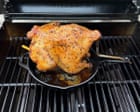
Put simply, it is a stainless steel rod that suspends a chicken above a cast iron pan. Weighing about half a pound and 15in in length, it’s designed to insert into the handle of a Lodge cast iron skillet or any pan handle with a similar tear drop-shaped opening. Once secure, you can slide a chicken onto what PoulTree founder Tony Smith calls a “no-tisserie”.
By hanging the chicken above the cast iron’s hot plate, the rod allows the bird to brown and crisp better, thanks to radiant heat from the pan and hot air in the oven circulating around as well as through the meat. It also allows the steam generated from cooking chicken to evaporate quickly, key to a crisp skin. (Chicken is two-thirds water by composition.) And it lets the pan capture the liquid gold of fat and juices to flavor sides such as gravy, vegetables, potatoes or rice.
As a product developer myself – I work in Drexel University’s Culinary Arts and Food Science programs – I love the simple yet effective design. A PoulTree rod also works great on the grill. And the brand offers an XL rod for turkeys, plus skillet-free stands that can rest on a sheet pan.
How do you cook with a chicken rod?
Once prepped, PoulTree recommends you roast the chicken at 425F for 1hr. I’ve used store-brand whole chickens from Whole Foods (about 4lbs) that I season generously with a dry rub inside and out, then air dry in my fridge for a day or two. (Smith recommends salt and herbs de Provence for the rub.)
Sliding the chicken onto the rod (or “perch”) is easy – removing the hot bird is trickier because it sticks a bit to the perch, but doable with a pair of tongs. PoulTree recommends you roast the chicken over an empty pan; you’d think cooking with vegetables in the pan would be more efficient, but when I tried that, it generated too much steam to give me the crispy skin I sought.
Instead, I cook the chicken first in a Lodge pan, then remove it from the pan to rest for the next 15 minutes. While the chicken rests, I use a metal spoon to scrape the drippings from the pan, and add veggies to it – I’ve enjoyed a mix of halved Brussels sprouts, scallions, par-cooked potatoes and peeled garlic cloves. I also add some kosher salt and a couple of pats of butter. Then I return the pan, sans chicken and full of veggies, to the oven to roast for those 15 minutes until brown.
This way, the chicken comes out uniformly brown, its legs are perfectly cooked and juicy, and the flavor is exactly what I hope for. For the veggies, after removing them from the pan, I’ve deglazed them with red wine and added a bit of chicken stock, cream and thyme to make a very quick pan sauce.
PoulTree
Chicken Rod
from $24.99
$29.99 at Amazon$24.99 at PoulTree
Protip: make sure you’re using your oven’s conventional setting, not its convection setting. I am the type of dad who assembles furniture first and then reads the instructions afterward, cursing and taking it apart to learn what I did wrong. My first few attempts using the Poultree in a hot convection oven (425F) were less than ideal: over-browned skin bordering on burnt; grease caked onto the pan; and an oven spotted with chicken grease as the rendered fat became airborne from the fan.
A gadget like the PoulTree is perfect if you like to tinker the way I do. I prefer my chicken to be a bit browner and will try to achieve that with slightly higher heat. The breast can get just slightly overcooked, so I’m hoping a higher heat and shorter cooking time addresses that. I am confident that with more practice (perhaps weekly), my results with the PoulTree will be consistent. And if not, it will be fun trying. Smith says on the product’s website, “Roasting chicken is an art, not a science.” I’d say it’s an art and a science.
The Guardian
About the Author