Türkiye’s efforts to end PKK violence and remove the discord the terrorist group has sown for over four decades have entered a new phase as the terror-free initiative turned one on Friday.
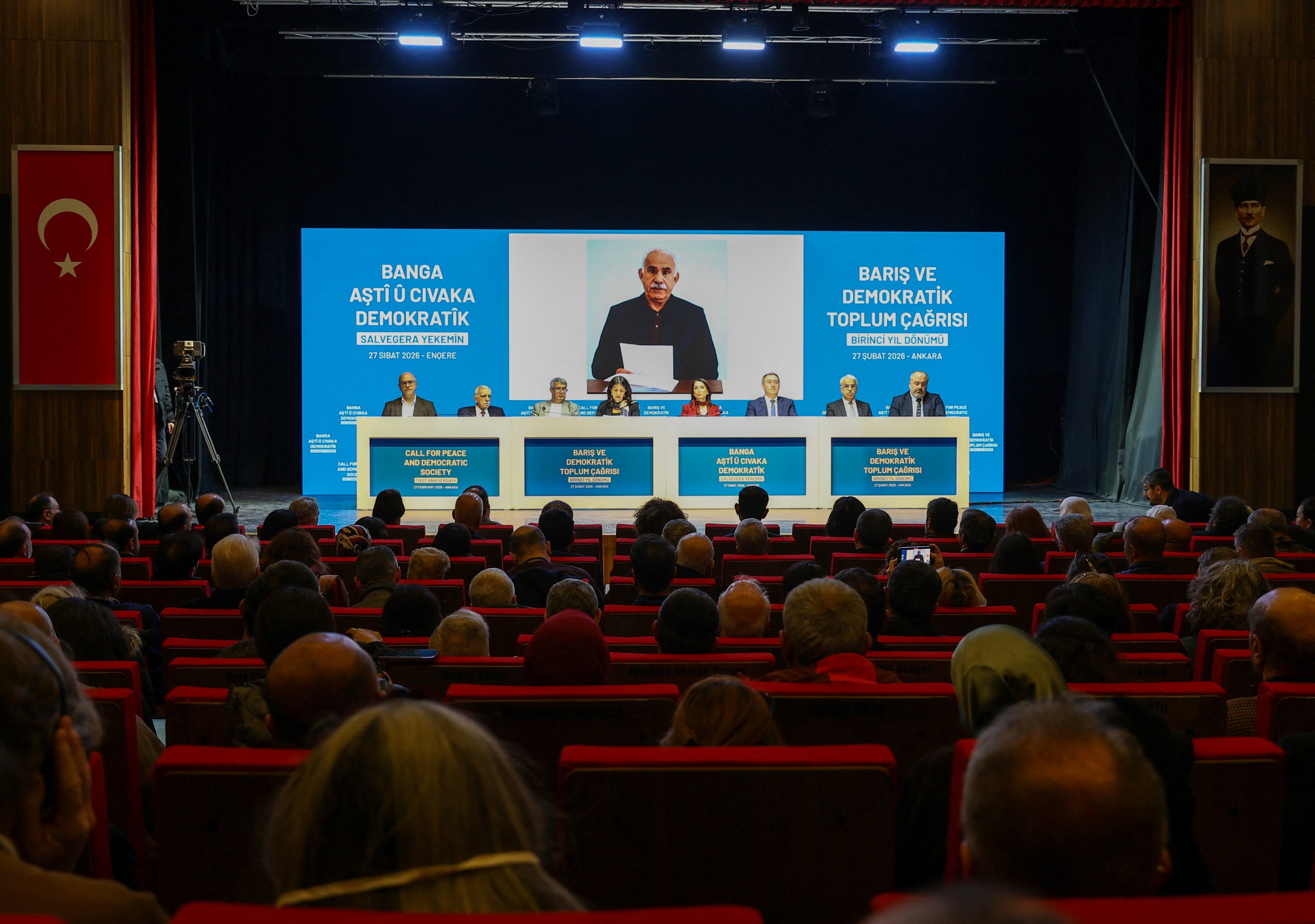
Jailed PKK founder Abdullah Öcalan said in a letter that the path was open to a “new political era”, exactly a year after his historic call to end PKK’s armed struggle under the terror-free Türkiye initiative.
The initiative was first conceived in October 2024 by government ally Devlet Bahçeli who extended an olive branch to Öcalan should he urge his terror group to lay down arms.
Following Öcalan’s appeal, the PKK formally disbanded, ending its terror campaign that began in 1984 and claimed some 50,000 lives, sowing discord at home and spreading violence across borders into Iraq and Syria.
“The door is opening to a new political era and strategy,” he said in a written statement from Imralı prison where he has been held in solitary confinement since 1999.
“We aim to close the era of violence-based politics and open a process based on democratic society and the rule of law,” urging all segments of Turkish society to engage with the process.
Since his call, the PKK has formally disbanded, held a symbolic arms burning ceremony in northern Iraq where it held its stronghold and withdrawn all members from Turkish soil.
In Ankara, a cross-party parliamentary commission last week published a key report meant to prepare the legal groundwork to advance the process, backing plans to reintegrate former PKK members.
Ankara has repeatedly ruled out amnesty for Öcalan or PKK terrorists, with officials saying the legal framework would only consider integration for PKK members who have not engaged in terrorist activities.
Öcalan said his call on Feb. 27, 2025, “aimed to break the mechanism that feeds on bloodshed and conflict” and that “the transition to democratic integration needs laws of peace.”
The democratic society solution envisions a “legal framework with political, social, economic, and cultural dimensions,” he said.
“There can be no Turks without Kurds and no Kurds without Turks,” he added.
The PKK, for decades, has exploited disadvantaged members of the Kurdish community to recruit members to its cause of establishing a so-called “Kurdistan.” Turkish officials have said the terror-free Türkiye confirms Turkish-Kurdish unity.
The report is expected to be put before parliament next month, likely after the end of the holy Muslim month of Ramadan. If it passes, it will be the first concrete step taken by Türkiye.
The report does not require the surrender of the “last weapon” as a condition for legal reforms. Instead, reaching a certain threshold in the disarmament process will be deemed sufficient. As an example, the evacuation of areas stretching toward Kandil in northern Iraq, including Metina, Hakurk and Gara, has been cited as a possible benchmark.
PKK disarmament efforts had slowed amid tensions related to its Syrian offshoot’s, the YPG, failure to integrate with the Syrian administration. However, following the YPG’s deal to integrate with the Syrian administration, activity on the ground has resumed, and the pace of weapons surrender and cave evacuations has accelerated.
Developments on the ground are being monitored by the National Defense Ministry and the National Intelligence Organization (MIT). The two institutions are expected to submit a joint assessment to President Recep Tayyip Erdoğan in the coming weeks, detailing the current stage of the disarmament process. Erdoğan is then expected to assign a specific body to oversee and monitor the next phase.
Previous attempts
Türkiye tried its hand at resolving the PKK issue as early as the 1990s. Then-President Turgut Özal took the first concrete steps for a new way to resolve the problem and reached out to Iraqi Kurdish leaders viewed as close to the terrorist group. It was a time when the predecessor of the pro-PKK Peoples’ Equality and Democracy Party (DEM Party), a key actor in the terror-free Türkiye initiative, first won seats in the Turkish Parliament.
Özal favored a “civilian” solution to the problem. He sought to address the problems the PKK exploited to advance its own agenda, such as more rights for Türkiye’s Kurdish community. Özal’s efforts partially paid off when the PKK briefly declared a “cease-fire.”
However, several violent terrorist attacks in the same decade and Özal’s death in 1993 hindered this fledgling process that would also reportedly include a general pardon for convicted PKK members.
Terrorist attacks continued until Öcalan’s capture in 1999. In the late 1990s and early 2000s, the PKK reduced its terrorism campaign before another flare-up in violence.
Starting from 2012, the state launched a new process that was informally called the “reconciliation process.” The process cautiously proceeded, and the government offered expansion of rights for the Kurdish community, especially in education in their own language. The PKK scaled back its activities again, but this process ultimately collapsed too in 2015.
The PKK resumed its campaign and moved attacks from rural parts of the country to urban centers in the southeast, which hosts a predominantly Kurdish population. In response, Türkiye intensified counterterrorism operations and, in the past decade, stepped up aerial strikes and limited cross-border offensives to eradicate terrorists in Türkiye, Iraq and Syria.
DAILYSABAH
About the Author