Donald Trump has claimed the US has begun clearing mines in the strait of Hormuz “as a favour to countries all over the world”.
In a post on his Truth Social app, the US president said Iran’s minelaying ships “are also lying at the bottom of the sea”.
While claiming all of the Iranian military’s air and naval capabilities have diminished and its missiles and drones “have been largely obliterated”, Trump added:
The only thing they have going is the threat that a ship may “bunk” into one of their sea mines which, by the way, all 28 of their mine dropper boats are also lying at the bottom of the sea. We’re now starting the process of clearing out the Strait of Hormuz as a favor to Countries all over the World, including China, Japan, South Korea, France, Germany, and many others. Incredibly, they don’t have the Courage or Will to do this work themselves.
He repeated an earlier comment that empty tankers “from many nations” are heading to the US for oil.
Iranian media has denied reports that US warships have crossed the strait of Hormuz.
The denial in the semi-official Tasnim news agency follows a report by the US news site Axios, citing a US official, that several US navy ships crossed the narrow waterway today.
There are conflicting reports over what’s happened. Tasnim, quoting an Iranian foreign ministry spokesperson, reported that a US destroyer attempted to enter the strait but was forced to retreat after a warning from Iran’s armed forces. Axios, citing a US official, said no such warning was given.
Earlier today, Donald Trump claimed the US has started to clear mines in the strait of Hormuz.
Just days before negotiations are expected to take place in Washington between Israel and Beirut, the Israeli military said it has struck more than 200 targets in Lebanon in the past 24 hours, claiming they belong to the Iran-backed Hezbollah group.
“The air force continues to strike infrastructure belonging to the Hezbollah terrorist organisation and to support the operations of ground forces operating in southern Lebanon,” the Israel Defense Forces said in a statement on social media.
In Lebanon, opinion was split over the government’s decision to negotiate directly with Israel, raising social tensions in the country already racked by a mass displacement crisis.
A rally by Hezbollah supporters on Friday saw Hezbollah supporters march from the prime ministers’ office to Hamra in West Beirut. Shouting matches erupted between residents of Hamra, an area not typically supportive of Hezbollah, and protesters, with the latter chanting, “Shia, Shia,” – a reference to the majority Shia support base of the group.
Hezbollah supporters staged another rally in front of the prime ministers’ office against negotiations on Saturday afternoon, with protesters waving Hezbollah flags and pictures of the late Hezbollah chief Hassan Nasrallah. The Lebanese army deployed troops around the area, and warned that it would not tolerate any attempts to destabilise the country at “this sensitive moment”.
Internal tensions in Lebanon had been on the rise since Israeli bombing over the last month displaced more than 1.2 million people across the country. Disagreements over Lebanon’s engagement with Israel threatened to further fracture the divided country.
Residents of Lebanon were hopeful that Iran would make good on its promise to include Lebanon in its ceasefire with Israel and the US. Lebanese looked ahead to a meeting between Lebanon’s prime minister Nawaf Salam and US secretary of state Marco Rubio in Washington next week for potential progress on a ceasefire in Lebanon.
Despite talk of a ceasefire, Israeli strikes and Hezbollah rocket fire continued. Israeli strikes on the southern towns of Kafr Sir, Zifta and Toul killed ten people overnight, while Hezbollah fired rockets at cities in Israel’s north. Israeli troops and Hezbollah fighters continued to clash inside Lebanon, battling over the strategic city of Bint Jbeil.
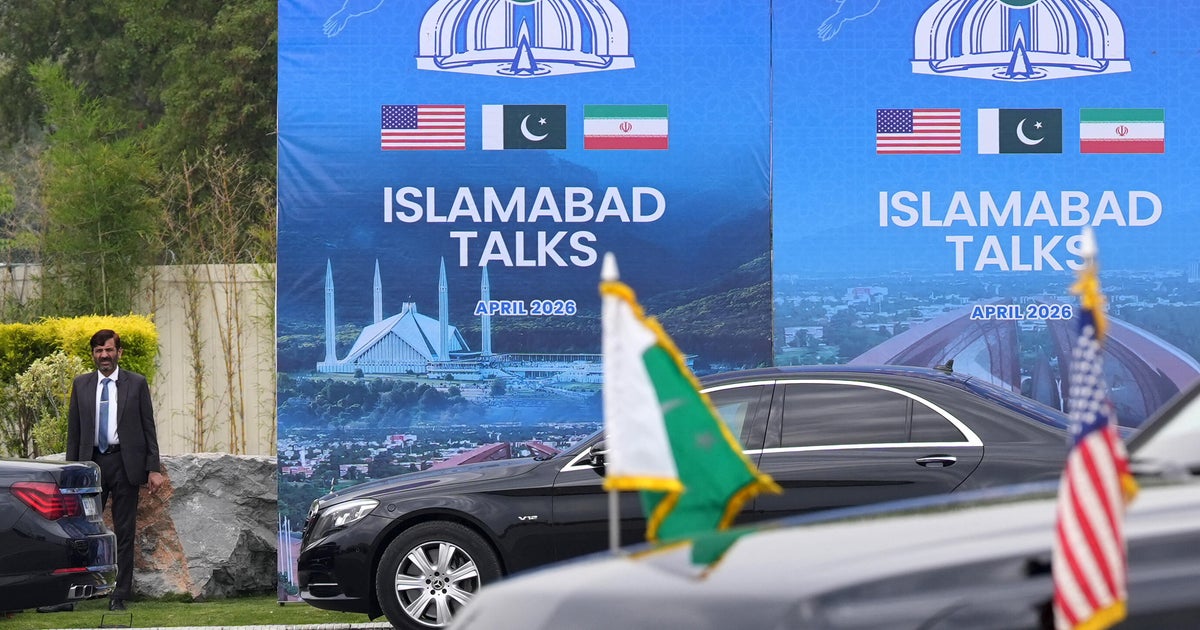
Al Jazeera, citing sources close to the mediation, has reported that the Iranian and US delegations are meeting face-to-face, with Pakistani mediators also present in the negotiating room.
Reuters has also reported the same, citing a Pakistani source.
The three-way talks are between US officials JD Vance, Steve Witkoff and Jared Kushner, Iran’s Mohammad Ghalibaf and Abbas Araghchi and Pakistan’s army chief Asim Munir.
In previous US-Iran negotiations, including the indirect nuclear talks that took place in Oman in the days before the war began on 28 February, mediators would shuttle back and forth between the two disputing parties to relay proposals and other information.
Donald Trump has claimed the US has begun clearing mines in the strait of Hormuz “as a favour to countries all over the world”.
In a post on his Truth Social app, the US president said Iran’s minelaying ships “are also lying at the bottom of the sea”.
While claiming all of the Iranian military’s air and naval capabilities have diminished and its missiles and drones “have been largely obliterated”, Trump added:
The only thing they have going is the threat that a ship may “bunk” into one of their sea mines which, by the way, all 28 of their mine dropper boats are also lying at the bottom of the sea. We’re now starting the process of clearing out the Strait of Hormuz as a favor to Countries all over the World, including China, Japan, South Korea, France, Germany, and many others. Incredibly, they don’t have the Courage or Will to do this work themselves.
He repeated an earlier comment that empty tankers “from many nations” are heading to the US for oil.
The Israel Defense Forces (IDF) said it is investigating an incident where rockets launched from Lebanon landed in northern Israel yesterday without warning sirens being activated.
“A preliminary investigation suggests that the launches were not detected, which is why no warning was issued in the town,” the IDF said in a statement on X, adding that the “circumstances of the incident, including the failure to detect the launches, are currently being investigated by all relevant authorities”.
French president Emmanuel Macron has said he discussed the Iran ceasefire talks with Saudi Arabia’s crown prince Mohammed bin Salman, and that the two leaders had agreed to stay in close contact on the issue.
I reiterated my support for the ceasefire, which must be fully respected and extended without delay to Lebanon. We discussed the need to restore fully free and safe navigation in the Strait of Hormuz as quickly as possible.
As talks get underway in Islamabad, we agreed to remain in close contact in order to contribute to a de-escalation, freedom of navigation, and the conclusion of an agreement to ensure lasting peace and security in the region.
Both CBS and Reuters are reporting that peace talks between the US and Iran have now begun.
Iran’s Fars news agency is reporting the same thing.
JD Vance, a vocal opponent of US wars in the Middle East, has gone quiet since the beginning of the current military campaign. He now faces off with Iranian negotiators who feel emboldened by their new control of the Hormuz strait and their resilience in the face of the largest US-Israeli onslaught in history. Vance’s presence at the talks as vice-president will make it the highest-level meeting since the Iranian revolution of 1979.
His task is straightforward enough: to bridge the gap between a rhetorical ceasefire in serious peril and a more durable peace. But Vance will face a difficult choice in Islamabad: to either undersign considerable US concessions to Iran in order to hold the ceasefire and negotiate the opening of the strait of Hormuz – or effectively cut off negotiations, personally backing a return to war that is unpopular with the American public.
The results could have a considerable impact on his expected run for the presidency in 2028, where his Maga credentials are already in question for failing to offer a more full-throated opposition to the war. Vance entered office calling for a more restrained foreign policy and an end to US forever wars in the Middle East – but the negotiations could drag him further into the largest US intervention in the region since the beginning of the Iraq war.
Read more here:
Iran is unable to find the mines it laid in the strait of Hormuz and does not have the capacity to remove the explosives, preventing Iran from allowing more traffic through the waterway, the New York Times reported, citing US officials.
Iran laid mines in the strait of Hormuz last month after the US and Israel declared war against the country, dropping explosives throughout the waterway with small boats. The US was mostly unable to monitor the small boats which were mining the strait, leaving the country uncertain about the location and number of mines in the waterway.
Maritime traffic through the strait ground almost to a standstill due to the mines, as well as Iranian drones and missiles that threatened to hit ships. A senior Revolutionary Guards official said on 2 March the country would set ships “ablaze” if they tried to traverse the strait.
A small number of ships have continued to pass through after being given the go-ahead by Iran, which allowed vessels from friendly nations that paid tolls.
US officials have said that Iran placed mines in the strait erratically, and may not have marked where it put all of them. Some mines also drifted or moved from their original location, US officials suggested.
Read the full piece here:
In Lebanon, a funeral is being held for 13 security personnel who were killed by Israeli airstrikes near a government complex and a State Security office in Nabatieh.
Donald Trump’s addiction to framing every event in the most apocalyptic terms is what allows conservative commentators such as Mark Levin to praise him as “a once-in-a-century president”.
But Trump cannot play out his entire presidency on a reckless high wire without eventually falling off – potentially taking America with him into a steep decline into the unknown.
Trump likes to portray Europe as being under civilisational threat from migration, but this week he threatened that a 7,000-year-old civilisation would “die … never to be brought back” if it did not comply with his demands.
He swiftly discovered it was not a threat on which he could follow through, and had to be extricated from it in a rescue mission led by Pakistan and, ignominiously for him, China. He pulled back in a social media post issued just 88 minutes before the implied destruction of Iran.
Not for the first time, Trump had disregarded Iran’s history of resilience. As the late Iranian essayist Bastani Parizi once wrote: “Sometimes the fate of this kingdom hangs by a hair, but that hair does not break.”
Faced by Iran’s refusal to back down, symbolised by millions of Iranians volunteering to stand on the bridges of their homeland, a late-night White House scramble ensued to find a justification to bring his latest piece of brinkmanship to a semi-dignified end before his ghoulish deadline.
Read on here:
French president Emmanuel Macron said he met with his Turkish counterpart, Recep Tayyip Erdoğan, and discussed the importance of ensuring Lebanon is included in the US-Iran ceasefire.
In a statement on X, Macron said:
We first discussed the situation in the Middle East and Near East, calling for respect for the ceasefire and its implementation in Lebanon, respect for freedom of navigation in the Strait of Hormuz, and underscoring the need for a robust and lasting diplomatic solution.
He added that the two leaders also discussed the war in Ukraine.
Donald Trump has posted on his Truth Social app, saying a “massive” number of empty tankers are heading to the US to load up with oil and gas.
He wrote:
Massive numbers of completely empty oil tankers, some of the largest anywhere in the World, are heading, right now, to the United States to load up with the best and “sweetest” oil (and gas!) anywhere in the World. We have more oil than the next two largest oil economies combined – and higher quality. We are waiting for you. Quick turnaround!
It is not entirely clear if this message is connected to Iran’s ongoing control, and effective closure, of the strait of Hormuz.
The Guardian
هلدینگ کاسپین استانبول | خرید ملک در ترکیه | صرافی معتبر ایرانی در ترکیه | خرید و فروش طلا در ترکیه | مهاجرت به ترکیه | واردات و صادرات در ترکیه | نیازمندیهای ترکیه | اخبار ترکیه | اخبار جهانی | توریست ایران | خدمات توریستی در ایران | تورهای گردشگری ایران | هلدینگ اول | خدمات کاریابی و فریلنسری و شغل | مرجع اطلاعات ایران (همه چیز در ایران) | کیف پول و خدمات مالی و پرداخت یار | اخبار ایران | تابلو زنده قیمت ارز در ترکیه و استانبول | صرافی آنلاین ترکیه | قیمت طلا و نقره در ترکیه | سرمایه گذاری در ترکیه | جواهرات در ترکیه | نرخ لحظه ای ارزها در استانبول | قیمت دلار امروز در ترکیه | قیمت دلار استانبول امروز | قیمت لحظه ای دلار | اخبار روز ترکیه استانبول | اپلیکیشن ISTEX | اپلیکیشن قیمت لحظه ای دلار و یورو و لیر و ارزها در ترکیه
About the Author