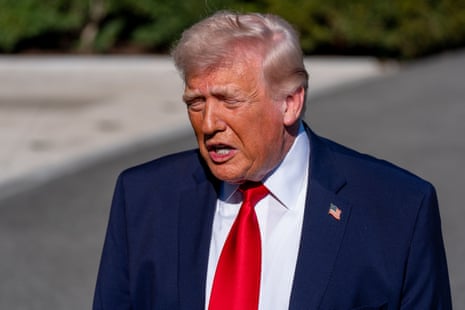
The US president, Donald Trump, said the US Navy would immediately start blockading the strait of Hormuz and would also interdict every vessel in international waters that had paid a toll to Iran.
In a lengthy Truth Social post, he said the US is going to start “BLOCKADING any and all Ships trying to enter, or leave, the Strait of Hormuz”.
Trump said that the US Navy is going to start “ destroying the mines the Iranians laid in the straits”, warning that any Iranian who fires at the US or at “peaceful vessels will be blown to hell”.
“No one who pays an illegal toll will have safe passage on the high seas,” he said, adding that the blockade – which will involve so far unspecified other countries – will “begin shortly”.
“Iran will not be allowed to profit off this Illegal Act of EXTORTION. They want money and, more importantly, they want Nuclear,” Trump wrote.
Iran’s Revolutionary Guard (IRGC) has warned in its latest statement that “approaching military vessels to the strait of Hormuz is considered a violation of the ceasefire.”
“The Navy of the Islamic Revolutionary Guard Corps declares that contrary to the false claims of some enemy officials, the strait of Hormuz is under intelligent control and management, open for the harmless passage of non-military vessels in accordance with specific regulations, and any military vessels attempting to approach the strait of Hormuz under any pretext or excuse will be considered a violation of the ceasefire and will be dealt with harshly and decisively.”
Senator Mark Warner, a Virginia Democrat and the vice chairman of the US Senate Intelligence Committee, told CNN on Sunday that he questions the logic of Trump’s blockade strategy.
“I don’t understand how blockading the strait is going to somehow push the Iranians into opening it. I don’t get the connection there,” Warners told CNN’s State of the Union.
Warner added that he didn’t see “how blockading the strait gets it open suddenly, I don’t get that logic.”
During his Fox News interview, Trump also said that the US “doesn’t need the strait.”
“We don’t get our oil from there. We have so much oil,” the US president said.
“We have boats pouring up to the United States. They’ll be filling them up, and they’ll be leaving and they’ll be packed with the best oil you can get. Light, sweet, crude. We don’t need the strait,” he added.
When asked if blockading the strait would result in lower oil and gas prices, Trump responded: “Well, eventually it’s gonna be lower. No, it might not happen initially but it’s gonna go down. When this is all over, look, the stock market, the Dow hit 50,000.”
The Dow Jones industrial average crossed 50,000 for the first time back in February, as ballooning tech valuations and hopes of lower interest rates drove it to new highs. However, the Dow has since been falling and is currently sitting under 48,000, due largely to surging energy costs caused by the war on Iran.
Trump also defended his earlier threats during his Fox News interview, saying on Sunday that his previous post where he wrote that a “whole civilization will die tonight, never to be brought back again” was what brought Iran to be willing to negotiate. He also accused the Islamic Republic of making worse statements, such as “Death to America. Death to Israel. America is a Satan.”
He then reiterated his threats: “In one half of a day they wouldn’t have one bridge standing, they wouldn’t have one electric generating plant standing and they’re back in the stone ages.”
Trump has reiterated his threat to destroy Iran’s power plants and other civilian energy infrastructure if no deal is reached to end the war, which he started with Israel in what is widely seen as an illegal and unprovoked attack.
“I could take out Iran in one day,” he told Fox News’ Maria Bartiromo by phone. “I could have their entire energy everything, every one of their plants, their electric generating plants, which is a big deal.”
Donald Trump’s threats to launch mass bombing of civilian infrastructure in Iran would likely amount to war crimes if carried out, according to legal scholars.
“Intentionally attacking civilian infrastructure constitute war crimes under international law,” Agnès Callamard, secretary general of Amnesty International said last week, after Trump warned that “a whole civilization will die tonight” unless Iran agreed a deal to end the war and unblock the strait of Hormuz.
“Even in the limited cases that civilian infrastructure qualify as military targets, a party still cannot attack them if this may cause disproportionate harm to civilians,” Callamard said.
“Power plants, water systems and energy infrastructure are indispensable to civilian life, underpinning access to clean water, medical care, hospital electricity, food supply chains, and basic livelihoods. Attacking them would be disproportionate and thus unlawful under international humanitarian law and could amount to a war crime.”
Trump also told Fox News that “numerous countries are going to be helping us” with the strait of Hormuz.
He said the UK is among those that were sending minesweepers to remove mines that may have been placed in the water.
Downing Street has not publicly confirmed this yet, although the UK has been working to figure out a “practical” plan to reopen the strait.
“We have minesweepers there. Now we have highly sophisticated underwater minesweepers, which are the latest and the greatest, but we’re also bringing in more traditional minesweepers,” Trump said in an interview with Maria Bartiromo on Fox News’ Sunday Morning Futures with Maria Bartiromo.
“And so I understand is the UK and a couple of other countries are sending mine sweepers,” he added.
Donald Trump has followed up on his statements made on Truth Social a short while ago (see this post and that post) in a phone interview with Fox News. He said again that the US will be blockading the strait of Hormuz, in what would be a major escalation in the war, but acknowledged that it may “take a little while” to do so. Trump then claimed that it won’t “take long” to “clean out” the strait.
He claimed that Nato, which he has repeatedly criticised for the alliance’s unwillingness to assist in his war on Iran, wants to help with unblocking the strait.
A group armed with automatic weapons tried to board a vessel in the Red Sea about an hour ago, the UK maritime security monitors have said.
The Royal Navy coordinated UK Maritime Trade Operations (UKMTO) said the board was “approached by a skiff with approximately 10-12 people on board, 4-5 of whom were armed with automatic weapons”.
“The crew requested that the sailing vessel stopped and when the Master refused they attempted to pull the skiff alongside to board.”
“The Master deployed a flare and the skiff turned away and departed to the southeast. Authorities are investigating,” it said.
The incident happened at about 11.25am universal time or 12.25 British Summer Time. It took place off the cost of Yemen. UKMTO acts as a bridge between military forces and merchant vessels reporting incidents including drones and missile or projectile attacks in Indian Ocean, the Red Sea and the Gulf region.
Israel’s war on Iran has cost Israel 35 billion shekels ($11.52bn; £8.57bn) in budgetary expenses, with 22 billion shekels ($7.3bn; £5.4bn) of that going to defence, the finance ministry said, citing a preliminary estimate.
The amount has already been added to the 2026 budget, it added.
Trump signed off one of his Truth social posts by saying the US was “fully locked and loaded”, warning Iran that the American military “will finish up the little that is left” of the country if he decides on that action at some point in the future.
These continued threats by Trump are unlikely to foster positive relations between Washington and Tehran before any future diplomatic talks.
From his statement it sounds as if he may be warning Iran of future US military attacks if it strongly resists or reacts militarily to the promised American blockade of the strait of Hormuz.
In another Truth Social post, Trump also claimed that Iran has “knowingly failed” to make good on its promise to open the strait, causing “anxiety” and “pain” for many countries around the world. He went on to warn that Tehran “better begin the process” of opening the vital waterway and to do it quickly, saying the regime has “violated” every “law in the book”.
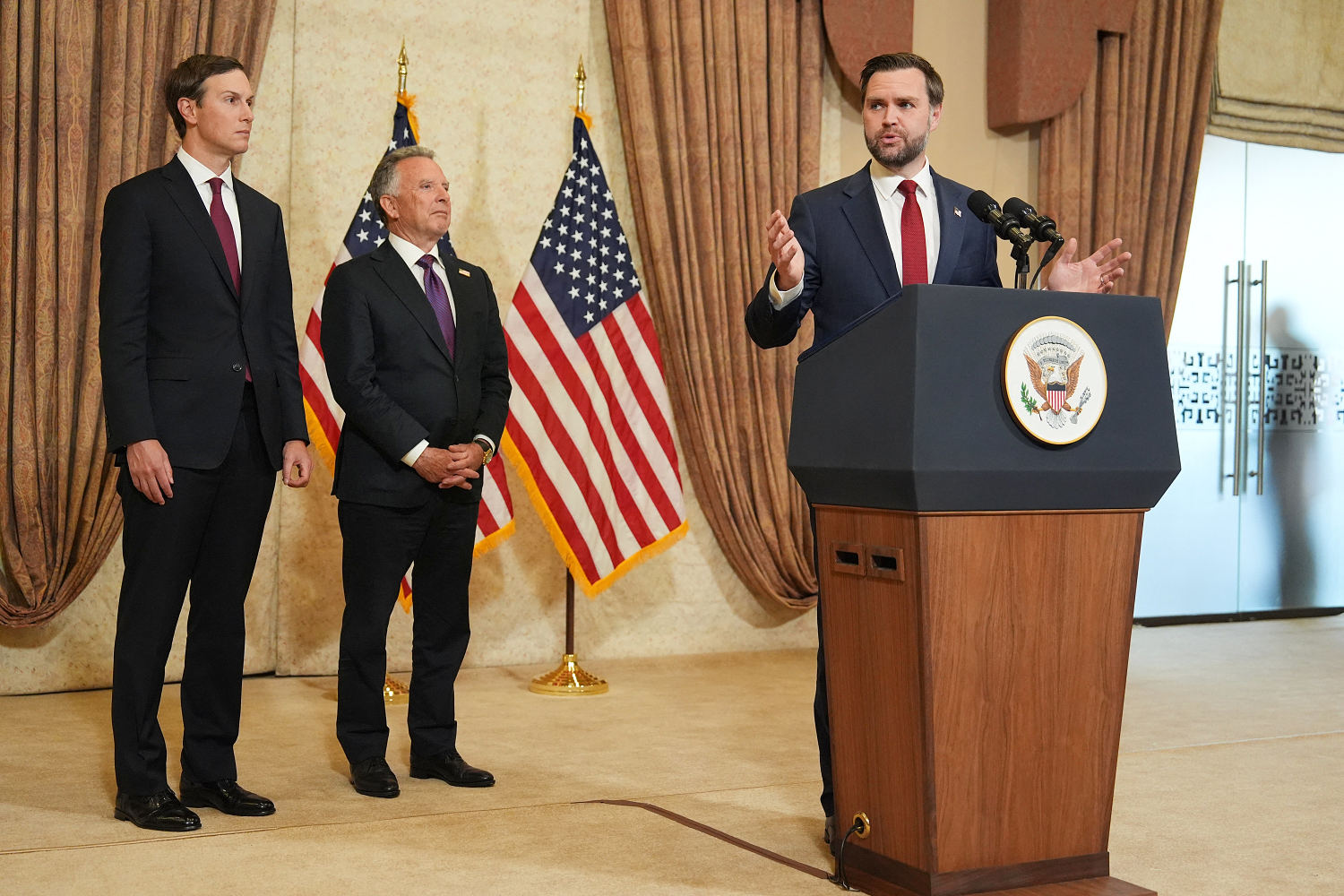
Trump said he has been debriefed by his vice president, JD Vance, his special envoy Steve Witkoff and son-in-law/advisor Jared Kushner on the Pakistan talks that failed to produce a breakthrough to bring an end to the war.
He said Saturday’s meeting in Islamabad lasted close to 20 hours. “I could go into great detail, and talk about much that has been gotten but, there is only one thing that matters — IRAN IS UNWILLING TO GIVE UP ITS NUCLEAR AMBITIONS! In many ways, the points that were agreed to are better than us continuing our Military Operations to conclusion, but all of those points don’t matter compared to allowing Nuclear Power to be in the hands of such volatile, difficult, unpredictable people,” Trump wrote.
The US president, Donald Trump, said the US Navy would immediately start blockading the strait of Hormuz and would also interdict every vessel in international waters that had paid a toll to Iran.
In a lengthy Truth Social post, he said the US is going to start “BLOCKADING any and all Ships trying to enter, or leave, the Strait of Hormuz”.
Trump said that the US Navy is going to start “ destroying the mines the Iranians laid in the straits”, warning that any Iranian who fires at the US or at “peaceful vessels will be blown to hell”.
“No one who pays an illegal toll will have safe passage on the high seas,” he said, adding that the blockade – which will involve so far unspecified other countries – will “begin shortly”.
“Iran will not be allowed to profit off this Illegal Act of EXTORTION. They want money and, more importantly, they want Nuclear,” Trump wrote.
Sultan Al Jaber, the chief executive officer of the Abu Dhabi National Oil Company (Adnoc), has said the strait of Hormuz has never been Iran’s to close or restrict navigation through.
“Any attempt to do so is not merely a regional issue, but represents a disruption to a global economic lifeline and a direct threat to the energy, food, and health security of all countries in the world,” he said in a post on X.
“This behavior is illegal, dangerous, and unacceptable, and the world cannot bear its consequences or allow it to happen.”
He said at least 22 ships have been targeted and nearly 400 oil tankers stranded since 28 February, when the US and Israel launched their war on Iran by killing the country’s former supreme leader in airstrikes on Tehran.
In response to the attacks, Tehran effectively closed the strait of Hormuz to vessels, only allowing a relatively small number of ships from “friendly” countries like China, Malaysia and Pakistan through.
Iranian authorities have since demanded the right to impose tolls on vessels transiting the vital waterway, where roughly 20% of the world’s oil and liquefied natural gas usually passes through, including after the war ends.
Tehran’s 10-point ceasefire plan would reportedly permit Iran and Oman to charge a fee of up to $2m (£1.5m) a ship on vessels moving through the strait.
Reuters reports on some of the victims of Israel’s strikes on Lebanon:
Wrapped in bloodied bandages, Aline Saeed, 7, barely survived the Israeli strike on her home in south Lebanon last week. She was there to bury her father as hopes of a truce spread across the region, but a new strike killed her infant sister and other relatives.
The strike on the Saeed family home in the village of Srifa took place on Wednesday, the first day of a US-Iran ceasefire that many in Lebanon hoped would apply to their country, too. Instead, Israeli strikes killed more than 350 across Lebanon and left the Saeed family with four more relatives to bury.
“They said it was a ceasefire. Like all these people, we went up to the village. We went to the casket to read the prayers and walk home … suddenly we felt like a storm was landing right on us,” said Nasser Saeed, Aline’s 64-year-old grandfather, who also survived.
Heavy bombardment on Lebanon has continued, with nearly 100 people killed on Saturday.
Dr Abbas Attiyeh, head of emergency operations at Tyre’s Jabal Amel hospital, said last week’s bombardment was one of the heaviest in recent years and many of the patients arriving at his hospital were children.
“The challenges we’re facing now are the numbers of wounded that come at the same time, within the same 30 minutes or hour,” Attiyeh said.
Asked about the Srifa incident, the Israeli military said it was looking into the report of the strike.
Iranians reacted with a mixture of disappointment and defiance on Sunday after peace talks with the US failed to reach an agreement, AP reports.
Standing outside a newsstand in the capital, Tehran, Farhad Simia said he had hoped for successful negotiations and an end to the fighting, but stood with Iran despite the failure of the talks. “I’m against war. I think negotiation is the better path,” Simia, 43, said. He blamed “inappropriate demands” by the US for the failure to reach a deal.
Mehdi Hosseini, also 43, agreed: “The fact that the Iranian negotiating team managed to preserve what it achieved in the war, while refusing to back down and surrender, gives reason for hope.”
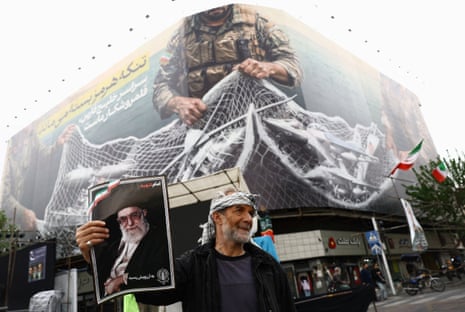
The streets of Tehran were lined up with large Iranian flags and giant billboards glorifying the country’s leaders and military achievements. One large mural depicted Iranian men in uniform lifting a fishing net out of the sea with a catch of miniature-sized US military aircraft and warships. “The Strait Remains Closed,” the billboard read.
Hamid Haghi, 55, said “America’s overreach” was the reason for the talks’ failure. The US wants “to come to the Strait of Hormuz, which is a legacy from our fathers,” he said. “We can oversee (it) ourselves.”
Like many Iranians, 60-year-old Mohammad Bagher believes Iran should continue to stand strong against the US in what he sees as a war of their own making. “We are a nation of dialogue and negotiation as long as our interests are respected. We have never sought war,” he said. “We will stand firm to the end, we are ready to sacrifice our lives, and will not give them one inch of our land.”
Here’s a round-up of the key events from the Middle East so far today:
-
The US failed to gain trust of the Iranian delegation in Pakistan peace talks, Iran’s parliamentary speaker said. Mohammad Bagher Ghalibaf, said he stressed before the talks yesterday that Iran had no “trust in the opposing side” after “the experiences of the two previous wars”.
-
Iran’s foreign ministry downplayed the stalling of negotiations on Sunday. “Naturally, from the beginning we should not have expected to reach an agreement in a single session. No one had such an expectation,” ministry spokesperson Esmaeil Baqaei said, according to state broadcaster IRIB.
-
Strait of Hormuz “completely” under Iranian control, deputy parliament speaker said. The Iranian deputy parliament speaker, Haji Babaei, has been quoted by the Mehr news agency as having said that the strait of Hormuz is “completely” under Iranian control, adding that tolls must be paid in the country’s currency, rials.
-
Saudi Arabia says east-west pipeline, energy facilities restored to “operational capacity” after attacks. “Energy facilities and the east-west pipeline damaged by attacks have recovered and regained their operational capacity, enhancing the reliability of supplies,” the official Saudi Press Agency reported, citing an energy ministry statement.
-
In a call this morning, the UK’s prime minister, Keir Starmer, and the Sultan of Oman agreed that all sides should avoid “any further escalation” in the US-Israel war on Iran. A Downing Street spokesperson said: “They discussed the peace talks held in Pakistan over the weekend and urged both sides to find a way through. It was vital there was a continuation of the ceasefire, and that all parties avoided any further escalation, the leaders agreed.”
-
Javad Zarif, a former Iranian foreign minister, said in a post on X this morning that the Pakistan talks failed because Iran is not going to accept terms dictated to it by the US. He said: “No negotiations – at least with Iran – will succeed based on “our/your terms.” The US must learn: you can’t dictate terms to Iran. It’s not too late to learn. Yet.”
Javad Zarif, a former Iranian foreign minister, said in a post on X this morning that the Pakistan talks failed because Iran is not going to accept terms dictated to it by the US.
He said: “No negotiations – at least with Iran – will succeed based on “our/your terms.” The US must learn: you can’t dictate terms to Iran. It’s not too late to learn. Yet.”
Zarif, who was Iran’s top diplomat between 2013 and 2021 in the government of the ‘moderate’ president Hassan Rouhani, was in office when the US reached its nuclear deal with Iran in 2015 under Barack Obama.
Donald Trump exited the agreement three years later by claiming that Iran was building a nuclear program, without providing evidence to support this claim at the time.
In a call this morning, the UK’s prime minister, Keir Starmer, and the Sultan of Oman agreed that all sides should avoid “any further escalation” in the US-Israel war on Iran.
A Downing Street spokesperson said:
They discussed the peace talks held in Pakistan over the weekend and urged both sides to find a way through. It was vital there was a continuation of the ceasefire, and that all parties avoided any further escalation, the leaders agreed.
His majesty updated on the situation in the Strait of Hormuz, and the prime minister thanked him for Oman’s efforts to rescue sailors from vessels in distress in the region.
Reflecting on international efforts to co-ordinate safe passage for shipping in the region, the prime minister said that following meetings convened by the foreign secretary and British military planners, partners continued to work towards restoring freedom of navigation for the long term.
The prime minister also reiterated the UK’s commitment to ensuring Oman’s security and updated on the UK’s work with Ukraine on drone technology. It was clear Ukraine’s expertise had been vital to the region in recent weeks, while Russia appeared to continue to support Iran’s aggression. The leaders agreed to speak again soon.
You can read what the health secretary, Wes Streeting, said this morning about the peace talks held in Pakistan over the weekend here.
The Guardian wp:paragraph
هلدینگ کاسپین استانبول | خرید ملک در ترکیه | صرافی معتبر ایرانی در ترکیه | خرید و فروش طلا در ترکیه | مهاجرت به ترکیه | واردات و صادرات در ترکیه | نیازمندیهای ترکیه | اخبار ترکیه | اخبار جهانی | توریست ایران | خدمات توریستی در ایران | تورهای گردشگری ایران | هلدینگ اول | خدمات کاریابی و فریلنسری و شغل | مرجع اطلاعات ایران (همه چیز در ایران) | کیف پول و خدمات مالی و پرداخت یار | اخبار ایران | تابلو زنده قیمت ارز در ترکیه و استانبول | صرافی آنلاین ترکیه | قیمت طلا و نقره در ترکیه | سرمایه گذاری در ترکیه | جواهرات در ترکیه | نرخ لحظه ای ارزها در استانبول | قیمت دلار امروز در ترکیه | قیمت دلار استانبول امروز | قیمت لحظه ای دلار | اخبار روز ترکیه استانبول | اپلیکیشن ISTEX | اپلیکیشن قیمت لحظه ای دلار و یورو و لیر و ارزها در ترکیه
/wp:paragraph wp:paragraph /wp:paragraph
About the Author