After some 20 minutes, Magyar is turning towards foreign policy now.
He says the Hungarians are proud to be a part of the EU and Nato, even as he acknowledges some of the EU’s flaws with its networks of lobbies and interests.
“It’s a complicated bureaucratic, compromise-seeking … organisation,” he says.
But he insists “you can find compromises” that will work for Hungary.
“I am sure we will have debates … but we are not going there to fight for the sake of fighting so we can write on billboards that Brussels is evil and needs to be stopped,” he says in another swipe at Orbán.
Again: expect him to get asked about what these compromises on key issues – such as the rule of law, migration and Ukraine – could look like when we eventually get to Q&A.
Magyar then gets asked about Poland as he hails his special relationship with the Polish government and plans to make Warsaw his first foreign trip, hopefully in early May.
He jokes that he will want to meet with the country’s conversative president, Karol Nawrocki, too – even though he didn’t congratulate him on the win and appeared to support Orbán’s relection.
He also gets asked about two former Polish government ministers evading the Polish justice system in Budapest. He jokingly advises them not to buy too much furniture from Ikea and don’t get too comfortable in the capital.
He then also makes similar points about the importance of regional cooperation with Austria and other countries in CEE.
For all the enthusiasm among Europe’s liberals and progressives in response to Tisza’s win last night, his comments on Russia will serve as a handy reminder that there still will be some fairly big issues in which Hungary will have a distinctively different view to the EU mainsteam.
That list is likely to include Russia, Ukraine, energy, and migration policies, among others.
Magyar turns to energy for a bit, and he says that Hungary “cannot change geography” and will need to figure out a way forward on energy imports, also from Russia.
He says:
Russia will be there, Hungary will be here. But we will try to diversity.
He adds that “that does not mean that we want to detach ourselves; but we want to buy oil at low prices securely.”
“But with the Druzhba pipeline, the Friendship oil pipeline and what’s happened there, we can see that it threatens Hungary’s energy supply; what’s happening in Tehran in Iran threatens our energy supply,” so Hungary will need to “diversity.”
But here comes the tricky bit.
He then says he is hopeful that the Russian aggression of Ukraine would end soon and “then immediately, Europe will lift the sanctions, because we are neighbours to Russia and it is not in Europe’s interests to buy raw materials at higher prices because that destroys our competitiveness.”
“I understand the moral issues … or principles, and I will protect human rights as much as possible, … but let’s not shoot ourselves in the leg,” he says.
Expect these comments to get some scrutiny as there is limited appetite for removing the sanctions or returning to normal energy imports from Russia.
Magyar gets now a question about his earlier comments about Szijjártó and his allegations (14:39) that the foreign minister is trying to get rid of some confidential documents ahead of the government change.
He doesn’t give away too much and merely says it comes from “an insider” at the ministry, with many officials turning to Tisza to blow the whistle on the outgoing government’s actions.
Magyar gets asked about his phone call with Orbán last night, in which the outgoing PM congratulated him on the election win.
He tells a story of how the call came about, via an earlier call from one of Orban’s closest aides Gergely Gulyás, his former friend from his time at Fidesz and the godfather of his son.
In a classic Millenial moment, he says he asked for the last four digits of Orbán’s phone number in return, because he otherwise doesn’t take phone calls from unknown numbers.
Fair enough.
Turns out it was a very short conversation, though.
Magyar is now talking about his future government and top jobs, but says he won’t reveal the key names just yet.
But he talks about the structure of government more broadly.
Earlier he said he would like to introduce a two-term limit for the prime minister, and commit to it in the constitution.
He now says that it would also apply retrospectively, effectively banning Orbán – who served in the top role for 20 years in total – from becoming a prime minister ever again.
He then talks about his plans to deal with corruption and to end political interference in police and administrative procedures. He wants a new anti-corruption office, tasked with recovery of fraudulently spent money, to be up and running by June.
Curiously, discussing the president’s future, Magyar makes it clear that despite the two-third majority in the new parliament, he will be careful about how he uses it and wouldn’t move
“We will not take unlawful measures to restore the rule of law that way,” he declares.
But he repeats that Sulyok should essentially be gone from office before the 70th anniversary of the 1956 revolution in October.
Magyar repeats his call to get president Tamás Sulyok to step down from his office, as he calls him a “puppet” of Viktor Orbán.
“He was appointed to sign everything; every document that he is presented with – whether it’s the menu or the constitution or the laws – so we don’t need people like that. To me, he is not the president,” he says.
Magyar says the report about Szijjártó offers ahint at how difficult this transition from the Orbán era will be.
He says normally an incoming PM gets a national security briefing from the outgoing leader, but he does not expect to get one.
He alleges there are lots of legal documents that the Hungarian public or even he don’t know about, including on international obligations and loans overseas.
“We will have to get our hands on all of the documents that haven’t been shredded” to figure out the detail, he says.
He says his government will try to make them public whenever possible and not breaching confidentiality clauses to put more light on the dealings of the outgoing government.
And with that, we finally go into the Q&A.
In a nice touch, Magyar’s spokesperson gives the floor to independent Hungarian media first in recognition of their hard work under the previous government.
I will bring you slightly less detailed coverage of questions on domestic issues – he is currently discussing the value of holding open cabinet meetings – but fear not, I will bring you all the key lines on foreign affairs.
Oh, that’s explosive.
At one point during the press conference, Magyar got a piece of paper with a message on it which clearly disrupted his flow.
He pauses and tells reporters he has learned that the country’s foreign minister Péter Szijjártó, who recently attracted scrutiny over his ties with Russia, is reportedly at the ministry of foreign affairs “destroying documents that have to do with sanctions” against Russia.
“They are shredding documents, and that’s not going to help them – but this is just to give you some context about the situation in Hungary,” he says.
He compares it to attempts to destroy public record “just like in the old communist age.”
After some 20 minutes, Magyar is turning towards foreign policy now.
He says the Hungarians are proud to be a part of the EU and Nato, even as he acknowledges some of the EU’s flaws with its networks of lobbies and interests.
“It’s a complicated bureaucratic, compromise-seeking … organisation,” he says.
But he insists “you can find compromises” that will work for Hungary.
“I am sure we will have debates … but we are not going there to fight for the sake of fighting so we can write on billboards that Brussels is evil and needs to be stopped,” he says in another swipe at Orbán.
Again: expect him to get asked about what these compromises on key issues – such as the rule of law, migration and Ukraine – could look like when we eventually get to Q&A.
Magyar also makes a point to talk about how much time he spent on the campaign trail, meeting with ordinary people.
He says he gets asked about why his campaign was so successful, and says “the secret lies in that politics is about people, and this is what many politicians forgot.”
“I can see that many places in Europe, there are crises in government, one after the other. Mainstream politicians are frightened that extreme forces are gaining more and more ground and the party system is overturned in many European countries.
I can send a message, as I was asked personally by Western European politicians about the secret: you have to stay with the people. You have to put the work into it, whether you like it or not. I visited 700 towns and villages in two years. There are towns and villages some I visited seven times.
I was on Hungarian streets and squares more than in my own bed in my own flat. This meant that I met my three sons far less than I would have liked to.
We went around Hungary. I was there in the smallest settlements. I met many million people. I looked into the eyes of hundreds of 1000s of people. We shook our hands and we asked, How can we help? How can we prove that politics can be beautiful, it can be frank, it can be honest, it can be fair, and it can be useful.
Many people can say this is populism. If it is, it’s a good kind of populism, because this is what politics should be about, not politically correct talk, talk, but honesty, humanity.”
He then goes on to say that Facebook posts and social media frenzies will never replace that person-to-person element of politics.
Magyar also pushes back on what he calls “lies” of the previous government, saying that the new government will also be committed to peace in Europe, despite scaremongering posters plastered all over Hungary and “Goebbels-like, North Korea-like propaganda” about his intentions towards Ukraine.
“In Hungary, nobody wants war. Hungary stands for peace. The Tisza government will be the government of peace,” he says.
I am sure he will get questions on what is specifically means for Hungary’s relations with Ukraine later.
He then takes a swipe at Orbán for being too focused on foreign affairs – with Russia, Ukraine, the US and Iran – and not on resolving domestic issues facing the electorate.
“He spoke about everything except issues, problems that affected the Hungarian people and the Hungarian people said no to all this,” he says.
Our history is not written in Brussels or in Washington, but on Hungarian streets, and in Hungarian squares.
Magyar makes a point to stress that the electorate voted “not just for a change of government, but for a change of the regime” to move away from what he says are compromised institutions and structures of the Orbán era.
He also makes a point that his administration will make inevitably make mistakes, but will own them – and “our country will no longer be a country of no consequences.”
He also stresses his pro-EU message and notes it was particularly symbolic that the vote was held on the 23th anniversary of Hungary’s accession to the EU.
He says the electorate clearly voted to anchor Hungary firmly in the EU, “no matter what the outgoing … government was planning or trying to lead us to.”
Magyar urges the Hungarian president to convene the new parliament at the earliest possible day after the election result becomes final on 4 May, even potentially the very next day, on 5 May.
He says there is no time to waste and the new administration is keen to get going as quickly as possibly.
“Hungary is in trouble in more than one ways. It’s been robbed, it’s been betrayed, it’s been indebted, it’s been devastated. We became the most impoverished and the most corrupt country in the EU,” he says.
Magyar opens by saying he has phone calls planned with other European leaders this afternoon and doesn’t want to keep them waiting so we need to get on with it.
And so the briefing gets under way.
He repeats his main lines from yesterday, saying that the Hungarian electorate “wrote history yesterday,” remarking on how much the result resonated around the world.
He says the only reason that Viktor Orban’s party got so many votes anyway was down to the entire state apparatus helping them in the election campaign.
You can watch Magyar’s press conference along with us below, and I will bring you the key lines here too.
in Budapest
We are now waiting for Péter Magyar’s press conference at which he is expected to take some questions from the international media. It should get under way in the next half hour.
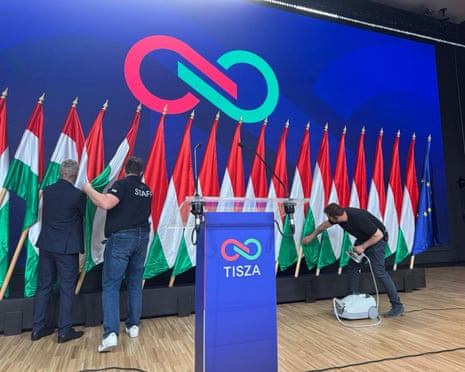
The conference will be hosted at a massive theatre-stylevenue, reflecting the incredible level of truly global interest in Hungary’s next prime minister – and the life after Viktor Orbán. This is not just any other election in the region.
Tisza’s staff are taking it very seriously too: as I type, they are… ironing the flags so they look absolutely spotless on stage – and, to be fair, they do look great!
The Guardian wp:paragraph
هلدینگ کاسپین استانبول | خرید ملک در ترکیه | صرافی معتبر ایرانی در ترکیه | خرید و فروش طلا در ترکیه | مهاجرت به ترکیه | واردات و صادرات در ترکیه | نیازمندیهای ترکیه | اخبار ترکیه | اخبار جهانی | توریست ایران | خدمات توریستی در ایران | تورهای گردشگری ایران | هلدینگ اول | خدمات کاریابی و فریلنسری و شغل | مرجع اطلاعات ایران (همه چیز در ایران) | کیف پول و خدمات مالی و پرداخت یار | اخبار ایران | تابلو زنده قیمت ارز در ترکیه و استانبول | صرافی آنلاین ترکیه | قیمت طلا و نقره در ترکیه | سرمایه گذاری در ترکیه | جواهرات در ترکیه | نرخ لحظه ای ارزها در استانبول | قیمت دلار امروز در ترکیه | قیمت دلار استانبول امروز | قیمت لحظه ای دلار | اخبار روز ترکیه استانبول | اپلیکیشن ISTEX | اپلیکیشن قیمت لحظه ای دلار و یورو و لیر و ارزها در ترکیه
/wp:paragraph wp:paragraph /wp:paragraph
About the Author