In April 2026, the visit of Nationalist Party (KMT) leader Cheng Li-wun to China once again sharpened a long-standing divide in Taiwanese politics. However, interpreting this divide solely through current political competition would be insufficient. What is unfolding in Taiwan today is not merely a difference between parties but the reflection of two deeply rooted political traditions in foreign policy.
One tradition, represented by the KMT, seeks to reduce tensions with China by maintaining engagement and managing relations within a controllable framework. The other, represented by the Democratic Progressive Party (DPP), aims to preserve Taiwan’s political room for maneuver by limiting institutional and economic ties with China. This divide is not simply a product of present-day preferences; rather, it reflects two distinct political experiences rooted in Taiwan’s modern history, and it is this historical background that makes the current divide more understandable.
Historical background
The origins of this divide can be traced directly to Taiwan’s modern history. After being under Japanese colonial rule from 1895 to 1945, the island came under the control of the Republic of China following World War II. Yet the main turning point behind today’s political and social tensions occurred in 1949.
After losing the Chinese civil war, the KMT, led by Chiang Kai-shek, retreated to Taiwan with approximately 2 million people. This development not only made the division between China and Taiwan permanent, but also created a new social fault line within the island.
The tension between the mainland-origin population known as Waishengren and the local communities, particularly the Minnan people, quickly evolved into a political crisis. The Feb. 28 Incident of 1947 became the most violent manifestation of this tension, and the subsequent White Terror period deeply undermined trust between the state and society. This historical trauma is not only a human rights issue but also forms the sociological foundation of Taiwan’s current political divide.
At this point, what matters is how this historical rupture translated into political strategies. The KMT’s relationship with China is not merely a foreign policy choice. It is rooted in a claim of historical and social continuity. In contrast, the DPP, founded in 1986, emerged as a reaction to this very experience and rose as a political movement aiming to limit the line represented by the KMT.
As democratization accelerated in the late 1980s, the DPP gained strength and institutionalized a second political trajectory. As a result, two distinct approaches took shape in Taiwan: one that prioritizes maintaining ties with China as part of a broader continuity, and another that seeks to limit those ties in order to secure political autonomy.
Over time, this divide began to shape political preferences as well. Communities of mainland origin and their subsequent generations have tended to support the KMT, while the local population has generally gravitated toward the DPP. This pattern should not be seen as a rigid or fixed division, but rather as a broad framework reflecting general tendencies. Within this framework, the DPP emphasizes a more independent Taiwanese identity, while the KMT advocates a dual identity in which Chinese and Taiwanese elements coexist.
The 1990s marked the first period when these two approaches directly confronted each other. The 1992 Consensus, supported by the KMT, created a fragile framework for dialogue between China and Taiwan. This arrangement was based on both sides accepting the “One China” principle through different interpretations, and for a long time, it functioned as the main mechanism for managing tensions.
The KMT treated this as a space of strategic flexibility and kept communication channels open. The DPP, however, saw it as a process that could eventually pave the way for Taiwan’s integration with China. At this stage, the defining divide in Taiwanese politics became clear. For the KMT, engagement with China was a necessity, whereas for the DPP it was a risk that needed to be carefully limited.
Modern divide
Cheng Li-wun’s political stance represents a contemporary expression of this historical line. Her statement during the party leadership campaign that she wanted all Taiwanese people to be able to proudly and confidently say “I am Chinese” reflects not just rhetoric, but the KMT’s sense of historical continuity. Her remarks that Taiwan and the mainland should join forces to reach new heights in human civilization and that the overwhelming majority of Taiwan’s culture, history and ancestry is Chinese, further illustrate that she views relations with China not only in strategic terms but also as part of a broader cultural and historical unity. The fact that this was the first direct contact between a KMT leader and Chinese leadership since 2015 and the emphasis on the 1992 Consensus show that the party has once again activated its traditional strategy.
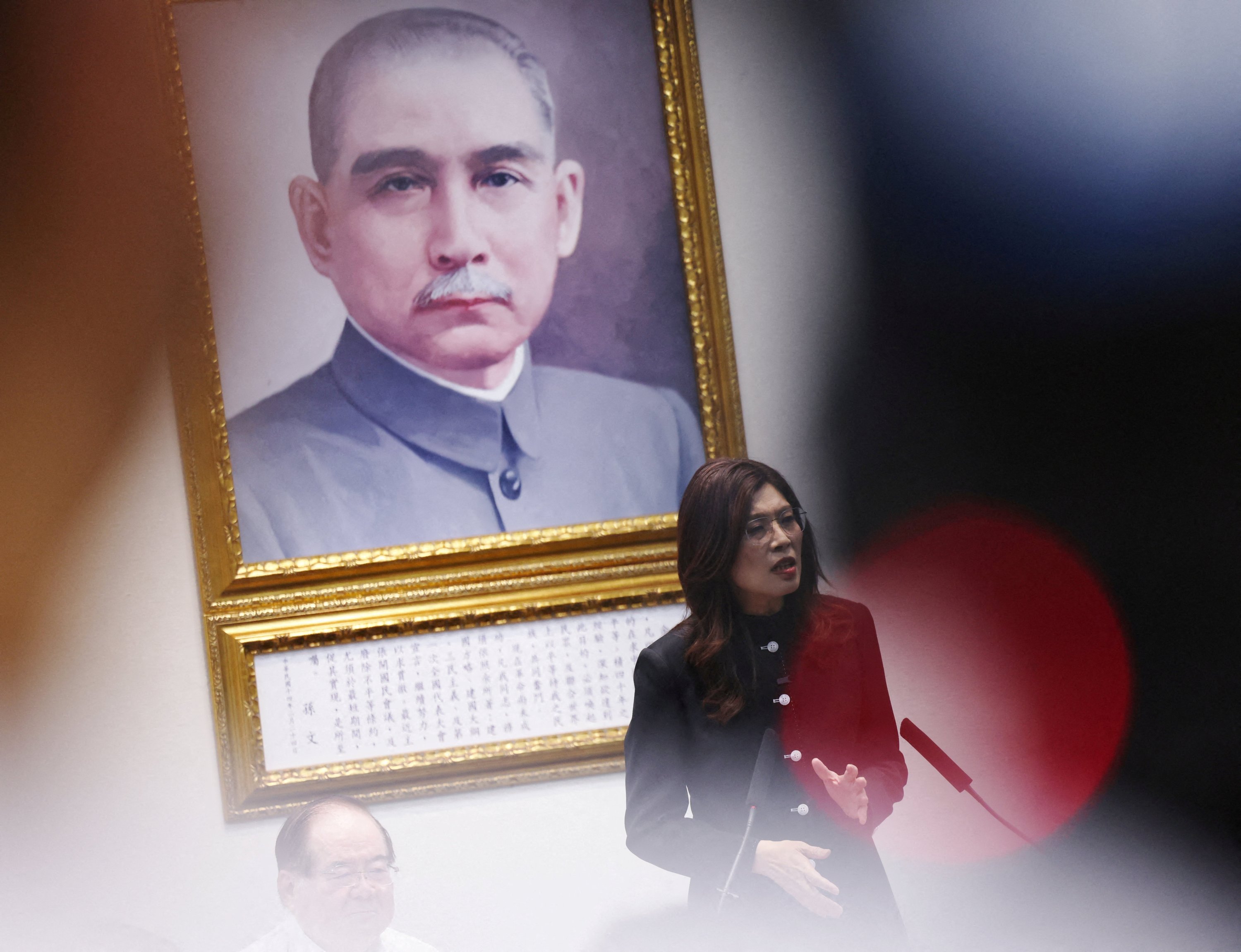
In contrast, the Democratic Progressive Party argues that such rapprochement would narrow Taiwan’s room for maneuver in the long term. It maintains that increasing economic ties with China would gradually turn into political dependence, that institutional contacts would open channels of influence for Beijing. For this reason, the DPP and its affiliated circles advocate maintaining economic relations while limiting dependence in critical sectors and keeping institutional engagement under strict control. This approach aims to preserve strategic autonomy without fully severing ties, and it is pursued alongside a policy of external balancing.
China’s role in this debate is decisive. Rather than applying direct military pressure, China seeks to integrate Taiwan over the long term through economic and cultural means. The incentive packages announced after the visit, covering media, agriculture, transportation and youth exchange programs, are clear examples of this approach. This model is based on transformation through interdependence rather than coercion.
While this strengthens the KMT’s engagement-oriented strategy, it also raises questions about its limits. At this point, the United States becomes a key actor. While aiming to contain China’s rise, Washington supports Taiwan but avoids encouraging outright independence, instead focusing on preserving the existing balance. The U.S. does not directly oppose Taiwan’s economic relations with China, but it seeks to prevent these ties from reaching a level that would undermine Taiwan’s political autonomy. For this reason, it provides a form of security backing through military support, technological cooperation and regional alliances, thereby reinforcing the DPP’s strategy of maintaining distance.
In the end, the debate in Taiwan has crystallized into two distinct paths and the central question in Taiwanese politics, therefore, becomes increasingly clear. Will a path based on engagement and balance with China prevail, or will a strategy based on distance and controlled autonomy dominate? The answer remains uncertain, and Taiwan’s future will ultimately be determined by which of these approaches gains broader social and political support.
The views and opinions expressed in this article are solely those of the author. They do not necessarily reflect the editorial stance, values or position of Daily Sabah. The newspaper provides space for diverse perspectives as part of its commitment to open and informed public discussion.
DAILYSABAH
هلدینگ کاسپین استانبول | خرید ملک در ترکیه | صرافی معتبر ایرانی در ترکیه | خرید و فروش طلا در ترکیه | مهاجرت به ترکیه | واردات و صادرات در ترکیه | نیازمندیهای ترکیه | اخبار ترکیه | اخبار جهانی | توریست ایران | خدمات توریستی در ایران | تورهای گردشگری ایران | هلدینگ اول | خدمات کاریابی و فریلنسری و شغل | مرجع اطلاعات ایران (همه چیز در ایران) | کیف پول و خدمات مالی و پرداخت یار | اخبار ایران | تابلو زنده قیمت ارز در ترکیه و استانبول | صرافی آنلاین ترکیه | قیمت طلا و نقره در ترکیه | سرمایه گذاری در ترکیه | جواهرات در ترکیه | نرخ لحظه ای ارزها در استانبول | قیمت دلار امروز در ترکیه | قیمت دلار استانبول امروز | قیمت لحظه ای دلار | اخبار روز ترکیه استانبول | اپلیکیشن ISTEX | اپلیکیشن قیمت لحظه ای دلار و یورو و لیر و ارزها در ترکیه
About the Author