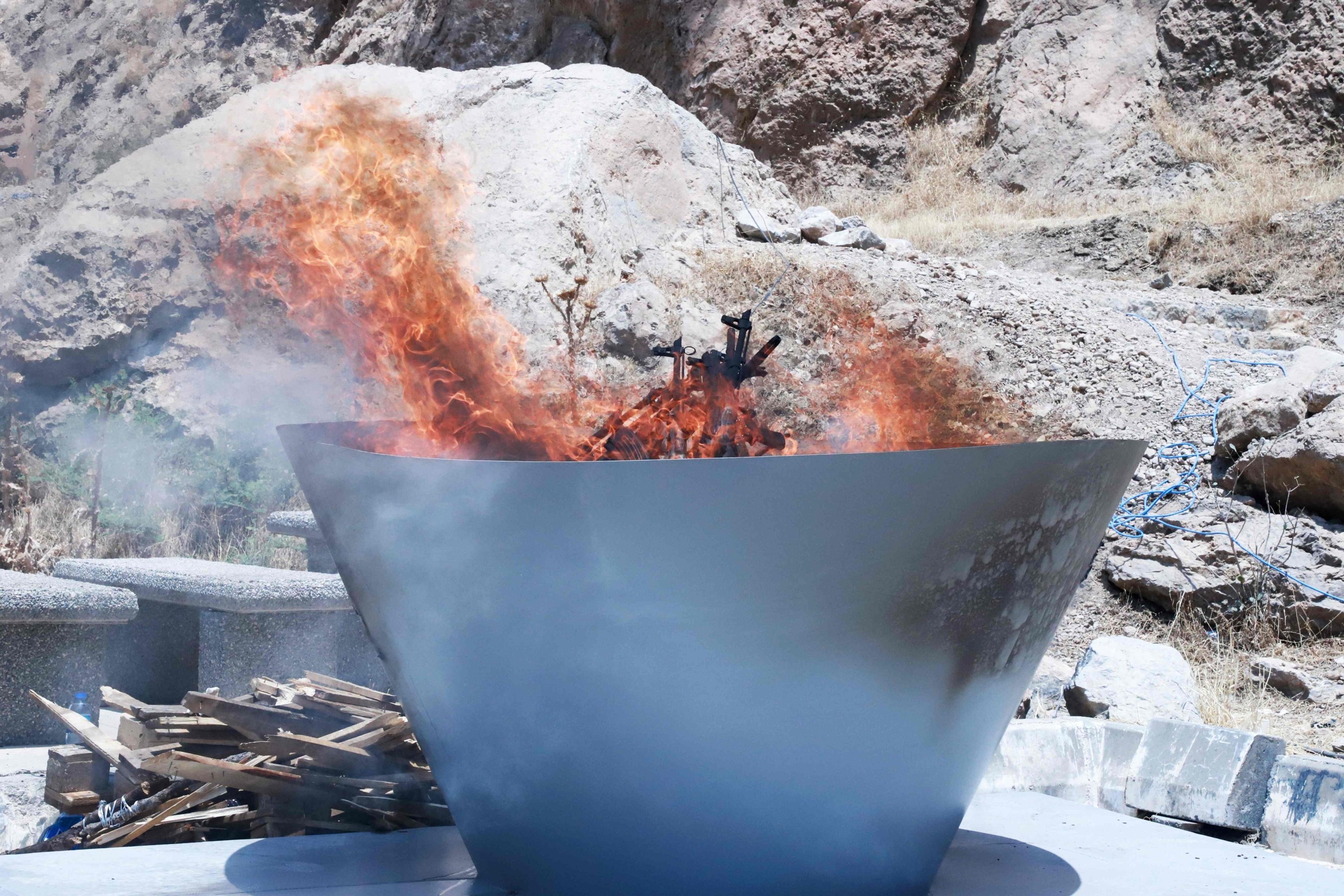
Türkiye’s terror-free Türkiye initiative has entered its most critical stage, with the central issue no longer focused on political negotiations but on who will control the terrorist PKK’s disarmament process and under what conditions the group’s weapons will be surrendered.
Türkiye’s terror-free Türkiye initiative has reached a decisive turning point as the focus shifts from political dialogue to the practical reality of disarmament and the struggle over who controls the process on the ground.
The latest statements from the PKK/KCK leadership revealed growing tension between PKK’s imprisoned terrorist ringleader Abdullah Öcalan’s symbolic authority and the operational control exercised by the group’s Mount Qandil-based commanders. During remarks marking the first anniversary of the organization’s May 2025 dissolution congress, senior KCK figures Mustafa Karasu and Sozdar Avesta announced that the group would continue under the name “Apoist Movement Management.” Yet the organization’s armed structure, leadership cadres and KCK titles remained unchanged, while the statements themselves were delivered alongside armed terrorists.
The development reinforced Ankara’s long-standing concern that while Öcalan is still accepted as the terrorist group’s ideological leader, control over weapons and the timeline of disarmament is being kept in Qandil’s hands. Turkish officials view this distinction as the core challenge facing the process.
Ankara’s position has become increasingly clear: weapons must first be surrendered unconditionally, after which legal and political mechanisms can follow. The National Intelligence Organization (MIT) is expected to oversee a verification and monitoring mechanism aimed at confirming whether militants genuinely disarm and withdraw from armed activity.
At the same time, the Justice Ministry is preparing legislation focusing on two key areas: the return of militants not involved in crimes and the technical framework governing how the disarmament process will be managed. Turkish officials insist the state will prioritize concrete developments on the ground over political declarations.
Nationalist Movement Party (MHP) Chairman Devlet Bahçeli publicly outlined Ankara’s sequencing formula, stating that Öcalan’s legal status could only be considered after the terrorist group fully dissolves and hands over all weapons. Bahçeli also proposed a “Peace Process and Political Integration Coordination Office,” though the framework similarly rejected any discussion of political status before complete disarmament.
Qandil, however, continues to oppose Ankara’s approach. Mustafa Karasu openly rejected linking legal reforms to disarmament, insisting that “legal steps should not be tied to laying down arms.” The contradiction became more visible as the group simultaneously claimed armed units had withdrawn beyond Türkiye’s borders while continuing to appear publicly with armed cadres.
Another key issue has emerged around Öcalan’s ability to directly influence the process. The pro-PKK DEM Party delegation has reportedly been unable to establish direct contact with Öcalan for nearly a month, a development viewed by security officials as strategically important because every delay increases Qandil’s room for maneuver and bargaining power.
The process has also exposed growing political divergence between the DEM Party and the PKK’s armed leadership. DEM Party co-chair Tuncer Bakırhan openly supported the political framework proposed by Bahçeli and rejected arguments that instability in the Middle East justified delaying disarmament. Bakırhan further stated that if democratic reforms were implemented and the PKK still failed to comply, the DEM Party itself would become the organization’s first critic.
Attention has also turned toward the PKK’s long-standing financial structure in Europe, which Turkish observers describe as one of the organization’s most important power bases. Networks stretching from Luxembourg and Rotterdam to Paris and Brussels allegedly include front companies, money laundering channels, extortion schemes and narcotics trafficking operations that have sustained the group for decades. Within this framework, weapons are viewed not only as an ideological tool but also as the foundation of an entrenched political and economic order.
Turkish officials remain determined not to repeat the collapse of the 2013-2015 reconciliation process, when the PKK recalculated regional conditions during the Syrian conflict and returned to armed confrontation. As a result, the current initiative is being built around intelligence-based verification mechanisms and measurable developments in the field rather than political promises alone.
The process now hinges on whether Qandil is genuinely prepared to end its armed structure or seeks to preserve a controlled military presence as leverage for future negotiations. Turkish officials increasingly see this as the defining question that will determine the fate of the initiative.
DAILYSABAH
هلدینگ کاسپین استانبول | خرید ملک در ترکیه | صرافی معتبر ایرانی در ترکیه | خرید و فروش طلا در ترکیه | مهاجرت به ترکیه | واردات و صادرات در ترکیه | نیازمندیهای ترکیه | اخبار ترکیه | اخبار جهانی | توریست ایران | خدمات توریستی در ایران | تورهای گردشگری ایران | هلدینگ اول | خدمات کاریابی و فریلنسری و شغل | مرجع اطلاعات ایران (همه چیز در ایران) | کیف پول و خدمات مالی و پرداخت یار | اخبار ایران | تابلو زنده قیمت ارز در ترکیه و استانبول | صرافی آنلاین ترکیه | قیمت طلا و نقره در ترکیه | سرمایه گذاری در ترکیه | جواهرات در ترکیه | نرخ لحظه ای ارزها در استانبول | قیمت دلار امروز در ترکیه | قیمت دلار استانبول امروز | قیمت لحظه ای دلار | اخبار روز ترکیه استانبول | اپلیکیشن ISTEX | اپلیکیشن قیمت لحظه ای دلار و یورو و لیر و ارزها در ترکیه
About the Author