Home – CBSNews.com
President Trump said in a post on Truth Social that “Iran has been playing games with the United States, and the rest of the World, for 47 years,” while railing against previous administrations for their posture toward the Islamic Republic.
The president criticized former President Barack Obama’s approach to Iran, claiming Obama was “not only good to them, he was great, actually going to their side, jettisoning Israel, and all other Allies, and giving Iran a major and very powerful new lease on life.”
“They finally found the greatest SUCKER of them all, in the form of a weak and stupid American President,” Mr. Trump said. “He was a disaster as our ‘Leader,’ but not as bad as Sleepy Joe Biden!” Obama’s administration negotiated the 2015 deal that was aimed at limiting Iran’s nuclear program. Mr. Trump announced during his first term that he would not certify the deal.
The president said for “47 years the Iranians have been ‘tapping’ us along, keeping us waiting, killing our people with their roadside bombs, destroying protests, and recently wiping out 42,000 innocent, unarmed protestors, and laughing at our now GREAT AGAIN Country.”
“They will be laughing no longer!” he added.
Before the post, the president had been quiet on social media Sunday, while the U.S. awaits a response from Iran to its latest peace proposal. State media in Iran reported Tehran had delivered a response, but the U.S. has not commented, according to the Associated Press.
Iran’s deputy foreign minister warned against a planned French-British effort that aims to support maritime security in the Strait of Hormuz after hostilities are over.
“The presence of French and British vessels, or those of any other country, for any possible cooperation with illegal U.S. actions in the Strait of Hormuz that violate international law will be met with a decisive and immediate response from the armed forces,” Kazem Gharibabadi said on social media.
French President Emmanuel Macron responded by saying it won’t be a military deployment but an international mission to secure shipping once conditions allow.
The British Royal Navy said the HMS Dragon, a destroyer, was deploying to the Middle East this week.
Several attacks against ships in the Persian Gulf have occurred over the past week, and a U.S. effort to “guide” ships through the strait was quickly paused.
Democratic Sen. Mark Kelly of Arizona said the state of the munitions stockpile amid the war with Iran is “shocking,” citing Pentagon briefings detailing specific munitions.
“I think it’s fair to say it’s shocking how deep we have gone into these magazines, because this president got our country into this without a strategic goal, without a plan, without a timeline,” Kelly said in an interview Sunday for “Face the Nation with Margaret Brennan.”
Kelly said “because of that, we’ve expended a lot of munitions, and that means the American people are less safe.”
“Whether it’s a conflict in the western Pacific with China or somewhere else in the world, the munitions are depleted,” Kelly said.
The Arizona Democrat said when it comes to how long it will take to replenish the stockpile, “we’re talking about years.”
Iran has sent its response to the latest U.S. ceasefire proposal to Pakistani mediators and wants negotiations to focus on permanently ending the war, Iran’s state-run media said Sunday.
State TV said Iran seeks to end the war on all fronts, including in Lebanon, and ensure the security of shipping. Washington’s latest proposal had addressed a deal to end the war, reopen the Strait of Hormuz and roll back Iran’s nuclear program, an issue that Tehran would rather discuss later.
There was no immediate comment from the White House about Iran’s reply.
Energy Secretary Chris Wright said he expects the U.S. will get a response from Iran to its latest peace proposal “very soon,” citing growing economic pressure on the leaders of the Islamic Republic.
“Things are tough for the leaders of Iran right now, and I think they’ve got growing motivation to make a deal,” Wright said on “Face the Nation.”
Wright argued that although the route is not yet clear, “we know where this is going to end.”
“At the end of the day, we’ll have free flow of traffic through the Straits of Hormuz, and we will have an end to the Iranian nuclear program,” he said.
Wright said bringing an end to Iran’s nuclear program will be “most likely achieved by negotiation, but doesn’t necessarily have to be achieved by negotiation.” The Energy secretary said it’s a “critical thing,” outlining that Iran has nearly 1,000 pounds of uranium enriched to 60%.
“So close to weapons grade, way higher than any potential commercial use of it,” he said. “They’ve lied all along that it’s for a civil nuclear program, it’s for their own energy — it was never about that. It was always about weapons. And the world just can’t live with a nuclear-armed Iran.”
Wright said the U.S. is ratcheting up the economic pressure on Iranian leaders to “drive their motivation to come to the table.” He predicted that a deal on their nuclear program could take a few weeks, but wouldn’t be a drawn-out negotiating process, amid fears of further impact on oil markets.
“Ending the Iran nuclear program is a tough challenge,” he said. “Is there short term dislocation from that? Absolutely, but we need to make that trade off, or we have a long term threat to peace in the region, long term threat to energy supplies, long term threat to Americans.”
In an interview with Iranian state media, a spokesman for the Iranian military said late Saturday that forces were on “full readiness” to protect nuclear sites where the uranium is stored.
“We considered it possible that they might intend to steal it through infiltration operations or heliborne operations,” Brig. Gen. Akrami Nia told the IRNA news agency late Saturday. He didn’t offer further details.
One of the main sticking points in the negotiations between the U.S.and Iran is the fate of Iran’s stockpile of highly enriched uranium. The United Nations’ International Atomic Energy Agency says Iran has more than 970 pounds of uranium that is enriched up to 60% purity, a short, technical step from weapons-grade levels.
The majority of Iran’s highly enriched uranium is likely still at its Isfahan nuclear complex, IAEA Director-General Rafael Mariano Grossi told The Associated Press last month. The Isfahan facility was bombarded by U.S.-Israeli airstrikes in the 12-day war last year, and faced less intense attacks in this year’s war.
The shaky ceasefire in the Iran war was tested again on Sunday when a drone set a small fire on a ship off the coast of Qatar, while the United Arab Emirates and Kuwait reported separate drones entering their airspaces.
The UAE blamed Iran for the latest attack, the latest threat to a month-old ceasefire, which the Trump administration says remains in effect.
There were no casualties reported, and no one immediately claimed responsibility.
Iran and its armed allied groups possess a large fleet of drones and have used them to carry out hundreds of strikes since the war began. The events marked the latest threats to a month-old ceasefire, which the Trump administration says remains in effect.
The pause in fighting has faced difficulties, with Iran restricting traffic through the Strait of Hormuz, a strategic waterway key to the global flow of oil, and the U.S. imposing a blockade of Iranian ports.
Qatari Prime Minister Sheikh Mohammed bin Abdulrahman bin Jassim Al-Thani departed Miami on Sunday morning, where he discussed efforts to end the Iran war with several White House officials.
In a statement on social media, Al-Thani said he met with Secretary of State Marco Rubio and President Trump’s Middle East envoy Steve Witkoff. Al-Thani also met one-on-one with Vice President JD Vance, with no aides present, CBS News has learned.
During the meeting with Witkoff and Rubio, they “reviewed the relations of cooperation and the close strategic partnership between the State of Qatar and the United States of America, along with ways to support and enhance them in various fields, particularly in the areas of defense and energy,” Al-Thani said in the statement.
Al-Thani, Rubio and Witkoff also discussed the “the latest developments in the regional situation, and the Pakistani mediation aimed at deescalation to contribute to strengthening security and stability in the region,” according to the statement.
A ceasefire took effect in Iran on April 8 as part of efforts led by Pakistani mediation.
The Iranian Revolutionary Guards threatened Saturday to target U.S. sites in the Middle East if Iran’s tankers come under fire, Iranian media reported.
“Any attack on Iranian tankers and commercial vessels will result in a heavy attack on one of the American centers in the region and enemy ships,” the Guards said, a day after U.S. strikes on two Iranian tankers in the Gulf of Oman.
Qatari Prime Minister Sheikh Mohammed bin Abdulrahman bin Jassim Al-Thani met in Miami, Florida, on Saturday with Trump envoy Steve Witkoff and later Secretary of State Marco Rubio, CBS News has learned. The topic of discussion was regarding efforts to end the Iran war.
A State Department spokesperson later confirmed Rubio’s meeting with the prime minister, saying in a statement that they “discussed U.S. support for Qatar’s defense, and the importance of continued close coordination to deter threats and promote stability and security across the Middle East.”
It comes after the prime minister met one-on-one Friday with Vice President JD Vance, with no aides present. Those briefed on that meeting told CBS News the sense from it was that there was positive momentum.
Saudi Arabia is also trying to help arrange for a ceasefire, and Saudi Arabia’s top diplomat spoke by phone with the Qatari prime minister Saturday, CBS News learned.
According to a Qatari official, the prime minister has since departed Miami.
Israel carried out strikes across Lebanon on Saturday, killing at least eight people in the south according to authorities, with raids also targeting a highway not far from Beirut outside of Hezbollah’s traditional strongholds.
The fresh attacks were some of the most intense since the start of a three-week-old ceasefire involving Israel and Iran-backed militant group Hezbollah that has done little to halt daily exchanges of fire, mostly in southern Lebanon.
Hezbollah said Saturday that it had targeted troops in northern Israel with drones on at least two occasions in response to the continued strikes.
The Israeli military said “several” explosive drones were launched into Israeli territory, with one army reservist severely wounded and two others moderately injured in one of the attacks.
Lebanon’s state-run National News Agency, meanwhile, reported a series of Israeli strikes across the south, including one on the town of Saksakiyeh.
The health ministry said that raid “resulted in an initial toll of seven martyrs, including a girl, and 15 wounded, including three children.”
The Israeli military said it struck “Hezbollah terrorists operating from within a structure used for military purposes” in Saksakiyeh.
It added it was “aware of reports regarding harm to uninvolved civilians in the structure in which the terrorists were struck. The details of the incident are under review.”
The health ministry reported that another Israeli strike on a motorbike in the city of Nabatieh hit “a Syrian national and his 12-year-old daughter.”
Israel’s military had called on residents of nine villages to evacuate, saying it would act “forcefully” against Hezbollah, though neither of the two locations of the fatal strikes were included in the warnings.
President Trump told a French reporter on Saturday he “expects to hear very soon” from the Iranians in regard to the latest U.S. peace plan.
The president spoke by phone with Margot Haddad, a journalist with the French TV station LCI, and said the Iranians still “very much” want to finish a lasting peace deal.
While Mr. Trump said he was expecting a response shortly, he also said Friday evening he was expecting it that night.
“We’re getting a letter [from Iran] supposedly tonight, so we’ll see how that goes,” Trump told the media at his golf course in Virginia.
When asked if he thought Iran was intentionally drawing out the process, Mr. Trump said, “I don’t know. We’ll find out soon enough.”
The president is scheduled to attend the LIV Golf tournament being held at Trump National Golf Club in Sterling, Virginia, on Saturday.
Three Israeli soldiers were injured on Saturday, one seriously, by an explosive drone launched by Hezbollah, according to the Israeli army.
The drone fell near the Israel-Lebanon border and was one of several incidents labeled as ceasefire violations by Israeli officials.
One reservist was injured severely, while a reserve officer and another reservist were moderately injured, according to the Israeli army.
Israel highlighted several other drone attacks by Hezbollah in southern Lebanon on Saturday, but they were either intercepted or did not cause any injuries, the army said.
Israel and the Lebanon-based, Iran-backed Hezbollah have accused each other of repeated violations of the ceasefire bartered in conjunction with the U.S. The two countries are expected to send representatives to Washington next week for talks aimed at a lasting peace.
As a tenuous ceasefire continues, U.S. Central Command said it has now turned around 58 commercial vessels attempting to exit or enter Iranian ports through the Strait of Hormuz.
That is an increase of just one ship from CENTCOM’s update nearly 24 hours ago.
CENTCOM also repeated four vessels have been disabled when trying to pass through the blockade, which remains the same as when the U.S. announced it disabled two ships on Friday.
The HMS Dragon, a vessel in the U.K.’s Royal Fleet, is being deployed to the Middle East to “pre-position ahead of any future multinational mission to protect international shipping when conditions allow them to transit the Strait of Hormuz,” a Ministry of Defense spokesperson said Saturday.
“The pre-positioning of HMS Dragon is part of prudent planning that will ensure that the UK is ready, as part of a multinational coalition jointly led by the UK and France, to secure the Strait, when conditions allow,” the spokesperson added.
The deployment is part of the U.K.’s commitment to a defensive, multinational mission to strengthen the confidence of commercial shipping in the waterway, the agency said. Britain and France have led planning meetings involving several dozen countries on a coalition to reestablish freedom of navigation in the strait. But they stress it won’t start until there is a sustainable ceasefire and the maritime industry is reassured ships can go through the strait safely.
The Associated Press contributed reporting.
Bahrain said Saturday that it had arrested dozens of people allegedly linked to a group affiliated with Iran’s Revolutionary Guard.
The nation’s Ministry of Interior said Saturday it had arrested 41 people and said investigations are ongoing to take further action against anyone affiliated with the group, but did not provide further details.
Bahrain is led by a Sunni Muslim monarchy but, like Iran, its population is majority Shiite. Rights groups have said that the kingdom has used the war between Iran and the U.S., which bases its Fifth Fleet in the country, as an excuse to crack down on dissent at home.
United Nations Secretary-General Antonio Guterres expressed concern at the reported exchange of fire between Iran and the United States in the Strait of Hormuz, his spokesperson said.
“He underscores that this is a critical moment for de-escalation and urges all sides to exercise maximum restraint to avoid further escalation,” spokesman Stephane Dujarric said Friday.
Guterres calls on all parts to refrain from action “that could lead to renewed escalation or undermine ongoing diplomatic efforts,” Dujarric said.
Meanwhile, Iranian Ambassador to the U.N. Amir Saeid Iravani in letters Friday to the U.N. Security Council and Guterres said that the consequences of the U.S.’s recent actions in the Persian Gulf and Strait of Hormuz “could be catastrophic” and extend far beyond the Middle East.
He called on the secretary-general and Security Council to urge the U.S. “to comply with its obligations under international law and refrain from further provocative actions.”
The U.S. Treasury Department on Friday announced a new round of sanctions against 10 individuals and companies it accused of helping enable Iran’s drone and ballistic missile programs.
The sanctions, implemented by the U.S. Treasury’s Office of Foreign Assets Control, target those “that are enabling efforts by Iran’s military to secure weapons, as well as raw materials with applications in Iran’s Shahed‑series unmanned aerial vehicles and ballistic missile program,” the Treasury Department said in a news release.
The State Department was targeting another four entities with sanctions, the Treasury Department said.
Among those sanctioned were companies based in China, Dubai, Hong Kong and Belarus that the Treasury Department alleged have served as intermediaries, helping Iran’s Center for Innovation and Technology Cooperation, the CITC, with “financial, material, technological or other support.”
According to the Treasury Department, the CITC has sought to purchase weapons and air defense systems from China.
One of the sanctioned companies, Hong Kong-based Mustad Limited, has helped, or attempted to help, Iran procure “millions of dollars’ worth of weapons,” the Treasury Department stated.
“Under President Trump’s decisive leadership, we will continue to act to Keep America Safe and target foreign individuals and companies providing Iran’s military with weapons for use against U.S. forces,” Treasury Secretary Scott Bessent said in a statement.
Secretary of State Marco Rubio said in a separate statement that Friday’s sanctions hold “China-based entities accountable for their support to Iran. The United States will take all necessary action at its disposal to target third-country entities and individuals aiding Iran’s military and defense industrial base.”
Southeast Asian leaders adopted a contingency plan Friday to mitigate the impact of the Iran war on their people and economies but acknowledged it will be difficult to enforce complex steps like establishing a regional fuel reserve to ensure a steady supply.
The Philippines, among the worst affected by fuel price spikes caused by the Iran war, hosted the group’s annual summit on the central island province of Cebu. President Ferdinand Marcos Jr. ordered the summit stripped of the traditional pomp and pageantry in keeping with the economic headwinds worldwide.
ASEAN’s contingency plan calls for actions including the ratification possibly this year of an agreement that will pave the way for coordinated emergency fuel sharing, planning a regional power grid and fuel stockpile and diversifying the region’s sources of crude oil.
Promoting the use of electric vehicles and studying the use of new technologies, including civilian nuclear energy, were also part of the crisis plan.
Satellite images reviewed by The Associated Press show what appears to be an oil slick in the Persian Gulf emanating from the western side of Kharg Island, Iran’s main crude export terminal.
Images taken Friday show the slick covering about 27 square miles and appear to show oil still leaking from the terminal, said Ami Daniel, CEO of maritime intelligence firm Windward AI.
Daniel estimated the equivalent of roughly 80,000 oil barrels has spilled from Kharg Island since the slick was first detected by satellite images Tuesday. It’s unknown whether the spill was caused by a malfunction, an airstrike or something else.
“This is the risk of fighting in an oil-rich area,” said Daniel, adding that it’s unlikely any cleanup efforts will be launched in Gulf waters that have become an active war zone.
He said the spill appears to be spreading southwest and within the next two weeks could potentially reach the shores of the UAE, Qatar or Saudi Arabia.
Nina Noelle, an international crisis operations expert with Greenpeace Germany, said Friday recent images show the spill beginning to disperse and it appears unlikely that it will impact land, though it could still possibly affect some sensitive marine habitats.
“More likely, it will dissipate offshore under prevailing conditions,” Noelle said.
The Pentagon declined to comment on whether the U.S. military was tracking the spill or whether there had been recent strikes on the Iranian island. Based on the imagery taken earlier this week, the spill occurred before the most recent round of U.S. strikes.
Two days of “intensive talks” will be held in Washington, D.C., between representatives from Lebanon and Israel on May 14 and 15 to work out a “lasting peace and security arrangements,” according to the State Department.
This will be the third round of recent talks between the two sides, following meetings on April 14 and 23.
“Building on the April 23 round, which was led personally by President Trump, both delegations will engage in detailed discussions aimed at advancing a comprehensive peace and security agreement that substantively addresses the core concerns of both countries,” the State Department said in a statement.
“These talks aim to break decisively from the failed approach of the past two decades, which allowed terrorist groups to entrench and enrich themselves, undermine the authority of the Lebanese state, and endanger Israel’s northern border,” it continued.
The April 14 meeting was the first time representatives from the two countries had direct talks in decades and resulted in a 10-day ceasefire. The ceasefire was extended for three more weeks at the April 23 meeting.
But the ceasefire has largely been in name only, especially in recent days. Both sides have been exchanging small-scale strikes at each other in southern Lebanon, and Israel launched its first major strike on Beirut in weeks on Wednesday, targeting and killing the leader of Iranian-backed Hezbollah’s elite Radwan forces.
U.S. forces have redirected 57 commercial vessels and disabled four as part of the U.S. blockade to keep ships from going to or leaving Iranian ports, the U.S. military said Friday.
CENTCOM shared the update on X alongside photos of the USS Truxtun, the USS Rafael Peralta and the USS Mason – destroyers currently positioned in the Arabian Sea in support of the blockade.
An adviser to Iran’s supreme leader on Friday compared control over the Strait of Hormuz to having an “atomic bomb,” and vowed not to relinquish it.
Adviser Mohammad Mokhber said Iran had long “neglected” its privileged position along the strait, a vital conduit for oil and gas shipments that Tehran shut early in the Middle East war, throwing markets into turmoil and stranding hundreds of vessels.
“The Strait of Hormuz represents an opportunity as precious as an atomic bomb,” he said in a video published by the Mehr news agency.
“Indeed, having in one’s hands a position that allows you to influence the global economy with a single decision is a major opportunity.”
Pledging not to “forfeit the gains of this war,” he went on to say Iran would “change the (legal) regime of this strait,” through international law if possible, and unilaterally if not.
Mokhber did not specifically mention charging vessels to use the waterway, but the shipping journal Lloyd’s List reported on Friday that Iran had created an authority to approve transit through the strait and to collect tolls.
Hezbollah launched missiles at a military base in Israel on Friday in response to Israeli attacks that killed a top commander, while Lebanese authorities reported five people, including a rescuer, were killed in fresh Israeli strikes.
In a statement, Hezbollah said the missiles targeted a base south of the Israeli city of Nahariya “in response to the Israeli enemy’s violation of the ceasefire, the targeting of Beirut’s southern suburbs and the attacks that affected villages and civilians in southern Lebanon.”
The military said it “intercepted one launch, and the additional launches fell in open areas,” adding that no injuries were reported.
The Lebanese health ministry meanwhile said “the Israeli enemy’s raid on the town of Toura” in the southern Tyre district killed four people, including two women, and wounded eight others in a preliminary toll.
Lebanon’s civil defense said earlier that one of its members was killed in an Israeli attack on the south.
The Israeli military had issued evacuation warnings for seven southern Lebanese towns, including Toura.
Lebanon’s state-run National News Agency reported a series of strikes across the south on Friday.
Hezbollah also claimed responsibility for several attacks on Israeli troops in southern Lebanon.
Washington on Friday was awaiting a response from Iran to its latest proposal for a peace deal.
Speaking in Italy, Secretary of State Marco Rubio said the response was expected “at some point” Friday and that he hopes it will be “a serious offer.”
“We’ll see what the response entails,” he said, adding that the hope is for something “that can put us into a serious process of negotiation.”
Qatari Prime Minister Sheikh Mohammed bin Abdulrahman bin Jassim Al-Thani arrived Friday morning in Washington, D.C., where he is meeting with Vice President JD Vance to discuss topics including the Iran war.
Yesterday, the prime minister told al-Araby al-Jadeed there is a “high probability” that the U.S. and Iran will reach a deal. Speaking Friday morning in Italy, Secretary of State Marco Rubio said today the U.S. expects to receive Iran’s response to the draft agreement for ending the war.
“We’re expecting a response from (Iran) — we’ll see what the response entails,” Rubio said as he left Rome. He added that the hope is that it’s something that “can put us into a serious process of negotiation.”
The prime minister, who also serves as the minister of Foreign Affairs, is the emirate’s top diplomat. He has been a conduit for the U.S. on some of the thornier issues, including Gaza, Afghanistan and Iran. Qatar is also the base for U.S. Central Command.
Lebanon’s health ministry says 2,759 people have been killed from Israel’s attacks since March 2. Another 8,512 others have been injured.
More than 1 million people have been displaced from their homes by the fighting.
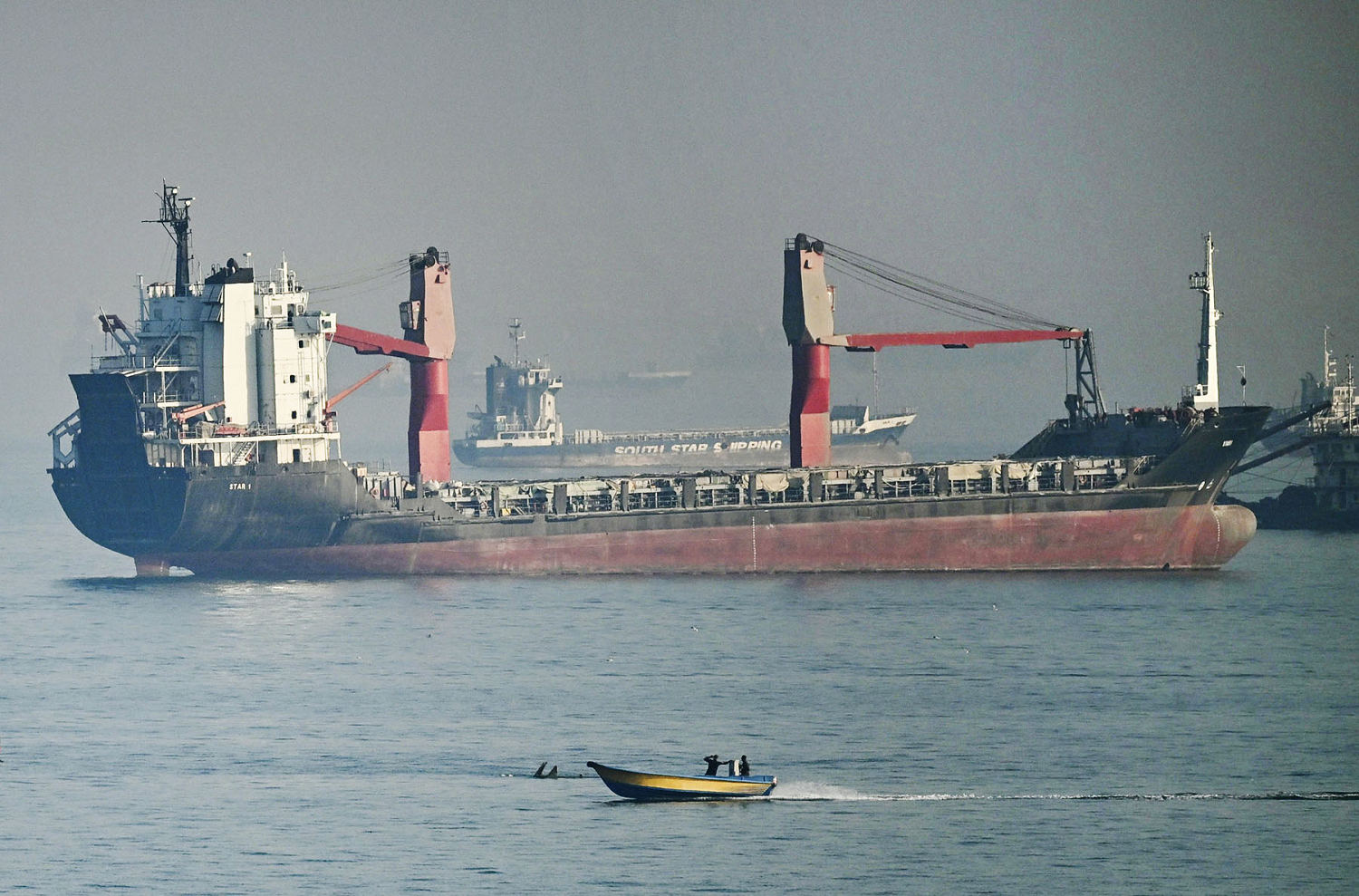
U.S. forces fired on two Iran-flagged oil tankers to stop them from docking at an Iranian port Friday in violation of the American blockade in the area, according to U.S. Central Command.
A U.S. Navy F/A-18 Super Hornet fighter jet “disabled both tankers after firing precision munitions into their smokestacks, preventing the non-compliant ships from entering Iran,” the military said in a statement.
The statement named the “unladen oil tankers” as the M/T Sea Star III and M/T Sevda.
The U.S. has been blockading Iranian ports since the two countries failed to reach a peace agreement in Islamabad, Pakistan, in early April. Iran in return has enforced a de facto blockade of the Strait of Hormuz, charging non-allied boats to pass through the vital waterway.
Both of the crude oil tankers turned off their Automatic Information System transponders weeks ago and were operating covertly. The Sevda was last located in the Malacca Strait – a known Iranian fuel smuggling route – 27 days ago, and the Sea Star III was in the same area more than a month ago.
In its statement, CENTCOM said a U.S. fighter jet disabled another Iranian-flagged oil tanker, M/T Hasna, trying to sail into an Iranian port Wednesday, firing several rounds into its rudder.
The military says it has intercepted more than 50 vessels “to ensure compliance.”
Iranian Foreign Ministry spokesman Esmail Baqaei described his country’s truce with the U.S. – which President Trump insisted late Thursday was still in effect despite the latest exchange of fire between the countries – as “a nominal ceasefire situation.”
Regarding negotiations toward a peace deal, Baqaei reiterated that the latest U.S. proposal was under review in Tehran, “and once a final decision is reached it will be announced.”
The United Arab Emirates said Friday that its air defenses had intercepted two ballistic missiles and three drones launched by Iran, but that debris from the interceptions had moderately wounded three people.
The statement from the UAE Ministry of Defense added that, since the start of the U.S.-Israeli war with Iran, the country had intercepted a total of 551 Iranian ballistic missiles, 29 cruise missiles, and 2,263 drones.
The total number of people wounded since the start of the Iran war has reached 230 in the UAE, a close U.S. ally, and 10 civilians, two members of the armed forces and one foreign civilian military contractor have been killed there, the government says.
Iran accused the U.S. on Friday of breaching the ceasefire between the two countries, rejecting the Pentagon and White House version of a violent clash Thursday in the Strait of Hormuz and saying there were new strikes launched on Friday.
In a statement, the Iranian Foreign Ministry said the regime “strongly condemns the aggressive action by the terrorist U.S. military against two oil tankers belonging to the Islamic Republic of Iran” in the Strait of Hormuz, “as well as attacks carried out on several locations in coastal areas overlooking the Strait of Hormuz, which took place in the late hours of Thursday night, May 7, and the early hours of Friday morning.”
The U.S. military said Iran attacked three American warships transiting the Strait of Hormuz on Thursday with missiles, drones and small assault boats. The Pentagon said all the threats were destroyed, and that “self-defense strikes” against Iranian ports were launched in response.
“Every time a diplomatic solution is on the table, the U.S. opts for a reckless military adventure,” said Foreign Minister Abbas Araghchi in a social media post. “Is it a crude pressure tactic? Or the result of a spoiler once again duping POTUS into another quagmire? Whatever the causes, outcome is the same: Iranians never bow to pressure.”
The ministry, in its statement, said the U.S. “provocative and aggressive actions not only constitute a clear violation of the ceasefire understanding dated April 8, 2026, but also represent a flagrant breach of Article 2(4) of the UN Charter and qualify as acts of aggression” under international law.
U.S. attacks in and around the Strait of Hormuz left 10 Iranian sailors wounded and five others missing, a regional official was quoted as saying Friday by Iranian state media.
U.S. Central Command said Iranian forces launched missiles, drones and small boats at three U.S. warships on Thursday, but that none were hit, and that U.S. forces retaliated with “self-defense strikes” on bases near Iranian ports in the Strait of Hormuz.
“During the Americans’ aggressive actions last night in the waters of the Strait of Hormuz and the Makran Sea [Gulf of Oman], a cargo vessel near the waters of Minab was struck and caught fire,” the semi-official Mehr news agency quoted Mohammad Radmehr, an official in the southern Hormozgan province, as saying Friday. “Ten injured sailors have been transferred to hospital, and local groups and search teams are trying to learn the fate of the other [five] sailors.”
Iran’s military claims it attacked the U.S. warships after they fired on “an Iranian oil tanker” moving from Iran’s coastal waters, as well as another ship entering the Strait of Hormuz off the coast of the United Arab Emirates.
CBS/AFP
President Trump has not yet decided how to respond to some U.S. allies denying use of their military bases for operations in the Iran war, Secretary of State Marco Rubio said Friday.
“If one of the main reasons why the U.S. is in NATO is the ability to have forces deployed in Europe that we could project to other contingencies, and now that’s no longer the case, at least when it comes to some NATO members, that’s a problem, and it has to be examined,” he told reporters during a visit to Rome, adding that Mr. Trump “hasn’t made those decisions yet.”
The president has grown increasingly frustrated with U.S. allies in Europe that have sought to avoid involvement in the U.S.-Israeli war with Iran.
So far, the only NATO member to flatly refuse any role in support of the ongoing U.S. military operations in the Middle East is Spain, while several other nations have granted use of bases, but not for offensive operations.
Last week, the Pentagon announced the U.S. would withdraw 5,000 troops from Germany, after German Chancellor Friedrich Merz said “the Americans clearly have no strategy” on Iran, and argued the U.S. was being “humiliated” by Iranian negotiators.
Mr Trump has threatened to leave NATO, calling the alliance a “paper tiger” for not joining the war. A 2023 law prevents the president from withdrawing the U.S. from the defensive alliance without approval from Congress.
CBS/AFP
Iran’s military claimed Friday that it had seized an oil tanker named the Ocean Koi in the Sea of Oman, saying the ship had attempted to “disrupt” Iranian oil exports. Iranian state TV aired a video showing what it said were naval commandos approaching the vessel at night and boarding it using ladders.
The forces then “escorted the vessel to southern Iranian waters and handed it over to judicial authorities,” according to the report, which said the crude oil tanker was “reportedly attempting… to damage and disrupt Iran’s oil exports and national interests.”
Tracking data from the MarineTraffic website showed the Ocean Koi off the coast of Oman for weeks, and its location broadcasting device showed it had come from an Iraqi port.
Ships can “spoof” their locations, and vessels have done so recently to hide visits to Iranian ports amid the ongoing U.S. naval blockade, but MarineTraffic data show the Ocean Koi has no oil on board, which raises questions about the Iranian military’s motives for the interception.
Even more unusual, the ship has been subject to U.S. sanctions under a previous name since February, labeled part of Iran’s shadow fleet — vessels that transport Iranian oil and petroleum products in defiance of sanctions.
The Iranian military did not say how exactly the vessel, which has since changed its name to Jin Li, was disrupting its oil exports.
The U.K. military’s Maritime Trade Operations Center (UKMTO), which reports threats to vessels in the area, told CBS News on Friday that it had received no reports from a ship under the name Ocean Koi or Jin Li.
The Israeli military told people living in seven villages in southern Lebanon to evacuate their homes on Friday.
Israel Defense Forces spokesman Avichay Adraee issued an “urgent warning” to people in Al-Namriyah, Tayr Filisiya, Hallusiyah, Upper Hallusiyah, Turah, Marakah and Al-Abbayiyya, saying if they didn’t leave, their lives would be in danger.
Adraee, who has issued similar evacuation orders almost daily since Hezbollah and Israel started exchanging fire two days after the Iran war began, said the IDF was “compelled” to act against Hezbollah in light of the group’s “violation of the ceasefire agreement” brokered by the U.S.
That truce was signed between the Israeli and Lebanese governments. Hezbollah was not a party to it, and it quickly accused Israel of violating the deal and said it was launching attacks in response. That exchange of fire, with both Hezbollah and Israel accusing the other side of breaching the ceasefire, has continued since the truce came into force.
Hezbollah said Friday it had attacked an Israeli military bulldozer, tank and troops.
The IDF acknowledged several Hezbollah strikes against its forces and said one soldier was severely wounded, and two others moderately wounded.
Lebanon’s Health Ministry said earlier this week that the death toll from Israel’s attacks since March 2 had risen to more than 2,700 people. More than 1 million people have been displaced from their homes by the fighting.
In Israel, more than 40 people have been killed by Iranian and Hezbollah attacks since the U.S. and Israel launched their joint war with Iran on Feb. 28.
Israel has arrested four people accused of spying for Iran when they were minors, the country’s military and main intelligence agency said in a joint statement Friday.
The Shin Bet intelligence service, Israeli police and Israel Defense Forces Israel said the civilian and three soldiers were suspected of “having long-term contacts with Iranian intelligence elements and carrying out missions under their direction.”
These allegedly include documenting various sites around Israel, including train stations, shopping centers, security cameras and “records of the Air Force Technical School where some of the suspects studied.”
“In addition, some of the defendants approached the operator on their own initiative to carry out security missions,” the statement continued.
The four were arrested in March. The three soldiers are suspected of carrying out the covert operations “before their recruitment to the IDF,” according to the bulletin.
The four were about 17 when they committed the offenses, according to Israeli news outlet Ynet.
Twenty-five Israelis and foreign residents in Israel were indicted on charges of spying for Iran in 2025, according to Shin Bet’s annual report, published in February. It said recruitment attempts on Israelis had increased by 400% compared to 2024.
An Israeli strike in southern Lebanon killed a member of Lebanon’s civil defense volunteer rescue organization, the group said Friday, a day after another strike killed a first responder with the Hezbollah-affiliated Islamic Health Committee.
In a statement, the civil defense said its member was killed, “as a result of an Israeli strike that targeted him” on a road between two southern towns.
World Health Organization chief Tedros Adhanom Ghebreyesus said Wednesday that the U.N. agency had “verified 152 attacks on healthcare that resulted in 103 deaths and 241 injuries” in Lebanon since the war began on March 2.
A ceasefire between the Lebanese and Israeli governments, brokered by the Trump administration, remains ostensibly in effect, but it has not stopped fighting between Israeli forces and Iranian-backed Hezbollah.
CBS/AFP
Iranian officials say the U.S. has “crossed the point of no return,” blasting American strikes on ports in the Strait of Hormuz on Thursday as a violation of the ceasefire that President Trump insists is still in effect.
In a statement released Thursday night, Iran’s central military command, the Khatam Al-Anbiya headquarters, claimed the U.S. targeted an Iranian oil tanker and another vessel near the strait, prompting Iranian forces to return fire on U.S. warships.
“In a simultaneous attack” the U.S. launched air raids “targeting civilian areas” in cooperation with regional allies on ports in Khamir, Sirik as well as Qeshm Island in the Strait of Hormuz.
U.S. officials, including President Trump, said Iran fired first at three U.S. Navy destroyers transiting the strait on Thursday, prompting “self-defense strikes” against military assets at Iranian ports.
Iran claimed its attacks on the ships caused “severe and substantial damage,” though President Trump said none were damaged in the exchange of fire.
Brigadier General Ebrahim Zulfuqari, a spokesman for the Al-Anbiya headquarters, said in a social media post Thursday that the U.S. had “crossed the point of no return, and the response will be commensurate with the crime and more.”
The United Arab Emirates reported early Friday morning local time that its air defense systems had been activated to respond to drones and missiles launched by Iran.
The UAE’s defense ministry said in a social media post that “sounds heard in various parts of the country are the result of the UAE air defense systems intercepting ballistic missiles, cruise missiles and drones.”
The UAE’s National Emergency Crisis and Disaster Management Authority cautioned residents to “remain in a safe place and follow the warnings and updates on official websites.”
President Trump told reporters late Thursday that a deal with Iran “might not happen, but it could happen any day.”
“I believe they want the deal more than I do,” he said during a visit to the Lincoln Memorial Reflecting Pool, where his administration is installing blue filament as part of a renovation project.
Mr. Trump also addressed Iran’s attacks on three U.S. Navy destroyers, which drew an American counterattack.
CENTCOM/Handout
“They trifled with us today. We blew them away,” he said. “They should not have done that today.”
Mr. Trump reiterated that the ceasefire is not over, in spite of Tuesday’s exchange.
“If there’s no ceasefire, you’re not going to have to know. You’re just going to have to look at one big glow coming out of Iran,” he said.
President Trump confirmed that three American destroyers passed through the Strait of Hormuz after dodging an Iranian onslaught — and warned Iran that it needs to strike a deal with the U.S. quickly.
Mr. Trump said in a social media post that the U.S. vessels were unharmed while Iran faced “great damage,” describing the military’s efforts to deflect Iranian boats, missiles and drones in vivid terms.
“They dropped ever so beautifully down to the Ocean, very much like a butterfly dropping to its grave!” he said of the U.S.’s response to the drone attacks.
“A normal Country would have allowed these Destroyers to pass, but Iran is not a normal Country. They are led by LUNATICS, and if they had the chance to use a Nuclear Weapon, they would do it, without question,” the president wrote.
He also warned that “we’ll knock them out a lot harder, and a lot more violently, in the future, if they don’t get their Deal signed, FAST!” Mr. Trump is seeking a longer-term peace deal with Iran, but the status of talks is unclear.
American forces “responded with self-defense strikes” on Iranian targets after three Navy destroyers came under missile and drone fire, but were not struck, U.S. Central Command said Thursday.
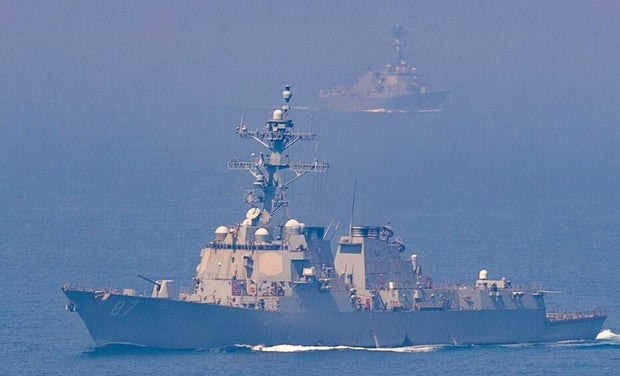
The destroyers USS Truxtun, USS Mason and USS Rafael Peralta were attacked by missiles, drones and small boats, CENTCOM said. The U.S. military responded by targeting Iranian facilities, including drone and missile launch sites.
Three U.S. Navy destroyers transiting the Strait of Hormuz came under renewed attack on Thursday, enduring what American officials described as a fiercer and more sustained Iranian assault than the barrage the warships faced only days earlier.
The destroyers came under an intense Iranian assault as swarms of Iranian fast-attack boats maneuvered close enough that American warships opened fire to keep them at bay, the U.S. officials told CBS News under condition of anonymity because they were not authorized to speak publicly.
Iranian forces also launched drones and missiles during the confrontation, the officials said.
Over several hours, the American warships and supporting aircraft mounted a layered defense.
Despite the intensity of the attacks, neither U.S. vessel was struck.
President Trump told ABC News Thursday that the U.S.-Iran ceasefire remains in effect despite American strikes on two Iranian ports, describing the strikes as “just a love tap.”
Mr. Trump spoke on the phone with ABC News senior political correspondent Rachel Scott.
When she asked if it means the ceasefire is over, she says he replied, “No, no, the ceasefire is going. It’s in effect.”
wp:paragraph
هلدینگ کاسپین استانبول | خرید ملک در ترکیه | صرافی معتبر ایرانی در ترکیه | خرید و فروش طلا در ترکیه | مهاجرت به ترکیه | واردات و صادرات در ترکیه | نیازمندیهای ترکیه | اخبار ترکیه | اخبار جهانی | توریست ایران | خدمات توریستی در ایران | تورهای گردشگری ایران | هلدینگ اول | خدمات کاریابی و فریلنسری و شغل | مرجع اطلاعات ایران (همه چیز در ایران) | کیف پول و خدمات مالی و پرداخت یار | اخبار ایران | تابلو زنده قیمت ارز در ترکیه و استانبول | صرافی آنلاین ترکیه | قیمت طلا و نقره در ترکیه | سرمایه گذاری در ترکیه | جواهرات در ترکیه | نرخ لحظه ای ارزها در استانبول | قیمت دلار امروز در ترکیه | قیمت دلار استانبول امروز | قیمت لحظه ای دلار | اخبار روز ترکیه استانبول | اپلیکیشن ISTEX | اپلیکیشن قیمت لحظه ای دلار و یورو و لیر و ارزها در ترکیه
/wp:paragraph wp:paragraph /wp:paragraph
About the Author