The World Decolonization Forum began Monday with prominent international scholars and experts convening in Istanbul to examine the legacy of colonialism and its impact on today’s global crises.
The forum, organized by the Istanbul-based Institute Social, brought together participants to discuss the historical roots of contemporary global challenges and the enduring effects of colonialism.
Held under the theme “Decolonizing Knowledge Production and Circulation,” the forum will address issues including occupation policies, technological transformations, algorithmic and data colonialism, as well as inequalities in education and culture.
Dr. Esra Albayrak, chair of the NÛN Foundation for Education and Culture and a member of the forum’s scientific committee, delivered a keynote speech at the forum and emphasized that the burden of decolonization lay on the shoulders of humanity.
“We have to tackle this on three levels. One of them is the epistemic level. We have to rewrite knowledge from our own perspective. The history of the United States was written by colonizers. If the history of Palestine is told from the perspective of those who lived there a century ago, the thesis of Clash of Civilizations will collapse,” she said.
“Thirdly, we need institutional decolonization. We have a problem if university students are not aware of any African or Muslim thinkers throughout their lives in education. It is a problem if artificial intelligence models are being trained on Western sources,” she added.
Albayrak also pointed out the need for political and economic decolonization, adding that at present, countries are not only invaded by military means but also through “contracts” where they are indebted to colonizers.
At the forum, experts will examine how colonial legacies continue to shape political, economic and social systems. Participants include Professor Şule Albayrak, a faculty member in the Department of Philosophy and Religious Studies at Marmara University, decolonial theorist Walter Mignolo, international law expert Mireille Fanon, former French national footballer and anti-racism activist Lilian Thuram, China strategy expert Guo Changgang, psychiatrist and author Kemal Sayar, philosopher of physics Enis Doko, Middle East scholar Joseph Massad, historian Halil Berktay, and economist Ann Pettifor.
Discussions will address colonial codes embedded in education, culture and academic systems. Sessions will examine how colonial-era structures continue to influence contemporary crises across political, economic and social systems in a systematic way.
The first day will conclude with a concert by Tunisian singer-songwriter Emel Mathlouthi.
Organizers said the forum aims to challenge one-sided perspectives in academia, media and historiography, calling for more equitable systems of knowledge production that reflect diverse cultural contexts.
It will also explore structural inequalities in global knowledge systems, including language dominance, academic dependency and imbalances in international publishing.
The event will serve as a platform for interdisciplinary dialogue in fields such as law, media, economics and education, promoting collaborative and critical approaches to scholarship.
“We propose talking about human’s burden,” Albayrak said in her speech, to counter the racist belief “white man’s burden.”
“We propose a view from the common responsibility instead of a racial and civilizational view. We have to work for a fairer world fitting for humanity’s dignity. Removing the burden will heal all, including colonizers. An order established by trampling on others’ dignity distances us from humanity and takes us to islands of shame, such as Epstein’s island,” she added.
Albayrak underlined that the truth is distilled from accounts of many, “not from one voice legitimizing the dominating power.”
Delving into the history of the colonial mindset at a time when modern sciences were founded, Albayrak pointed out Swedish biologist Carl Linnaeus’ system of naming plants and animals in the 18th century and how his work to classify humans served as “scientific cover” for colonization.
“This separation that defined sociology as the science of modern societies and anthropology as the science of ‘primitive’ societies, helped science to become an instrument to legitimize colonization,” she said.
Albayrak also referred to Marion Sims, the father of modern gynecology who experimented on enslaved women, adding that this was “the true face of the illusion that is so-called neutral science.”
“The land may be invaded, the language may be suppressed, but decolonization is always possible as long as the mind is not held captive,” she said, quoting notable anti-apartheid South African activist Steve Biko: “The most potent weapon in the hands of the oppressor is the mind of the oppressed.”
“When you erase the memory of a nation, you steal the possibility of their recognition of their wounds and how to heal them,” Albayrak said.
She also denounced former Israeli Defense Minister Yoav Gallant’s remarks describing Gazans as “human animals” and said it was the latest and most painful example of how the colonialist mind updated its self-styled legitimacy.
Albayrak highlighted that the digital world was home to the “future colonialism threat,” saying that “it is no coincidence that the new generation is called ‘digital natives.’ For the colonialist, the ‘native’ is someone who can be classified and managed. When AI systems are run by techno-feudal lords and trained on Western sources, these systems have no function beyond copying the past’s hierarchy to tomorrow’s data map.”
She stated that having the forum in Istanbul was significant, adding that the world needed “knowledge not generated only in London, Paris or New York but also wisdom from Istanbul, Jakarta, Rabat and Gaza.”
The forum is the first phase of a long-term, three-stage initiative running through 2030.
The process will include academic publications, online seminars, roundtables and media outputs, with further discussions on institutional transformation planned for 2028 and policy-oriented outcomes expected by 2030.
The 2030 roadmap is described more explicitly as aiming to produce concrete proposals for societal implementation, not only policy discussions.
Istanbul, historically a crossroads of civilizations, was chosen as the host city for its symbolic and cultural significance.
Partner institutions include Al Jazeera Centre for Studies, ISAM, Fudan University, International Islamic University Malaysia, University of Leeds, Shanghai University and CLACSO, among others.
The list of other partner institutions includes additional organizations such as SEPHIS, CECIC, the Institute of Islamic Thought Malaysia, the International Islamic University Indonesia and the Global South Institute (IGS).
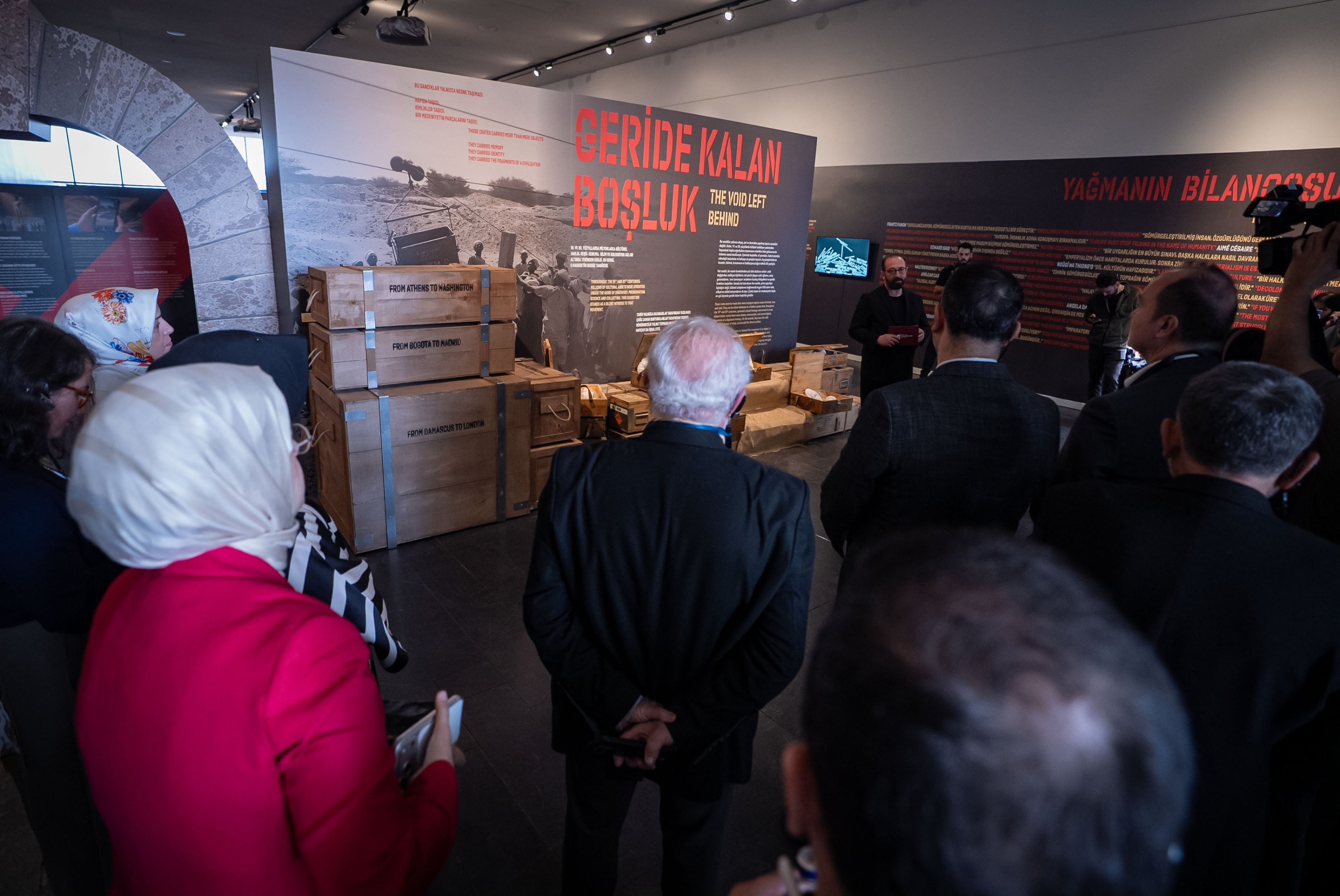
Alongside the forum, an exhibition titled “The Burden of Humanity: Decolonization Today” opened on May 9 at the AKM Art Gallery. The exhibition examines colonialism as an ongoing, multi-layered system, presenting themes such as looting, cultural displacement and systemic exploitation.
Following the forum, “Decolonize Film Days” will be held May 13-14 at the historic Atlas Cinema, featuring eight free screenings exploring colonial histories from Algeria to the Congo, Australia and Iranian director Majid Majidi will attend the opening.
He will also participate in discussions with audiences during the opening of the film program. Organizers said the combined events aim to foster critical engagement with colonial legacies while promoting more inclusive and pluralistic global knowledge systems.
DAILYSABAH
هلدینگ کاسپین استانبول | خرید ملک در ترکیه | صرافی معتبر ایرانی در ترکیه | خرید و فروش طلا در ترکیه | مهاجرت به ترکیه | واردات و صادرات در ترکیه | نیازمندیهای ترکیه | اخبار ترکیه | اخبار جهانی | توریست ایران | خدمات توریستی در ایران | تورهای گردشگری ایران | هلدینگ اول | خدمات کاریابی و فریلنسری و شغل | مرجع اطلاعات ایران (همه چیز در ایران) | کیف پول و خدمات مالی و پرداخت یار | اخبار ایران | تابلو زنده قیمت ارز در ترکیه و استانبول | صرافی آنلاین ترکیه | قیمت طلا و نقره در ترکیه | سرمایه گذاری در ترکیه | جواهرات در ترکیه | نرخ لحظه ای ارزها در استانبول | قیمت دلار امروز در ترکیه | قیمت دلار استانبول امروز | قیمت لحظه ای دلار | اخبار روز ترکیه استانبول | اپلیکیشن ISTEX | اپلیکیشن قیمت لحظه ای دلار و یورو و لیر و ارزها در ترکیه
About the Author