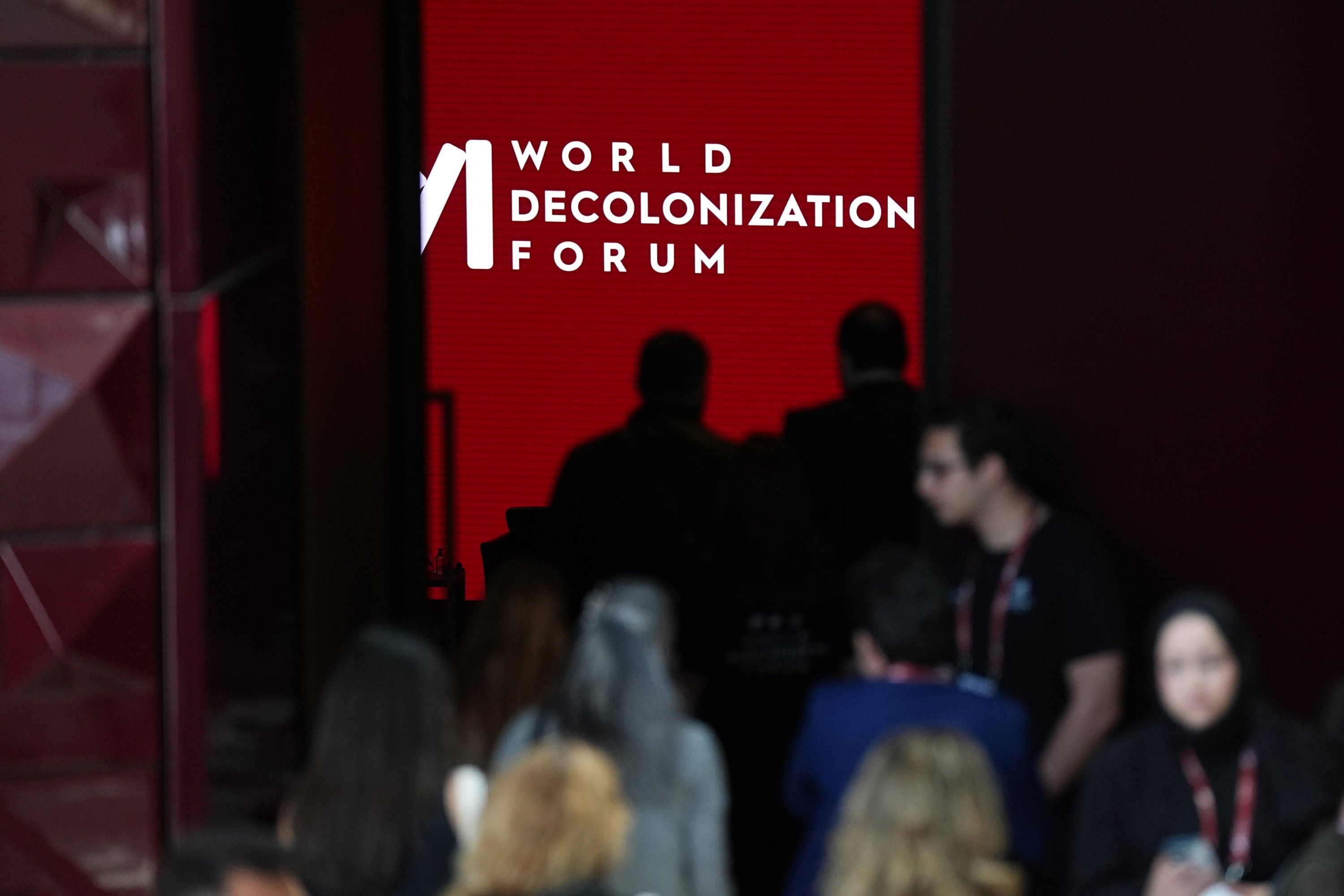
Academics and intellectuals from across the world gathered in Istanbul on Monday to examine how colonial legacies continue to shape global knowledge production, with speakers at the World Decolonization Forum urging universities, societies and cultural institutions to break away from Eurocentric frameworks.
The session, titled “The Problem of Knowledge Production: Decolonized Methodologies,” was held at the Atatürk Cultural Center as part of the World Decolonization Forum, which focused on the roots of global crises and the lasting impact of colonialism.
Speakers included decolonial theory scholar Walter Mignolo, Salman Sayyid from the University of Leeds, Syed Farid Alatas and U.S. political scientist and author Anne Norton.
Norton argued that colonialism remains embedded in modern global structures, saying today’s world continues to operate within systems built by colonial powers.
“Colonialism has not ended,” she said, adding that the colonization of the mind has become deeply normalized in everyday life.
She also pointed to the role of corporate power and universities, particularly in the United States, in sustaining these systems.
Sayyid emphasized that many universities around the world remain modeled on Western frameworks, not only rhetorically but institutionally.
He said decolonizing universities would transform knowledge production from a profit-oriented enterprise into a public good.
“A university should not merely become a diploma factory,” he said, stressing that cultural, social and academic decolonization must progress together.
Alatas described the decolonization of knowledge as fundamentally tied to critical thinking, arguing that Europe continues to maintain cultural, political and intellectual dominance through what he called modern forms of neocolonialism.
“Eurocentric knowledge functions to sustain neocolonial structures,” he said.
Mignolo explored the connection between modernity and colonialism, arguing that liberation and decolonization are understood differently across regions and societies.
He cautioned against conflating decolonization with “de-Westernization,” saying the latter is often driven by state-led geopolitical or economic projects, such as those associated with China, Russia or BRICS countries.
According to Mignolo, decolonization goes beyond state policy and instead involves a broader process of intellectual independence shaped through education, knowledge production and social consciousness.
While classical colonial administrations have largely disappeared, he said, coloniality continues through military power, financial systems, dollar dominance and global media networks.
He added that decolonization should not be viewed as opposition to the West, but rather as an effort by societies to reclaim intellectual and cultural autonomy.
DAILYSABAH
هلدینگ کاسپین استانبول | خرید ملک در ترکیه | صرافی معتبر ایرانی در ترکیه | خرید و فروش طلا در ترکیه | مهاجرت به ترکیه | واردات و صادرات در ترکیه | نیازمندیهای ترکیه | اخبار ترکیه | اخبار جهانی | توریست ایران | خدمات توریستی در ایران | تورهای گردشگری ایران | هلدینگ اول | خدمات کاریابی و فریلنسری و شغل | مرجع اطلاعات ایران (همه چیز در ایران) | کیف پول و خدمات مالی و پرداخت یار | اخبار ایران | تابلو زنده قیمت ارز در ترکیه و استانبول | صرافی آنلاین ترکیه | قیمت طلا و نقره در ترکیه | سرمایه گذاری در ترکیه | جواهرات در ترکیه | نرخ لحظه ای ارزها در استانبول | قیمت دلار امروز در ترکیه | قیمت دلار استانبول امروز | قیمت لحظه ای دلار | اخبار روز ترکیه استانبول | اپلیکیشن ISTEX | اپلیکیشن قیمت لحظه ای دلار و یورو و لیر و ارزها در ترکیه
About the Author